

Short answer
Yes, a dealership can deny warranty work, but only for specific reasons, and several reasons consumers are given at the service counter are unlawful. Federal law prohibits a manufacturer or dealer from conditioning your manufacturer's warranty on using their brand of parts or their service department. Knowing your legal rights is what separates a repair you pay for from one you do not.
Yes, a dealership can deny warranty work, but only for specific reasons, and several reasons consumers are given at the service counter are unlawful. Federal law prohibits a manufacturer or dealer from conditioning your manufacturer's warranty on using their brand of parts or their service department. Knowing your legal rights is what separates a repair you pay for from one you do not.
The Lemon Pros has helped more than 5,000 California consumers pursue relief under the state's lemon law. Our attorneys handle claims involving defective cars, trucks, SUVs, motorcycles, and electric vehicles, seeking buybacks, replacements, and cash settlements from manufacturers. Led by attorneys recognized within the legal community, the team is dedicated to helping consumers enforce their rights at no upfront cost. If you're driving a defective vehicle, contact us for a free case evaluation.
This blog post talks about when dealerships legally refuse service under warranties, reasons why claims frequently get denied, and what to do if you get rejected on warranty claims.
Can a Dealership Legally Deny Warranty Work?

A dealership can decline a warranty claim where the repair falls outside what the warranty covers. When a defect keeps coming back, the question shifts from warranty coverage to whether the vehicle meets lemon law qualifications. That includes a warranty that has expired by time or mileage, a part the warranty never covered, normal wear and tear items, and damage caused by an accident, abuse, neglect, or misuse.
Dealers cannot just say that a warranty is null if you've taken care of regular maintenance elsewhere or have put in aftermarket parts. This happens quite often but is generally against the law. Knowing whether you're up against denial is really important: that knowledge will help you decide whether you get charged for repairs versus winning an argument and knowing beforehand that most claims don't even get very far through preliminary hurdles.
In 2024, the BBB AUTO LINE dispute program rejected as ineligible 5,564 of 12,906 submitted claims that led to open case files, or 43.1 percent, generally because the vehicle exceeded age or mileage limits or because the manufacturer had not been given sufficient opportunity to repair. Those figures describe claims brought to that program rather than all warranty disputes, but the pattern is instructive: timing and documentation defeat a large share of claims before anyone reaches the merits.
What Does a Warranty Dispute Look Like in Practice?
So imagine you've got a car that has problems with its transmission that keep coming back. You have a warranty from when you bought it from the factory. You take it back to the dealership time and time again because of this problem. Over time, they start blaming modifications made after you purchased the car and refuse to fix anything anymore under warranty.
But really at heart, what's important isn't just whether modifications were installed; the core question is whether the manufacturer or dealership can prove that those modifications actually caused the transmission to break down. FTC says warranty cannot simply be rejected if someone uses parts from elsewhere or hires someone else to fix something. But manufacturers can still refuse to cover damage that really was caused directly by aftermarket parts or services they sell.
The key lesson here is that you should distinguish between what modifications exist and why something went wrong. If the seller can't connect an aftermarket part to some problem with a car, then a customer's warranty issue is quite different from one in which modifications directly caused damage.
What Makes a Warranty Denial Worth Challenging?
The most important thing is not just what the salesman says about denying a warranty. The key is really understanding why something has been denied and if the reasons given are related to any real defects at all. This article clears up some confusion around three points. These points are whether or not the warranty actually applies to this specific part, whether anything contributed to the malfunction, and whether the company insists on coverage for certain parts alone when there clearly shouldn't be.
Even though something has been modified, it can still retain valid warranty coverage. This fact applies even if the manufacturer says that modifications cause no coverage at all. The FTC understands clearly both sides of this distinction. Generally speaking, consumers don't need to buy specific parts or use specific service providers to maintain their warranty coverage. However, manufacturers can also refuse coverage if damage results from unauthorized modifications.
What Does the Magnuson-Moss Warranty Act Actually Say?
The Magnuson-Moss Warranty Act is the federal law governing consumer product warranties, and it applies to motor vehicles, whether you bought a new vehicle or a used car still under coverage. Two of its provisions decide most warranty denial disputes. A tie-in sales provision is a warranty term that requires you to buy a particular company's parts or use a particular company's service to keep your coverage. We have found that federal law prohibits them.
Section 2302(c) of the Act provides that no warrantor may condition his written or implied warranty of such product on the consumer's using, in connection with such product, any article or service, which is identified by brand, trade, or corporate name. The Federal Trade Commission's guide to federal warranty law states the rule directly: tie-in sales provisions are generally not allowed.
Sometimes manufacturers will ask for something specific from another brand even if they're giving an item or service for free as part of a warranty. They might also do this if the FTC gives a waiver and the product has to work properly with that specific thing.
A car dealership should not be able to say that if you take oil filters from somewhere other than them or go to another repair shop, you have nullified your warranty. That would mean they're making unreasonable decisions. They can't just refuse service under warranty simply because you bought filters elsewhere; that goes against federal law too.
When Can a Dealer Deny a Claim Over Aftermarket Parts?
Based on FTC guidance, sellers can refuse to cover a repair when a part supplied by someone else actually caused the failure. Buying parts from somewhere else does not, on its own, invalidate warranty coverage. Generally speaking, sellers or manufacturers should show that there is a link between faulty parts and what has gone wrong, and buyers don't need to prove that they were blameless.
In reality, changes made to one system will not affect another completely separate system. For instance, replacing aftermarket speakers doesn't change anything related to transmission problems; modification of exhaust systems won't fix whether air conditioning stops working; and improving suspension does not mean that dealers will be able to deny coverage for engine problems.
A dealer who denies coverage across the board because a vehicle has been modified is applying a rule that federal law does not support. If that is what has happened to you, it is worth understanding what lemon law is and where warranty rights end and statutory remedies begin. The table below separates denials that are generally lawful from denials that generally are not.
| Reason Given for Denial | Generally Lawful? | Why |
|---|---|---|
| Warranty expired by time or mileage | Yes | The warranty period or mileage limit has ended under its stated terms. |
| Part or system was never covered by the warranty | Yes | The claimed component falls outside the warranty's written coverage. |
| Normal wear and tear | Yes | Ordinary wear is commonly excluded from warranty coverage. |
| Damage from an accident, abuse, neglect, or misuse | Yes | The damage resulted from an outside event or improper use rather than a covered defect. |
| Damage actually caused by an aftermarket part | Yes | A manufacturer may generally deny coverage for damage caused by an aftermarket part. |
| You used an independent shop for routine maintenance | No | A manufacturer generally cannot require you to use a particular dealer or service provider to maintain warranty coverage. |
| You installed an aftermarket part unrelated to the failure | No | The mere presence of an aftermarket part does not prove it caused the warranty issue. |
| You did not use the dealer's branded parts | No | A manufacturer generally cannot condition warranty coverage on using its branded parts. |
What Are Legitimate Reasons a Dealership Can Deny Warranty Work?
Several denials are entirely proper and worth recognizing, because challenging a legitimate denial wastes time. Expiration of warranties is pretty straightforward. Generally, they last for a set amount of time or a certain number of miles depending on the manufacturer. Three years or 36,000 miles is a common term for bumper-to-bumper coverage. Powertrain protection typically lasts much longer. Coverage expires when either of those limits has been reached.
Next is scope of coverage: written warranties deal with defects in materials and workmanship. They don't cover all problems that develop in a car. Things like brake pads, windshield wipers, and tires wear out naturally, and these usually aren't covered either. And of course, damage from accidents, flooding, or fire is also excluded.
There are also cases of real abuse too: overloading a vehicle beyond its rated weight limit; using different fluids than recommended; waiting until something goes wrong before checking a warning light; using the car for things it wasn't designed for. Any of those result in damage that isn't covered under warranty. Changing odometers and having salvage or marked titles also affects what is covered. Under any of these scenarios, dealers have the right to refuse to pay for repairs related to those issues.
Note the pattern in all of these. Each is about the specific defect being claimed and its cause. None of them is about which shop you visited, and none of them cancels the entire warranty.
Does Using an Independent Shop Void Your Warranty?
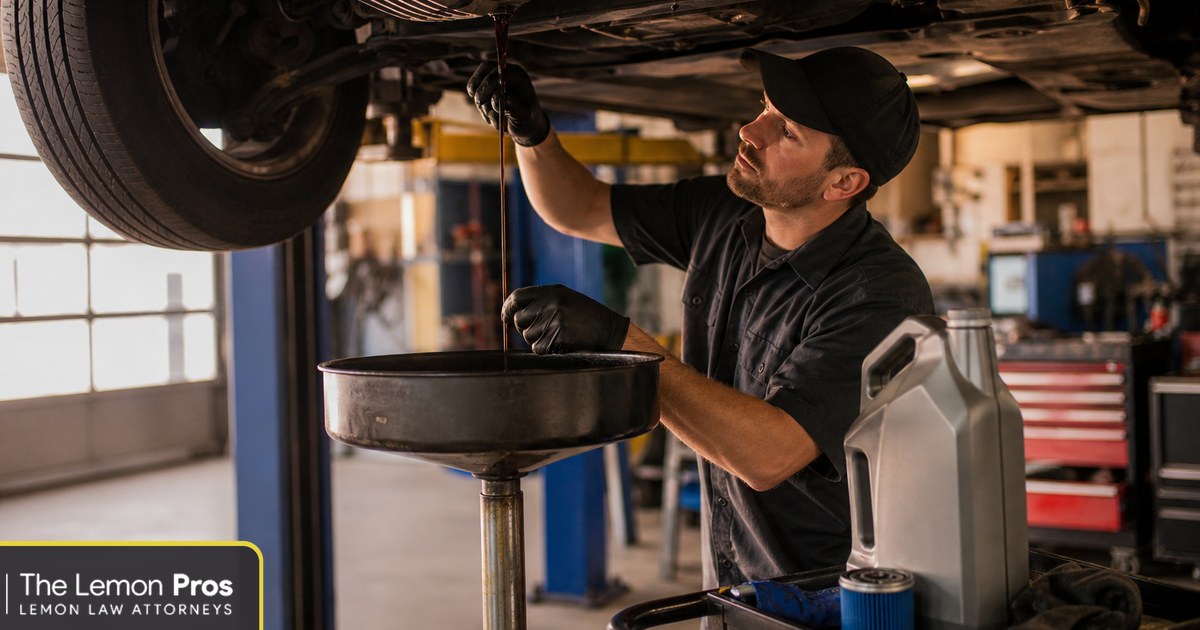
No. This is the most common misconception in this topic, and it costs consumers money. You may have routine maintenance performed anywhere, by an independent mechanic or by yourself, without losing factory warranty coverage. Oil changes, tire rotations, and scheduled servicing do not have to happen at a car dealership. What matters is that the maintenance was performed correctly and that you can prove it.
The law protects your right to use an independent shop, but it does not excuse you from proving the work was done. Keep every receipt and every service record, with dates and mileage. A denial based on undocumented maintenance is much harder to challenge than one based on where the maintenance happened.
How Do You Evaluate a Warranty Denial?
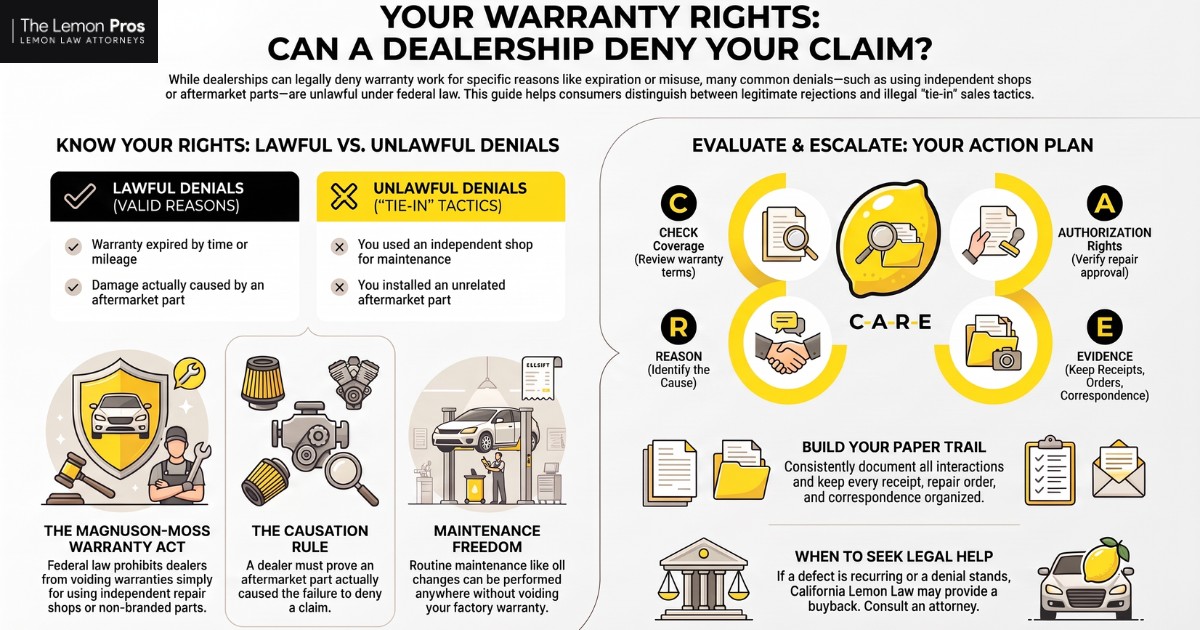
When a dealer says they won't do warranty repairs, that answer needs to be checked against warranty terms, what caused the failure, and the reasons given for rejecting the repair. Use the C-A-R-E test before accepting a dealership's explanation: Coverage, Authorization, Reason, and Evidence.
Coverage: Is the vehicle, component, and defect still within the written warranty's scope and time or mileage limits?
Authorization: Does the dealer deny coverage just because you used an independent mechanic or because you used parts that aren't branded? That denial should be looked at carefully because federal law usually forbids making coverage conditional on using a specific brand or service provider.
Reason: What does the seller claim happened, and is it something like an accident, using it improperly, use of parts not from the manufacturer, having it repaired incorrectly, or something else caused the damage?
Evidence: What evidence supports why something is being denied? Request things like repair orders, diagnostic results, warranty information, pictures, inspection reports, or any other evidence that links the reason given with the faulty part.
The C-A-R-E test helps separate a denial based on the actual warranty terms from one based primarily on the dealership's assumption about how the vehicle was maintained or repaired.
What Should You Do if Warranty Work Is Denied?
A warranty denial doesn't always mean you have to accept a repair bill. First of all, document clearly why the dealer said no. Then go higher up to the manufacturer if that reason seems weak. The steps below will help you create clear records, challenge denials, and figure out if more action is needed.
Step 1 - Ask for the Denial in Writing and for the Specific Reason.
Ask them specifically about which warranty provision they're relying upon for denying service, and also inquire how exactly that component purchased elsewhere was related to this failure. Usually it's hard to explain things very clearly if they don't hold up to close scrutiny.
Step 2 - Assemble Your Documentation.
Collect all records about the car, such as service receipts and any work orders for prior repairs. Also write down correspondence you had with dealerships. Include the date the car went in for repair, the specific problem you reported, and what was actually done. If this happened more than once because of similar problems, sort out those visits in chronological order.
Step 3 - Escalate to the Manufacturer.
A dealership is separate from the manufacturer and a service advisor doesn't make the final decision. You need to complain directly to the manufacturer. You should call the department that handles customer satisfaction or support. File your complaint and get a case number. Generally speaking, most denials reverse themselves at this stage without having to take legal action.
Step 4 - Use the Dispute Resolution Process if One Applies.
Many manufacturers have their own informal procedures that they use when dealing with disputes. If these procedures comply with FTC standards, then consumers should normally use them first before filing a lawsuit in civil court. Check whether or not this kind of arrangement applies to your situation with regard to your car.
Step 5 - Get Legal Advice if the Denial Stands.
The Magnuson-Moss Warranty Act allows a prevailing consumer to recover attorney fees from the warrantor, which is what makes these claims practical to bring. Under section 2310 of the Act, a consumer who prevails may recover costs and expenses, including attorney fees, based on actual time expended. Our explanation of how lemon law attorneys get paid covers what that means in practice.
Should You Keep Fighting the Dealer, Escalate, or Pursue a Legal Claim?
The right response really depends on why someone was rejected and if you have good documentation for that reason. Talking things out with your advisor might fix simple things like a paperwork mistake, but if you escalate to customer service at the manufacturer level, they will look at it carefully and create a formal file. Sometimes disputes also can be handled through programs offered directly by manufacturers; however, eligibility criteria and procedures differ among these programs.
Claims become especially significant when people point out that something has repeatedly gone wrong, lots of repairs have been done, equipment has been out of use for a long time, or there's confusion over whether parts bought later actually caused the trouble. However, there is also another way that can be faster and simpler: using informal escalation. But resorting to formal legal actions offers you an opportunity to seek remedy if other informal routes fail.
What turns out to matter less is that there is an obvious best path to follow. What's more significant is deciding which way to go based on the amount of opposition you encounter, the information you have, and what sort of solution you're seeking. So it's very important to document any refusals first; documenting refusals along with direct action is equally essential.
How Do You Protect Your Warranty Coverage?
Preventing denial of service is not glamorous but effective. Follow the manufacturer's recommended schedule for maintenance and keep proof that you have followed this schedule. Always use fluid and specifications as described in your owner's manual because using incorrect fluids is one of only a few things related to maintenance that really can cause components to fail. Keep all receipts in one place and sort them by both date and mileage.
Before you really need it, read your warranty carefully. Make sure you understand what is covered, how long coverage lasts, and what isn't covered so you're better prepared if there's a dispute with a representative. Also think hard about any changes you want to make. Changes to major parts can give manufacturers an opportunity to blame something else later on.
What Is the Difference Between a Factory Warranty and a Service Contract?
Products are often confusing these days, and manufacturers do this on purpose sometimes. The manufacturer gives you a warranty free of charge with your car. It covers defects in materials or workmanship for a certain length of time and for a certain number of miles driven.
An auto service contract, often marketed as an extended warranty, is an optional product sold separately. The manufacturer, the dealer, or one of many independent companies may offer it, and its terms vary widely. Some cover routine maintenance items that a factory warranty never would. Others exclude far more than buyers expect.
We need to be careful about distinguishing what is being rejected because different documents have different rights. Also, there are scammers selling warranty extensions: check these contracts carefully before buying them, and don't just look at them after you receive some rejection notice.
When Does a Warranty Problem Become a Lemon Law Claim?
Based on past experiences, when we repeatedly try to fix something and those fixes don't work out, that's analogous to what we think of as warranty disputes. State lemon laws are meant to deal with repeated failure to repair the same thing or if a car sits idle for a long time. Generally speaking, these laws require manufacturers to either buy back the car or replace it.
If your vehicle has been back for the same problem several times, the question is not only whether this denial was proper, but whether you have a lemon law claim. Our guide to what lemon law attorneys cost explains the fee position for those claims.
Need Help With a Denied Warranty Claim?
The FTC allows for denial of warranty coverage if the real damage comes from use of unauthorized services or parts. Consumers' positions cannot be considered correct just because their vehicle still has a warranty. What is important is to determine the cause. The manufacturer should be able to prove some connection between a specific failure and parts that came from somewhere else.
For strong advice, you want an experienced attorney on your side, like the Lemon Pros. Our team of California Lemon Law attorneys focuses exclusively on California Lemon Law cases and has helped drivers pursue claims, total loss disputes, and manufacturer buybacks. Contact us today for a free case evaluation to discuss your options.
Frequently Asked Questions
These are the questions vehicle owners ask most often after a dealership refuses warranty work.
Can a Dealership Refuse to Honor a Warranty?
Dealers often refuse claims when they don't fit within warranty coverage. This happens if the warranty has expired or if parts that aren't covered by warranty are used. Dealers can't just say that the entire warranty is invalid either if you have used an independent repair place or if you've replaced something with parts from elsewhere.
Do Aftermarket Parts Void a Car Warranty?
Federal law forbids warranty providers from insisting on only using parts branded by them. Also, dealers have to show convincingly that a part from an aftermarket really did cause a malfunction before refusing claims for that particular incident.
Can a Dealer Deny Warranty Work Because I Had Oil Changes Elsewhere?
Routine maintenance can be performed by anyone, either at an authorized repair shop or even at home, but doing so does not void your warranty. However, proof of regular maintenance is still required.
Does a Denial on One Repair Cancel My Whole Warranty?
Denial only applies to this specific claim. Everything else that is covered by the warranty stays intact. We will then review another claim separately and independently of this one.
What if the Dealership Will Not Put the Denial in Writing?
Keep a personal record of all conversations. Include the date of each conversation, who you spoke to, and why they mentioned something. Later on, send out an email summary as a way to document these interactions. Go straight to the manufacturer for escalations rather than dealing with store customer service.
Legal Disclaimer: This article is meant only to give information and does not provide legal advice. Reading this or contacting The Lemon Pros won't create an attorney-client relationship. Results can vary widely based on the specific facts and circumstances of each case, and previous results do not indicate future results.
ATTORNEY ADVERTISING. The Lemon Pros, 9100 Wilshire Blvd, Suite 500W, Beverly Hills, CA 90212. (855) 659-1784.
This page was written by Attorney Michael Saeedian, who has bar number 265470. We also review the content together with Attorney Timan Khoubian, who has bar number 296208. We regularly review content against current statutes and cases according to our editorial policies. We can be reached at (855) 659-1784.

Michael Saeedian, Esq.
Founding PartnerMichael Saeedian, Esq. is a California Lemon Law attorney and a founding attorney of The Lemon Pros; he develops tailored strategies to pursue the full compensation you're owed.
View Attorney Profile →