
The honest answer is that no high-volume seller can guarantee every car it moves will stay trouble-free. CarMax is the largest used-car retailer in the United States, selling hundreds of thousands of vehicles a year across its stores and online. That scale invites a fair question from anyone about to sign paperwork: can you still drive off with a lemon? So the real issue is not whether a bad car ever slips through, but how the company screens its inventory, what it discloses, and what protections you have if the vehicle you bought turns out to be defective.
The Lemon Pros has helped more than 5,000 California consumers pursue relief under the state’s lemon law and maintains a strong reputation backed by numerous positive client reviews. Our attorneys handle claims involving defective cars, trucks, SUVs, motorcycles, and electric vehicles, seeking buybacks, replacements, and cash settlements from manufacturers. Led by attorneys recognized within the legal community, the team is dedicated to helping consumers enforce their rights at no upfront cost.
In this guide, we show buyers the signs that you have a lemon car, how to file a claim, and discuss the practices of CarMax in comparison to the used car market.
How Does Lemon Law Apply to Used Cars?
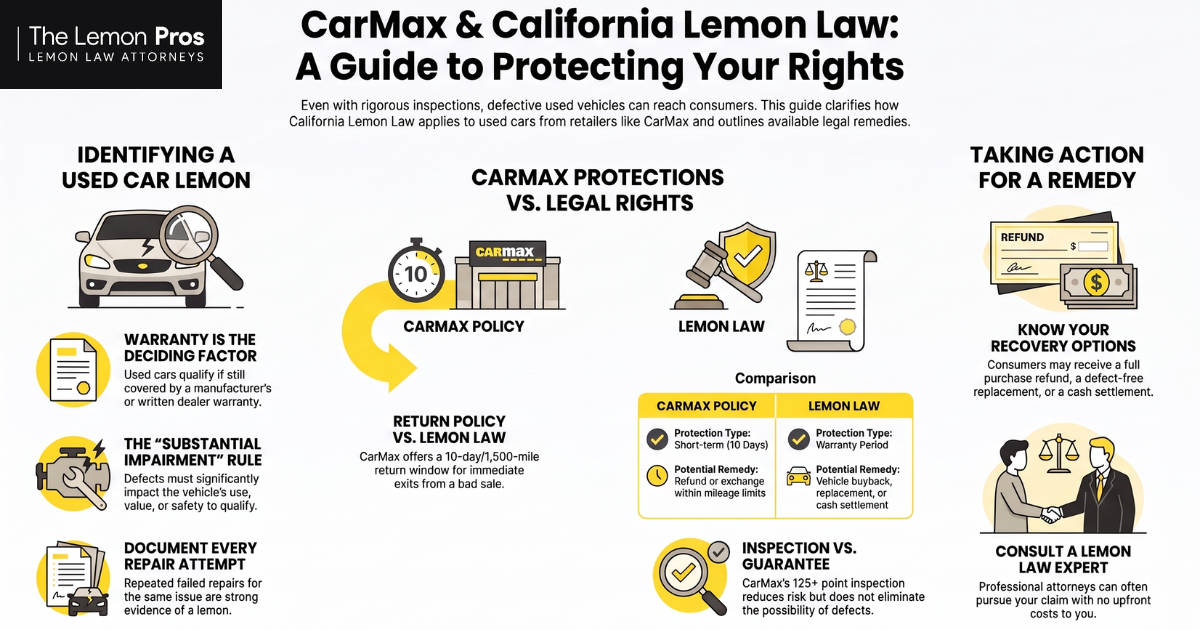
Lemon laws give consumers a remedy, typically a vehicle buyback or replacement, when a manufacturer or dealer cannot repair a defect after a reasonable number of attempts and the problem substantially impairs the vehicle’s use, value, or safety. In our experience, many buyers assume these protections apply only to new vehicles. However, used cars may also qualify if they are still covered by the manufacturer’s original warranty or are sold with a written dealer warranty.
The exact rules vary by state. In California, the Song-Beverly Consumer Warranty Act can apply to used vehicles covered by a manufacturer’s or dealer’s warranty. In Texas, the Texas Lemon Law focuses on vehicles still protected by the manufacturer’s warranty and requires buyers to meet specific repair-attempt and filing requirements. From what we’ve seen, warranty coverage is often the deciding factor in whether a used-car claim can move forward.
Used cars sold as-is are generally not covered by state lemon laws because the buyer accepts the vehicle without warranty protection. That said, in our experience, many buyers are surprised to learn that an active factory warranty or a written dealer warranty may still open the door to lemon law or warranty-based remedies.
Federal law can also help. The Magnuson-Moss Warranty Act allows consumers to pursue claims when a manufacturer or dealer fails to honor a written or implied warranty. While it is not a lemon law, we’ve found that it can provide an important alternative path for consumers dealing with warranty-related defects.
One common misconception is that lemon law claims must be filed within six months. In reality, filing deadlines vary by state and are often measured in years, although certain administrative or arbitration programs may have shorter deadlines. In our experience, acting quickly gives consumers the best chance of protecting their rights, so it’s worth learning how long the lemon law lasts on used cars before any applicable deadline passes.
Does CarMax Sell Lemons, and What Should Consumers Know?
CarMax has built its reputation around selling inspected used vehicles, but no inspection process can eliminate every potential problem. In our experience, many buyers assume a CarMax vehicle is the same as a manufacturer-certified pre-owned (CPO) vehicle, but it is not. CarMax uses its own inspection and reconditioning process, while manufacturer CPO vehicles are inspected and backed by the automaker. Its optional MaxCare coverage is also a separate product, not part of the certification.
We have found that CarMax’s inventory standards are more restrictive than those of many used-car dealers. CarMax's internally developed standards say it tries to sell vehicles without salvage, flood, fire damage, outstanding liens, or frame damage. To help buyers evaluate a vehicle’s background, CarMax provides vehicle history reports to confirm a clean title.
While these policies reduce risk, they cannot guarantee every vehicle will be free of defects. CarMax has also faced regulatory and legal scrutiny. In 2024, a class action lawsuit claimed CarMax failed to perform its advertised inspections, although those allegations remain unproven.
One important buyer protection is the company’s return policy. In our experience, this is often one of the biggest advantages of buying from CarMax instead of a traditional used-car lot. CarMax offers a 10-day/1,500 miles return policy for vehicles. This allows customers to return a vehicle if problems arise shortly after purchase, subject to the company’s mileage and policy terms in effect at the time of sale.
Scale also matters when evaluating customer complaints. CarMax sold around 810,000 used vehicles in fiscal year 2023, making it one of the largest used-car retailers in the United States. We have found that at that sales volume, some vehicles will inevitably develop serious defects after purchase.
That fact alone does not prove wrongdoing or mean CarMax intentionally sells lemons. Still, it does highlight why buyers should review a vehicle’s history, understand the available warranty coverage, and know their return and lemon law rights before completing a purchase.
CarMax also offers benefits many smaller used-car dealers do not, including standardized inspections, vehicle history screening, and a structured return process. Many customers purchase vehicles from CarMax without experiencing significant problems. Reviewing potential risks is not meant to suggest every CarMax vehicle is defective, but to help buyers understand what protections exist if something goes wrong.
Coverage Aspect | CarMax Warranty & Policies | Lemon Law Protection |
|---|---|---|
Covered repairs | Includes a limited warranty on every retail car, with optional MaxCare extended service plans available for purchase. | Covers defects that substantially impair a vehicle’s use, value, or safety when the vehicle qualifies under the applicable state lemon law and warranty. |
Coverage period | Limited warranty coverage is short-term, while MaxCare extends protection if you purchase it. | Varies by state and is generally tied to the manufacturer’s or dealer’s warranty and applicable filing deadlines. |
Eligible vehicles | Applies to used vehicles CarMax sells that meet its retail standards. | Most commonly applies to vehicles still covered by a manufacturer’s original warranty or a qualifying dealer warranty; as-is vehicles are often excluded. |
Return or buyback | CarMax offers a 30-day return policy for eligible vehicles (subject to its current terms and mileage limits). | The manufacturer may be required to repurchase or replace the vehicle after a reasonable number of unsuccessful repair attempts. |
Legal remedies | Buyers may rely on the limited warranty, MaxCare coverage (if purchased), or contractual rights under the sales agreement. | Consumers may pursue state lemon law claims and, where applicable, claims under the Magnuson-Moss Warranty Act or other consumer protection laws. |
If you want to confirm exactly what any car's coverage includes before you buy, here is a walkthrough on how to check a car's warranty.
The CarMax Lemon Risk Check: Our 5-Point Review Process
When consumers ask whether a CarMax vehicle could be a lemon, we don't look at one factor alone. We evaluate five areas that determine whether a vehicle presents a serious risk:
1. Title History Review: We first check whether the vehicle has a clean title, previous lemon designation, salvage history, flood damage, or accident records.
2. Warranty Verification: We determine whether the vehicle is still covered by the manufacturer’s warranty, CarMax’s limited warranty, or an optional protection plan such as MaxCare.
3. Repair Pattern Analysis: A single repair does not always indicate a lemon. However, repeated repairs for the same engine, transmission, electrical, or safety defect may signal a larger issue.
4. Financial Impact Review: We compare repair costs, depreciation, vehicle value, and ownership expenses to determine whether keeping the vehicle makes financial sense.
5. Legal Option Assessment: Before recommending a sale, we determine whether the consumer may have warranty claims, Lemon Law rights, or other legal remedies available.
This framework helps consumers avoid making a quick decision based only on frustration or a low resale offer.
How Can You Protect Yourself From Buying a Lemon at CarMax?
Screening standards and return windows help, but the strongest protection is the diligence you do before you sign. A short, disciplined routine catches most problems while you can still walk away. Work through these steps in order.
Step 1 - Read the Vehicle History Report First.
Review the AutoCheck report for the car, and look specifically for a branded title such as Manufacturer Buyback/Lemon, salvage, flood, or an accident record. Confirm the report shows the car as accident-free if that is what you were told.
Step 2 - Take a Thorough Test Drive.
Drive at highway and city speeds, test the brakes, transmission shifts, air conditioning, electronics, and warning lights, and listen for anything that does not belong.
Step 3 - Get an Independent Pre-Purchase Inspection.
Have a third-party mechanic you choose inspect the car. Ask whether you can take the vehicle to an outside shop for a pre-purchase inspection; an independent set of eyes can catch issues a sales inspection may miss.
Step 4 - Read the Limited Warranty and Note the Return Window.
Find out exactly what CarMax's included limited warranty covers, what MaxCare would add, and the deadline on the money-back guarantee (currently 10 days / 1,500 miles), so you know your no-questions-asked exit.
Step 5 - Check for Open Recalls by VIN.
Enter the vehicle identification number on the NHTSA website to pull current recall information. Since a dealer can legally sell a car with an open recall, verifying recalls yourself and getting them repaired is on you as the buyer.
Doing these five things does not eliminate every risk of owning a used car. Still, it dramatically narrows the odds that a serious defect surprises you after the paperwork is done.
Should You Repair or Sell Your Vehicle?

At The Lemon Pros, we have worked with many California drivers trying to decide whether it makes more financial sense to repair a mechanically damaged vehicle or sell it to CarMax. Over time, we have found that consumers often spend thousands of dollars chasing recurring problems without realizing the vehicle may qualify for Lemon Law protections or that selling the car could ultimately be the smarter option.
Since every situation is different, we generally recommend using a simple three-part framework before deciding whether to repair a mechanically damaged vehicle, pursue a Lemon Law claim, or sell it to CarMax. Compare Repair Cost to Vehicle Value. If repairs approach 40% to 50% of the vehicle's market value, selling may make more financial sense.
Review the Warranty Status. Vehicles still covered under a manufacturer's warranty may qualify for free repairs or even Lemon Law protection, depending on the defect history. Consider Reliability Trends. If the same issue keeps returning after multiple repair attempts, continuing repairs can quickly become more expensive than replacing the vehicle altogether. This process helps many consumers avoid sinking thousands of dollars into a car that may continue breaking down.
Does CarMax Negotiate on Offers for Cars With Mechanical Problems?

CarMax generally does not negotiate on vehicle purchase offers, including cars with mechanical problems. The company follows a no-haggle pricing policy, which means the appraisal amount you receive is typically the final offer.
When creating the offer, CarMax factors in the vehicle's year, mileage, market value, and repair costs. Serious issues like engine damage, transmission failure, or frame damage can drop the offer significantly, sometimes by half compared to a similar vehicle in good condition. Cars that do not meet CarMax's retail standards are usually sold through wholesale auctions instead of being placed on the sales lot.
If the offer is lower than expected, sellers still have alternatives. Some people compare offers from local dealerships, private buyers, or online car-buying services before deciding. Others choose to repair minor issues at home before returning for another appraisal, although expensive repairs do not always increase the value enough to justify the cost.
Selling to CarMax vs Other Buyers When Your Car Has Mechanical Problems
If your car has mechanical problems, compare multiple selling options before accepting an offer. Some buyers focus on convenience, while others may pay more but require additional effort, repairs, or negotiation.
Buyer Type | Acceptance of Mechanical Issues | Offer Process | Convenience | Price Expectation |
|---|---|---|---|---|
CarMax | Generally accepts cars with engine, transmission, or warning light issues | Fixed appraisal based on condition, mileage, and repair costs | High, quick appraisal and same-day offers | Moderate |
Private Buyer | Depends on the buyer's comfort level with repairs | Negotiated a sale between individuals | Lower, requires listings, meetings, and paperwork | Potentially highest |
Junkyard | Accepts severely damaged or non-running vehicles | Based mostly on scrap or parts value | Moderate, some offer towing | Lowest |
While CarMax offers convenience and speed, sellers should understand the trade-off involved. Private buyers may sometimes pay more for vehicles with repairable issues, but private sales also involve more risk, negotiation, and time spent coordinating meetings or handling paperwork.
Junkyards and salvage buyers are often the easiest option for severely damaged vehicles, especially non-running cars. Still, they usually provide the lowest payouts because the vehicle is valued primarily for scrap or parts.
Selling a Car With Transmission Problems to CarMax
At The Lemon Pros, we recently worked with a California driver who was struggling to sell a 2016 SUV with recurring transmission slipping, delayed shifting, and dashboard warning lights. After multiple failed repair attempts at the dealership, the client explored several selling options and received an offer of less than $2,000 from a local dealer because of the vehicle's mechanical condition.
The client then brought the SUV to CarMax, which still completed a written appraisal despite the ongoing transmission issues. Although the CarMax offer was below the vehicle's normal market value, the client chose to move forward because the process was fast, straightforward, and avoided the complications of selling a problematic car privately.
During our review of the repair records, however, our attorneys identified something more important. The SUV had undergone multiple transmission repair attempts while still covered under the manufacturer's warranty. In our experience, repeated repair visits for the same substantial defect are often one of the strongest warning signs that a vehicle may qualify under California Lemon Law protections.
As Michael Saeedian explains, “Many consumers assume selling a defective vehicle is their only option, but repeated repair attempts can sometimes open the door to a manufacturer buyback or compensation under California Lemon Law.”
This situation highlights an important point that many consumers miss. Selling a mechanically damaged vehicle to CarMax may solve the immediate problem. Still, drivers should first determine whether they may also qualify for compensation, a vehicle buyback, or a replacement under the Lemon Law.
What Are the Signs That Your Car Might Be a Lemon?

Is your car a lemon? If the car has significant defects that interfere with its use, safety, or value, you may be due compensation. For cars to qualify for Lemon Law cases, they must meet all state and federal laws. In California, the Song-Beverly Consumer Warranty Act is the set of guidelines for Lemon Law. Most regulations protect new cars, but the state also has a used car Lemon Law. However, the vehicle must be covered under warranty, be within the claim timeframe, have unrepairable defects, and have been purchased from a dealership.
If the used car you purchase is constantly breaking down or in the shop for repairs, you may be able to file a claim. Because of the vagueness of the California Lemon Law, most defects qualify if they can't be repaired. Therefore, the claim could include transmission failure, engine defects, and electrical system glitches.
Does a CarMax Purchase Qualify for a Lemon Law Claim?
Check how the car was sold before you plan anything. CarMax sells used vehicles, and an as-is sale generally falls outside lemon law protection. What decides the question is warranty coverage, not the dealer you bought from: a used car still covered by the manufacturer’s original warranty stands in a different position from one sold as-is. Where no qualifying warranty applies, a lemon law claim is generally not available.
What Cars Will CarMax Not Buy?
While CarMax buys many vehicles with mechanical problems, it may refuse to purchase some altogether. In most cases, the company prefers to make a lower offer rather than reject a vehicle, but certain conditions can disqualify a car from the appraisal process.
Vehicles with severe frame damage, extensive fire or flood damage, or major missing parts are more likely to be declined. Cars that cannot be legally sold because of title issues may also be rejected. For example, missing titles, unresolved liens, altered VINs, or certain salvage-title situations can create legal problems that prevent the sale from moving forward.
CarMax may also refuse vehicles with severe mechanical damage if repair costs are too high or the car can't be safely transported or inspected. Non-running vehicles missing engines, transmissions, airbags, or other essential components are harder to process because they may not meet auction or wholesale standards.
In some situations, state laws and consumer protection rules also affect what vehicles can legally be purchased or resold. Sellers are generally expected to disclose known issues accurately during the appraisal process, especially if the car has been declared salvaged, rebuilt, or structurally damaged in the past.
Even when CarMax declines a vehicle for retail purchase, many problematic cars that don't meet retail standards are typically redirected to wholesale auctions, where other dealers may still buy them for repair, parts, or rebuilding.
Do You Need a Lemon Lawyer?
Many articles about CarMax focus only on whether the company accepts damaged vehicles or how much sellers can expect to receive. This guide takes a different approach by examining both sides of the transaction. Our analysis combines used-car purchasing considerations, warranty issues, Lemon Law requirements, and real consumer scenarios to help drivers make decisions before accepting a repair bill, trade-in offer, or settlement.
The Lemon Pros will not take cases relating to CarMax purchases. For other lemon law questions, contact us today for a free case evaluation.
Frequently Asked Questions
While writing this blog, we came across some commonly asked questions about CarMax and buying vehicles with mechanical problems. We did our best to answer them.
How To Sell a Vehicle With Mechanical Problems?
Start by gathering the title, registration, and service records before taking the vehicle for an appraisal. Be honest about known issues because mechanical problems will affect the final offer amount.
Do You Have To Disclose Mechanical Issues to CarMax?
Yes, sellers should disclose known mechanical issues during the appraisal process. CarMax will still inspect the vehicle, but accurate information helps avoid delays or offer changes.
What Cars Will CarMax Not Buy?
CarMax may refuse cars with severe frame damage, missing titles, altered VINs, or major missing parts. CarMax may also decline vehicles with legal ownership issues or extreme damage.
How Long Can CarMax Return a Car You Sold to Them?
Once CarMax completes the purchase and paperwork, the sale is usually final. In rare cases involving title problems, fraud, or undisclosed legal issues, the company may contact the seller afterward.
What Car Brands Have the Most Lemons?
There is no reliable, definitive worst-brand ranking, and reliability varies far more by specific model and model year than by the badge on the hood. Complaint and defect data come from sources like the NHTSA complaint database and consumer reliability surveys, which track problems at the model level. A well-regarded brand such as Honda can still produce a specific model year with a known issue, so research the exact vehicle rather than trusting a brand-wide reputation.
What to Do if CarMax Sells You a Bad Car?
If you are still inside the money-back window, use it quickly. If the window has passed, document every problem and repair attempt, review your limited warranty and any MaxCare coverage, check for open recalls by VIN, and consult a lemon-law or consumer attorney if the defect is persistent and substantially impairs the car.
Legal Disclaimer:The information above describes general patterns and is not legal advice for your specific situation. Past results do not guarantee future outcomes. Lemon law remedies and the qualifying criteria vary by state. Reading this article does not create an attorney-client relationship. Consult a licensed attorney to evaluate the facts of your case.

Michael Saeedian, Esq.
Founding PartnerMichael Saeedian, Esq. is a California Lemon Law attorney and a founding attorney of The Lemon Pros; he develops tailored strategies to pursue the full compensation you're owed.
View Attorney Profile →