

Short answer
Two different clocks are involved. Coverage asks whether a written warranty was in force when the defect appeared, which for a used car depends on what came with the sale. The filing deadline is separate, and generally runs four years from when you knew or should have known you had a claim.
Most people asking how long the lemon law runs on a used car are really asking two questions at once, and the answers are different numbers on different calendars. One is about coverage: was a written warranty still in force when the trouble started? The other is about the courthouse: how much time is left to file. Californians lose good claims by answering one and assuming it settled the other.
Used cars sit in a strange spot under California law. The vehicle is secondhand, but the warranty attached to it may be brand new to you, or it may be whatever is left of the factory coverage the first owner never used up. That distinction drives everything that follows.
This page walks through both clocks, the 18-month and 18,000-mile figure almost everyone misreads, the thirty days your car can spend in a service bay, and what to do when the numbers are close. If you want a read on your own timeline, The Lemon Pros offers a free consultation and no fee unless we recover for you.
The California Statute Your Used-Car Claim Actually Runs On

California’s lemon law is the Song-Beverly Consumer Warranty Act. It is warranty law before it is anything else, which is the part that trips people up. The statute does not ask how old your car is or how many owners it has had. It asks whether someone gave you a written warranty and then failed to make the vehicle conform to it after a fair chance.
That framing is good news for used-car buyers and bad news for a specific group of them. Buy from a private party with no written warranty and there is usually nothing for the statute to attach to. Buy from a dealer with the balance of the factory warranty still running, or with a dealer-issued written warranty, and you are inside the same body of law that protects new-car buyers.
Compensation on a used vehicle tracks what you actually paid and what the car is worth, so the arithmetic looks different from a new-car case. That is a function of the purchase price, not a separate, weaker set of rights.
Which Used-Car Defects Rise to the Level of a Lemon
The legal test is substantial impairment. The defect has to meaningfully affect the use, value, or safety of the vehicle, and it has to survive a reasonable number of repair attempts by the warrantor. Annoyance is not enough. Neither is normal wear on a car with 70,000 miles on it, which is a distinction dealers raise early and often on used vehicles.
What typically qualifies:
- Drivetrain and engine faults — transmission that slams or hunts for gears, excessive oil consumption, persistent misfires, stalling in traffic.
- Electrical and electronic failures — infotainment that reboots itself, phantom battery drain, power seats or windows that quit, warning lights that return after every reset.
- Safety defects — airbag or restraint faults, braking irregularities, steering pull, an open recall the dealer keeps deferring.
On a used car, one extra question matters: did the defect exist before you bought it? A fault that shows up in week three is often a fault the previous owner already reported. Repair history from prior ownership can be pulled, and it frequently strengthens a case rather than weakening it.
Two Clocks, Not One: The Distinction That Decides Most Used-Car Cases
Here is the framework worth keeping. Two separate periods govern a used-car claim, they start on different dates, and neither one cancels the other.
Clock 1 is coverage. The defect has to arise while a written warranty is in force. That period is measured from delivery of the vehicle and it ends when the warranty term ends.
Clock 2 is the filing deadline. A breach of warranty claim in California is generally subject to a four-year statute of limitations, and it runs on its own schedule regardless of what the warranty is doing.
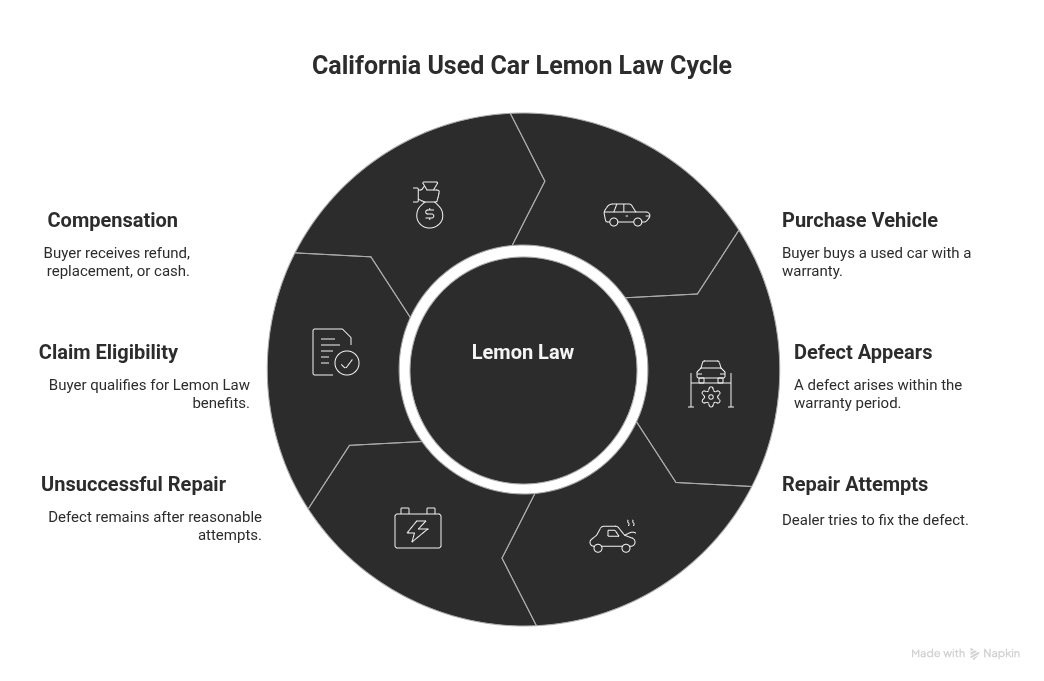
Picture a three-year factory warranty. The transmission starts slipping in month thirty-one, and by month thirty-six the warranty lapses with the problem unresolved. Clock 1 is satisfied because the defect arose inside the term. Clock 2 has years left. The car being out of warranty today says nothing about whether you have a claim, and that single misunderstanding sends more people away from a viable case than any other.
The 18-Month, 18,000-Mile Figure Is a Presumption, Not a Cutoff
This is the number everyone quotes and almost nobody explains correctly. Under the Tanner Consumer Protection Act at Civil Code section 1793.22, it is presumed that a reasonable number of repair attempts have been made if certain things happen within 18 months of delivery or 18,000 miles, whichever comes first.
Read that verb again. Presumed. Hit the window and the burden shifts in your favor. Miss it and you have to prove the repair attempts were unreasonable the ordinary way, with repair orders and testimony. Harder, yes. Over, no.
The triggers inside that window are worth knowing, because they are stricter than most summaries admit. Two or more repair attempts for a defect likely to cause death or serious injury, with the manufacturer directly notified at least once. Four or more attempts on the same nonconformity, again with direct notice. Or more than thirty cumulative days out of service. Notice that the presumption is written around vehicles sold with a manufacturer’s new-car warranty, so how cleanly it maps onto a particular used purchase depends on which warranty you have. The underlying breach-of-warranty claim does not depend on the presumption at all.
Clock One: Was a Written Warranty Alive When the Defect Appeared?

Four kinds of paperwork can put a used car inside the statute, and they behave differently.
Balance of the factory warranty. A three-year, 36,000-mile bumper-to-bumper on a car delivered new in 2024 still has time on it when you buy in 2026. You inherit the remainder, measured from the original delivery date, not yours.
A certified pre-owned warranty. CPO programs layer manufacturer-backed coverage on top of the original term. The terms vary sharply by brand, and the fine print on what counts as a covered component is where CPO disputes usually start.
A dealer’s own written warranty. Smaller lots sometimes issue short in-house warranties. These count. They also bring in Civil Code section 1795.5, which ties the implied warranty of merchantability on used goods to the length of the express warranty, with a floor of thirty days and a ceiling of three months. That three-month ceiling is where the widely repeated “90 days” number comes from. It caps the implied warranty. It does not cap a written warranty, and no statute attaches a 3,000-mile limit to any of this.
A service contract. The extended coverage sold at the finance desk is a purchased product with its own terms, often administered by a third party. It can create obligations and it can be breached. It is not the same instrument as a manufacturer’s warranty.
Clock Two: Four Years From the Breach, Not From Today
The filing deadline comes from Commercial Code section 2725: four years to bring an action for breach of a contract for sale. Accrual is the interesting part. The default rule is that a breach of warranty occurs at tender of delivery, but where a warranty explicitly extends to future performance, the claim accrues when the breach is or should have been discovered.
A written repair-or-replace warranty is generally understood to reach forward in time, which is why the practical starting point in most vehicle cases is the failed repair rather than the day you took the keys. Two people can buy identical cars on the same afternoon and end up with deadlines a year apart, purely because of when the defect surfaced and when the warrantor failed to fix it. Our breakdown of the California lemon law time limit goes deeper on how accrual is argued.
The safe posture is simple. Do not measure from a date you picked. Bring the repair orders to someone who reads these deadlines for a living, early enough that the answer still leaves you options.
The Third Number: Thirty Days in the Shop
Days out of service is its own timing element and it is chronically undercounted. The statute speaks of a cumulative total of more than thirty calendar days out of service for repair of nonconformities. Cumulative. Four days in March, eleven in June, nine in September, and eight in November get added together.
People assume the thirty days must run consecutively, so they never bother to total them. Pull every repair order, write down the date in and the date out for each, and add. Loaner car or no loaner car, the days still count. If your vehicle has been sitting at a service department for weeks, our page on how long a dealership can hold your car covers what that stretch means for your claim.
Why the Timeline You Read About Another State Does Not Apply Here

Search this topic and you will land on pages written for Texas, Illinois, Georgia, New Jersey, or Wisconsin. Those states run their own statutes, with their own windows, their own notice requirements, and in several cases no used-car coverage at all. The numbers do not transfer.
California ties protection to the warranty rather than to a fixed post-sale window, which is why a used vehicle here can stay covered for years while the same car in another state would have aged out months ago. If your car was bought and is registered in California, the California analysis is the only one that matters. The California DMV lemon law overview is a reasonable starting reference.
Building the Claim, Repair Order by Repair Order
Timing arguments are won on paper. Start by collecting the sale documents showing the full purchase price, the fees, sales tax, and registration, since those figures feed the eventual number.
Then the warranty itself. The original factory warranty booklet, the CPO certificate, the dealer warranty, the service contract, whichever applies. You are proving what was in force and for how long.
Then every repair order, including the ones that say “could not duplicate.” Those are often the most valuable documents you have, because they establish the date you first reported the problem while coverage was live. Check that each order shows the date in, the date out, your complaint in your own words, and what the technician did. Recall work and technical service bulletins should appear there too.
Written notice to the manufacturer or dealer by certified mail comes next, describing the defect, the repair history, and what you are asking for. Some manufacturers route these into arbitration programs, which can move quickly. Others do not respond at all, and litigation follows. Either way, the notice is dated proof that you asked.
What a Resolved Used-Car Claim Can Look Like

Outcomes depend on the facts, the warranty, and how the other side behaves. Nobody can promise you a result. These are the shapes a resolution tends to take.
Repurchase. The warrantor takes the car back and refunds what you put into it, typically the purchase price plus collateral charges, reduced by a mileage offset for the use you had before the defect first appeared. On a used vehicle, that offset calculation is often where the real negotiation happens.
Replacement. A comparable vehicle in place of yours. Less common on used cars for the obvious reason that finding a true comparable is harder.
Cash and keep. A payment while you hold onto the car. Sensible for a defect you can live with, though accepting it usually closes the door on the same issue later, so it deserves a careful conversation first.
Further repairs with extended coverage. Sometimes offered when the vehicle is close to fixed. Reasonable in narrow circumstances, and worth being skeptical of when the same part has already been replaced three times.
Buying Used in California Without Inheriting Someone Else’s Problem
The best time to think about warranty timing is before you sign anything. Four habits do most of the work.
Have an Independent Mechanic Look at It First

Pay a shop with no stake in the sale to put the car on a lift. A hundred dollars or so buys a compression check, a scan for stored codes, and an honest look at the underside. Ask for the report in writing. If a seller resists letting the car leave the lot for an inspection, you have learned something useful for free.
Pull the Title History and the Service Record
A vehicle history report shows accidents, title brands, odometer irregularities, and how the car was used. Fleet and rental histories are not automatically disqualifying, but they change what you should expect from the drivetrain. Ask the selling dealer for internal service records as well, since those sometimes reveal repeat repairs that never made it into a commercial report.
Drive It Longer Than Feels Polite
Fifteen minutes around the block tells you nothing. Get the car up to freeway speed, hold it there, then take it through stop-and-go. Run the climate control on both extremes. Cycle every window, seat, and camera. Intermittent electrical faults tend to appear when the car is hot, not when it is cold off the lot.
Read the Warranty Paperwork Before You Sign
Ask one direct question: what written warranty comes with this car, and what is the exact term left on it? Get the answer on paper. Find out whether the coverage is factory, CPO, dealer-issued, or a service contract, because those are four different legal instruments. A car sold with no written warranty at all leaves you with very little to stand on later, and that is worth knowing while you can still walk away.
Where a Used-Car Lemon Lawyer Changes the Timing Math

Most of what an attorney adds on a used-car file is date work. Which warranty applied, when it started running, when the defect was first presented, when the breach occurred, and which of those dates the other side will fight about. Manufacturers argue accrual aggressively on used vehicles because the sale dates are messy and the records are scattered across two or three owners.
There is also a practical reason to move early. Repair orders get purged, dealerships close, service advisors move on. The documentation that proves your first complaint fell inside the warranty term is easiest to obtain while the relationship is still active.
Song-Beverly provides for recovery of attorney fees and costs from the manufacturer in a successful action, which is why firms in this area work on contingency. You should not be paying hourly for a lemon claim. Look for a firm that handles used-vehicle matters day in and day out, offers a free case review, and will tell you plainly if your timing is a problem. Ours is on our page for a lemon law lawyer for used cars.
Talk to The Lemon Pros About Your Used Car
If you are somewhere in the middle of this and cannot tell which clock you are on, that is the normal state of things. The warranty term, the repair history, and the filing deadline rarely line up neatly on a secondhand vehicle, and the answer usually turns on a specific date buried in a repair order you already have.
Bring us the paperwork. We will tell you where you stand, what the deadlines look like, and whether the claim is worth pursuing. The consultation is free and we do not get paid unless you do. We represent used-car owners throughout California from our office in Beverly Hills.
FAQs
Does the clock start when I bought the car or at the first repair attempt?
Two different clocks run at once, which is where most of the confusion lives. Coverage depends on the warranty: the defect has to show up while the manufacturer’s written warranty is still in force, and that period is measured from delivery. The deadline to actually file suit is separate and is generally four years from the breach of warranty, not from the purchase date. So a defect that first appears in month thirty of a three-year warranty is still covered, and you are not out of time simply because the car is older than the warranty that once protected it.
My warranty expired while the car was sitting at the dealership. Am I too late?
Generally no. What matters is when the defect was first presented for repair, not when the repairs finally ended. If you brought the car in inside the warranty period and the same problem kept returning, the claim attaches to that first visit. A manufacturer that takes months to fix something does not get to run out your coverage while the car is in its own service bay. This is exactly why every repair order matters: the dated document showing when you first reported the fault is what fixes your position.
What is the difference between the warranty period and the deadline to file?
The warranty period decides whether the defect is covered. The statute of limitations decides how long you have to bring a claim about it. Mixing them up costs people cases in both directions: some assume they have no claim because the warranty lapsed, when the defect arose while it was active; others assume they can wait indefinitely because the defect was covered, and let the filing deadline pass. If you are unsure which clock you are on, that question alone is worth a free consultation.
Does an extended service contract extend my rights?
Not in the same way, and the difference is worth understanding before you buy one. A manufacturer’s written warranty comes with the vehicle and carries the repair-or-replace obligation the statute is built around. An extended service contract is a separate product you purchase, often administered by a third party, and it is governed by its own terms. A service contract can still create obligations and can still be breached, but it does not simply add years to the original warranty for the purposes of a repurchase claim.
I am past 18 months and 18,000 miles. Is my claim over?
No, and this is the most common misunderstanding about California’s used-car timing. That window is a presumption, not a cutoff. Meeting it means the burden shifts and the vehicle is presumed to qualify. Missing it means you have to demonstrate that the repair attempts were unreasonable, which is a heavier lift but not a closed door. Plenty of viable claims involve vehicles well past that mark. If you have a documented history of the same defect returning, the number of months on the odometer is not the end of the analysis.
My used car came with only the balance of the factory warranty. Where does that leave me?
After the California Supreme Court's 2024 decision in Rodriguez v. FCA, a used vehicle sold carrying only what remains of the original factory warranty generally no longer qualifies for a buyback or replacement. Other claims may still exist depending on the sale, so have the purchase paperwork reviewed.
Does a certified pre-owned car sit in a different position?
It can. Certified pre-owned vehicles are often sold with their own manufacturer-backed warranty rather than just the leftover factory term. A defect that first appears while that warranty is in force can still support a claim. Read the certification documents, since programs differ on what they cover and for how long.
I bought the car as is. Is that the end of it?
Not necessarily. An as-is sale of a used car with no written warranty removes the footing a Song-Beverly buyback claim stands on. But if the vehicle still carried a manufacturer warranty, or the dealer sold a service contract alongside the sale, the picture changes. Bring the contract for review.
Does the previous owner's repair history help my case?
It can. Repairs performed under the same warranty for the same defect stay attached to the vehicle, so a fault the first owner chased may already show a pattern. Pull the service history by VIN through a franchised dealer for your make, and add it to your own records.
If a used car does qualify, how is a buyback calculated?
The figure starts with what you paid, including sales tax, registration and finance charges. From that comes a mileage offset for the miles driven before you first reported the defect. Miles after that report generally do not reduce the number, which is one reason to report problems promptly.

Michael Saeedian, Esq.
Founding PartnerMichael Saeedian, Esq. is a California Lemon Law attorney and a founding attorney of The Lemon Pros; he develops tailored strategies to pursue the full compensation you're owed.
View Attorney Profile →