

Short answer
The Magnuson-Moss Warranty Act is the federal law governing written warranties on consumer products, vehicles included. It requires warranty terms to be clear before you buy, and lets consumers sue over a breached warranty with attorney fees available. In California it usually runs alongside the stronger state Song-Beverly Act rather than instead of it.
The Magnuson-Moss Warranty Act is a federal law that requires manufacturers and sellers to provide clear, detailed warranty information before you buy a product. If you purchased a vehicle or consumer product and the warranty failed to deliver on its promises, this law gives you the legal tools to fight back, including the right to sue for damages, recover attorney fees, and hold companies accountable for deceptive warranty practices.
The Lemon Pros has helped hundreds of Californians in defective vehicle claims across all 58 California counties. Our attorneys handle claims involving defective cars, trucks, SUVs, motorcycles, and electric vehicles, seeking buybacks, replacements, and cash settlements from manufacturers. Led by attorneys recognized within the legal community, the team is dedicated to helping consumers enforce their rights at no upfront cost. If you’re driving a defective vehicle, contact us for a free case evaluation.
This post covers what the Magnuson-Moss Warranty Act actually says, how it protects your rights as a consumer, and the steps you can take if a company violates its warranty.
What Is the Magnuson-Moss Warranty Act?
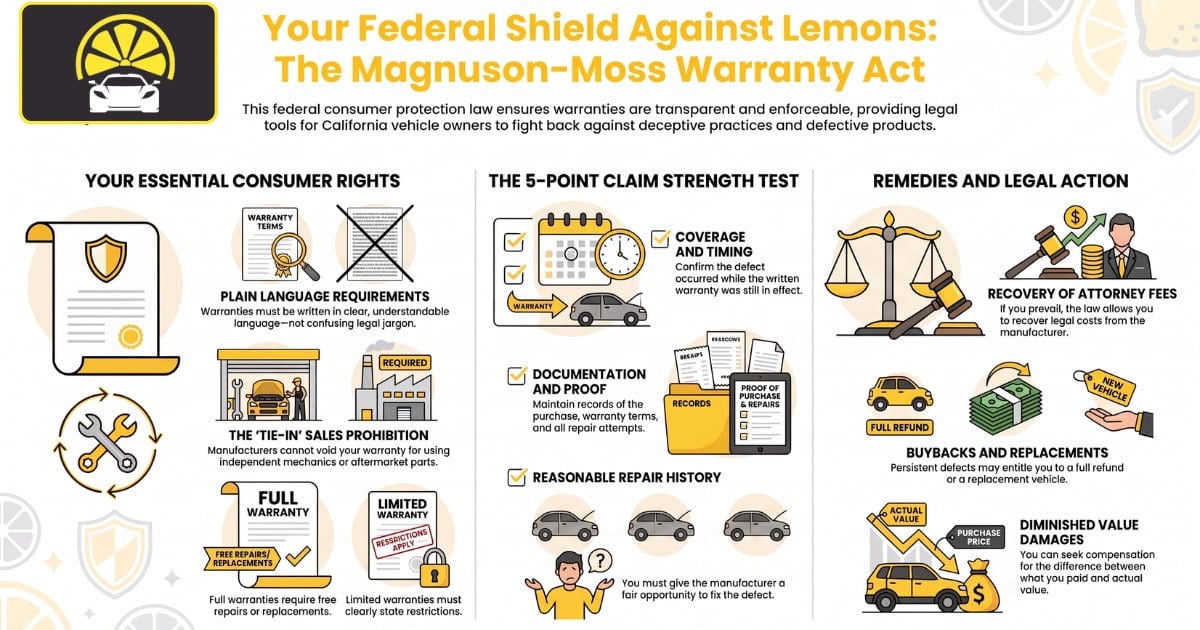
The Magnuson-Moss Act (15 U.S.C. Sections 2301 through 2312), formally known as the Magnuson-Moss Warranty Act, is a federal act and consumer protection law signed in 1975. Congress passed it because warranty documents were confusing, full of legal jargon, and often designed to limit the manufacturer's responsibility rather than protect the buyer.
Before this law existed, warranty terms were buried in fine print that most people never read. Manufacturers could promise a full warranty but then add so many restrictions that the coverage was almost meaningless. The Act changed that by setting federal minimum standards for warranties on consumer products.
In a 2024 FTC review, staff examined 161 smart products and found that 161 failed to provide information on their product webpages about how long software updates would be provided. Internet searches also failed to uncover support-duration information for 124 of the 161 products, or approximately 77%.
The Magnuson Moss Warranty Act applies to written warranties on consumer products, which are items of tangible personal property normally used for personal, family, or household purposes. At its core, the Act requires warranty terms to be written in plain, understandable language and sets rules for what full and limited consumer warranties must include.
It prohibits manufacturers from using deceptive warranty practices and gives consumers the right to sue in federal or state court when warranty terms are violated. If a consumer wins that lawsuit, the Act allows them to recover attorney fees and court costs in addition to their damages.
The Act applies to any consumer product that costs more than $15. For products over $15, the Federal Trade Commission (FTC) requires that warranty terms be made available to you before you purchase. For products over $5, the warranty must be titled as either "full" or "limited," making it clear upfront what level of protection the seller offers under applicable consumer product warranties.
One point worth clarifying is that the Act does not require companies to offer a warranty at all. But if a company chooses to provide a written warranty, the Act governs what that warranty must include and how the company must honor it.
"Many of our clients come to us after discovering that the warranty they thought protected them actually contained hidden exclusions," says Michael Saeedian, founding attorney at the Lemon Pros. "The Magnuson Moss Warranty Act exists specifically to prevent that kind of consumer deception."
What Rights Does the Magnuson-Moss Warranty Act Give Consumers?
The Magnuson Moss Warranty Act contains several provisions that directly affect your rights as a consumer. They are listed below.
Disclosure requirements: Any written consumer product warranties must clearly state what is covered, what is not covered, how long the coverage lasts, and what you need to do to get warranty service. Companies that offer written warranties must present the terms in readily understood language, not packed with legal terms designed to confuse you.
Full vs. limited warranty designation: A full warranty under the Act means the company must fix or replace a defective product within a reasonable time and at no charge. If the product cannot be fixed after a reasonable number of attempts, you are entitled to a refund or replacement. A "limited warranty" can impose some restrictions, but those restrictions must be clearly stated upfront. These rules often apply alongside any express warranty and certain implied warranties that may have a specified duration under applicable law.
Tie-in sales prohibition: Under Section 2302(c), a warrantor cannot require you to use a specific brand of product or service to maintain your warranty unless that item is provided free of charge. This means a car manufacturer cannot void your warranty simply because you used an independent mechanic or aftermarket oil filter, as long as the parts and service met the required specifications.
Right to sue: Section 2310(d) gives consumers the right to file suit in state or federal court for violations of the Act. If you prevail, the court may award you reasonable attorney fees and costs in addition to your damages. The Act's stated purpose is to provide consumers with access to reasonable and effective remedies for breaches of warranty on consumer products.
Ambiguous terms favor the consumer: Courts have consistently held that ambiguous statements in a warranty are construed against the warranty drafter. If a seller offers vague or unclear warranty language, that ambiguity works in your favor during a dispute.
| Provision | What It Means for You |
|---|---|
Disclosure Requirements | Warranty terms must be written in readily understood language, stating what is covered, what is not, how long coverage lasts, and how to obtain service. |
Full Warranty Standard | Free repair or replacement within a reasonable time, and your choice of refund or replacement if repair fails after a reasonable number of attempts. |
Limited Warranty Rules | Restrictions are permitted, but only where clearly disclosed upfront. |
Tie-In Sales Prohibition | A manufacturer cannot void your warranty for using an independent mechanic or a non-OEM part, unless it supplies that part or service free of charge. |
Right to Sue | You may file in state court, recover reasonable attorney fees and court costs if you prevail, and reach federal court where the jurisdictional threshold is met. |
FTC Enforcement | The Federal Trade Commission also enforces these rules directly and can act against companies using deceptive warranty practices, which is a separate route from your own claim. |
How Does the Magnuson-Moss Warranty Act Protect Consumers?

The Act gives you specific, enforceable rights when a product you purchased comes with a written warranty. Below is a breakdown of how the Magnuson-Moss Warranty Act protects consumers.
1. The right to clear warranty information before you buy: Retailers must make warranty terms available to you at the point of sale. For online purchases, the FTC's Pre-Sale Availability Rule requires sellers to post warranty terms on their website or provide them on request. You should never have to guess what your warranty covers, and the Act prohibits sellers from obscuring key terms.
2. The right to warranty service without unreasonable barriers: A company cannot make it unreasonably difficult for you to get warranty work done. If your vehicle's transmission fails within the warranty period, the manufacturer cannot require you to ship the car across the country for service or wait six months for an appointment.
3. The right to choose where you get maintenance: This is one of the most commonly misunderstood protections. Dealerships sometimes tell customers that getting an oil change at an independent shop voids the warranty. Under the Magnuson-Moss Warranty Act, that claim is false unless the manufacturer provides the maintenance product or service for free. The law protects the consumer's choice and generally prevents manufacturers from disclaiming implied warranties, modifying implied warranties, or limiting implied warranties in ways that violate the Act.
One of our clients brought their vehicle to a local mechanic for routine oil changes. When the engine developed a defect, the dealership refused the warranty claim, arguing that the independent service voided coverage. We were able to demonstrate that this directly violated the tie-in sales provision under 15 U.S.C. Section 2302(c), and the manufacturer was required to honor the warranty.
4. The right to a remedy: If a product under a full warranty cannot be repaired after a reasonable number of attempts, you have the right to choose between a full refund and a replacement. This provision is often described as the federal lemon provision, and it is one of the foundations on which several state lemon laws were built.
5. The right to seek diminished value damages: Damages under the Act can be measured by the difference between what you paid and what the defective product was actually worth, an approach often called diminished value.
6. The right to pursue a class action: If a manufacturer engages in a pattern of warranty violations affecting many consumers, the Act allows class action lawsuits. This is particularly relevant in cases involving widespread vehicle defects, where hundreds of owners may experience the same problem.
The 5-Part Warranty Claim Strength Test
Before deciding whether to pursue a Magnuson-Moss Warranty Act claim, evaluate the dispute using five questions: Coverage, Timing, Proof, Repair History, and Remedy.
Coverage: Is the product covered by a written warranty, and does the alleged defect fall within the warranty’s coverage?
Timing: Did the problem occur while the applicable warranty was in effect, or are there other circumstances that preserve a potential claim?
Proof: Can you document the purchase, warranty terms, defect, repair attempts, maintenance history, and communications with the manufacturer or seller?
Repair History: Did you give the warrantor a reasonable opportunity to repair the problem, and did the defect remain unresolved after those attempts?
Remedy: What are you actually seeking: repair, replacement, refund, damages, or another available remedy?
The more clearly you can answer all five questions, the easier it becomes to evaluate the strength and potential value of the dispute. A warranty claim is not determined by one fact alone. The warranty language, product history, repair records, applicable state law, and circumstances surrounding the denial can all affect the available remedies.
What Legal Recourse Do You Have Under the Magnuson-Moss Act?

When a manufacturer or other company refuses to honor a manufacturer’s warranty, the Magnuson-Moss Act provides several potential avenues for consumers to address warranty complaints. The Act establishes basic requirements for written warranties and prohibits deceptive warranty terms or warranty practices carried out in an unfair or misleading manner. Depending on the circumstances, consumers may also have rights under state law, including the Uniform Commercial Code.
Step 1: Document Everything
Keep copies of the manufacturer’s warranty, purchase receipts, repair and maintenance records, communications with the dealer or manufacturer, and any written decision to deny warranty coverage. These records can help establish whether the company significantly wronged you, failed to keep a product defect-free as promised, or imposed deceptive or misleading terms.
Step 2: Use Informal Dispute Resolution if Required
Some warranties require consumers to use an informal dispute resolution procedure before filing a lawsuit. Under Section 2310(a) of the Magnuson-Moss Act, if a warranty establishes an informal dispute settlement process that complies with applicable FTC disclosure standards, consumers may be required to complete that process before pursuing certain legal remedies.
The Act can also apply to businesses that sell service contracts or service contract companies that provide services relating to consumer products. However, whether a particular company, warranty, or service contract falls within the Act’s provisions depends on the specific terms and circumstances.
Step 3: Consider Filing a Lawsuit
If informal resolution fails or is not required, Section 2310(d) of the Magnuson-Moss Act permits qualifying consumers to bring a civil action. Depending on the circumstances, a claim may be filed in state court or federal court when the applicable jurisdictional requirements are satisfied.
A successful claim may allow a consumer to recover damages and, in appropriate circumstances, obtain other relief. State-law claims may also apply, including claims involving breach of warranty under the Uniform Commercial Code or other consumer-protection laws. If a manufacturer refuses to honor a warranty, imposes misleading warranty terms, or otherwise fails to meet its obligations, consumers may want to obtain a free case review to determine which remedies are available.
What Are the Legal Obligations of the Magnuson-Moss Warranty Act for Businesses?
Businesses that offer written warranties on consumer products must follow certain rules under the Magnuson-Moss Warranty Act. These requirements apply to manufacturers, retailers, and companies that provide service contracts. The law is designed to make warranty terms clear and help consumers understand their rights.
A warranty must clearly explain what is covered and what is not. Businesses should identify the specific parts, components, or systems covered by the warranty, how long the coverage lasts, and any exclusions that apply. Warranty terms should be written in a way that is easy to understand and must not contain misleading or deceptive language.
Companies must also explain how consumers can obtain warranty service. The warranty should state who will perform repairs, where to take the product, and what documents the consumer may need, such as proof of purchase. The warranty duration must also be clearly stated. For example, if a warranty uses the term lifetime, it should explain exactly what that means.
If a company offers a full warranty, it must repair or replace the product within a reasonable time and at no cost to the consumer. The business cannot impose unreasonable requirements on customers seeking warranty service. If the product cannot be fixed after a reasonable number of repair attempts, the company may have to provide a replacement or a refund. Limited warranties are allowed, but they must clearly disclose any restrictions or limitations.
Businesses that violate the Magnuson-Moss Warranty Act may face legal consequences. Consumers can file lawsuits for breach of warranty and may recover damages, related losses, and attorney fees. The FTC's Bureau of Consumer Protection can also investigate companies that use deceptive warranty practices or improperly deny valid warranty claims. In addition, state attorneys general may take action under state consumer protection laws.
We recently worked with a client who purchased a new vehicle covered by a 5-year/60,000-mile powertrain warranty. When the transmission began failing at 42,000 miles, the dealership denied coverage and blamed the issue on driver error. After reviewing the warranty terms, repair records, and maintenance history, we found no valid reason for the denial. Ultimately, we resolved the claim in our client's favor.
What Are Common Magnuson-Moss Warranty Challenges?
Warranty disputes often turn on details that are easy to overlook. In our experience, three issues appear repeatedly: proving the defect, understanding the reason for a denial, and documenting the manufacturer’s opportunity to repair the problem.
The manufacturer blames the owner. A company may argue that misuse, neglect, an accident, an unauthorized modification, or an aftermarket part caused the failure. Do not assume the accusation ends the matter. Ask for the reason for the denial in writing and preserve the diagnostic and repair records supporting the manufacturer’s position.
The repair history is incomplete. A consumer may remember bringing a vehicle to the dealership several times but have only one or two repair invoices. Obtain copies of every repair order and make sure the records accurately describe the complaint, diagnosis, and work performed.
The warranty language is difficult to interpret. Coverage may depend on exclusions, definitions, limitations, maintenance requirements, or other provisions. Read the actual warranty instead of relying solely on what a salesperson or service adviser says about coverage.
The consumer waited too long to escalate the dispute. Continuing to bring a defective product in for repair without preserving documentation can make the history harder to establish. Keep a running timeline from the first failure through every subsequent repair attempt and warranty communication.
The consumer assumes the law guarantees a buyback. Magnuson-Moss can provide important remedies, but it does not automatically create a federal buyback right in every defective-product case. The available remedy depends on the particular warranty, breach, damages, and applicable state law.
In our experience, the practical solution in each situation is the same: preserve the evidence, obtain the manufacturer’s position in writing, and evaluate the warranty and repair history together rather than relying on a verbal explanation.
Magnuson-Moss Warranty Act vs Lemon Law

The Magnuson-Moss Warranty Act and lemon laws both protect consumers, but they work in different ways. Lemon laws are usually governed by state law and often apply to vehicles with serious defects that cannot be repaired after a reasonable number of attempts.
The Magnuson-Moss Warranty Act is a federal law that applies to many consumer products used for personal, family, or household purposes that are covered by warranties, including situations that may not qualify under a state's lemon law. In some cases, it may even apply to a qualifying used car that is sold with warranty coverage.
These laws often work together rather than compete with each other. In some cases, a consumer may have rights under both a state lemon law and the Magnuson-Moss Warranty Act. If a lemon law does not apply, the federal law may still provide a path for seeking relief. This can be especially important when a warranty provides coverage for a fixed period, but the defect remains unresolved. A clear grasp of both options can help consumers determine the best way to address a warranty dispute.
The Act does not require manufacturers to provide warranties in the first place. It governs certain written warranties when they are offered and provides remedies for qualifying breaches. The available remedy can depend on the warranty’s terms, the nature of the defect, the number and adequacy of repair attempts, the consumer’s damages, applicable state law, and the procedural requirements for bringing a claim.
The Act also does not mean that every warranty denial is unlawful. A manufacturer may have a legitimate basis to deny coverage when a failure falls outside the warranty or when the manufacturer can establish that an exclusion applies. Similarly, using an independent mechanic does not automatically make every subsequent warranty claim valid; the manufacturer may still be able to show that the particular repair or aftermarket part caused the failure.
Ready to File a Claim Under the Magnuson-Moss Warranty Act?
The Magnuson-Moss Warranty Act empowers consumers by ensuring transparency and fairness in warranty terms. Understanding your rights under this law can help you make informed decisions and seek recourse if necessary. Whether you're dealing with a breach or want to know more, being proactive with this knowledge is key.
For great advice, you want an experienced attorney on your side, such as the Lemon Pros. Our team of Lemon Law attorneys in California focuses exclusively on California Lemon Law cases and has helped drivers pursue claims, resolve total-loss disputes, and secure manufacturer buybacks. Contact us today for a free case evaluation and to discuss your options.
Frequently Asked Questions
This FAQ section answers common questions about the Magnuson-Moss Warranty Act and how it protects consumers. It explains warranty rights, manufacturer obligations, and the legal options available when warranty disputes arise.
What Is the Magnuson-Moss Warranty Act?
It is a federal law, at 15 U.S.C. sections 2301 through 2312, that governs written warranties on consumer products and requires their terms to be stated in plain language. It does not force a company to offer a warranty, but it controls what a warranty must contain and how it must be honored once offered.
What Are the Penalties for Violating the Magnuson-Moss Warranty Act?
A company found in breach may be required to repair, replace, or refund, and may owe damages plus your reasonable attorney fees and court costs under section 2310(d). The Federal Trade Commission can separately investigate deceptive warranty practices, and state attorneys general may act under state consumer protection laws.
How Does the Magnuson-Moss Warranty Act Protect Consumers?
The law helps ensure that warranty information is easy to understand before a purchase is made. It also allows consumers to take legal action if a company fails to meet its warranty obligations.
Are There Any Exceptions to the Magnuson-Moss Warranty Act?
The Act covers written warranties on consumer products, so it does not reach purely oral promises or products sold with no written warranty. Products bought for resale or commercial use fall outside it too. Service contracts are treated separately from warranties, and the full-or-limited designation applies only above the statutory dollar threshold.
How Can I File a Claim Under the Magnuson-Moss Warranty Act?
Start by keeping records of the warranty, purchase, and any repair attempts. If the issue is not resolved, you may be able to pursue legal action or seek help from a consumer protection attorney.
Legal Disclaimer: This article is provided for general informational purposes only and is not legal advice. Reading it or contacting The Lemon Pros does not create an attorney-client relationship. Class action eligibility depends on the class definition, the claims deadline, and the terms approved by the court in each case, and settlement terms described here reflect published court filings as of the date of publication. Recall information reflects campaigns published by the National Highway Traffic Safety Administration and changes as new campaigns are filed. Lemon law eligibility and remedies vary by state and depend on the specific vehicle, defect, and repair history. Past results do not guarantee future outcomes. For advice about your own vehicle, consult a licensed attorney in your state.
How Does Magnuson-Moss Compare With California's Song-Beverly Act?
The federal law sets a floor for written warranties nationwide. Song-Beverly goes further for California vehicle owners, with repair attempt guideposts and a repurchase or replacement remedy the federal statute does not spell out. Claims often cite both, and the state statute usually does the heavier lifting here.
Can a Dealer Void My Warranty for Using Aftermarket Parts?
Not automatically. Magnuson-Moss stops a manufacturer from conditioning warranty coverage on branded parts or dealer service alone. Coverage can be denied for a specific failure the aftermarket part actually caused, and the manufacturer carries that burden. Keep receipts and installation records so you can show what was fitted and when.
What Is the Difference Between a Full and Limited Warranty?
Those labels come from the federal act. A full warranty covers repair at no charge within the stated period and cannot restrict coverage to the original buyer. A limited warranty may carry exclusions, shorter terms or transfer conditions. The label appears on the warranty document, so read it before the sale.
Does Magnuson-Moss Cover a Vehicle Sold As-Is?
The federal act governs written warranties, so a genuine as-is sale with no written warranty falls largely outside it. Where any written warranty or a service contract exists, the act applies to those terms. Check the buyer's guide and the sale documents to see which situation you are actually in.
Are Attorney Fees Available Under the Federal Act Too?
Yes. Magnuson-Moss allows a successful consumer to recover reasonable attorney fees and costs, which mirrors the fee-shifting in California's Song-Beverly Act. That is why vehicle claims here are typically handled without charging the owner directly. Confirm the arrangement in writing with whichever firm you retain.

Michael Saeedian, Esq.
Founding PartnerMichael Saeedian, Esq. is a California Lemon Law attorney and a founding attorney of The Lemon Pros; he develops tailored strategies to pursue the full compensation you're owed.
View Attorney Profile →