
Short answer
If your car is recalled in California, confirm the recall using your VIN, follow any interim safety guidance provided, and contact a franchised dealership to schedule the free repair. The manufacturer must provide an effective remedy designed to ensure the vehicle meets minimum safety standards and owners receive a safe vehicle. If the repair fails, the same type of defect returns, or the remedy is unavailable for an extended period, document the problem and your repair attempts. In rare cases, repeated unsuccessful repairs or serious safety defects can lead to repurchasing the vehicle or other legal remedies.
The Lemon Pros has helped more than 5,000 California consumers pursue relief under the state’s lemon law. Our attorneys handle claims involving defective cars, trucks, SUVs, motorcycles, and electric vehicles, seeking buybacks, replacements, and cash settlements from manufacturers. Led by attorneys recognized within the legal community, the team is dedicated to helping consumers enforce their rights at no upfront cost. If you’re driving a defective vehicle, contact us for a free case evaluation.
This guide covers the federal recall rules that apply everywhere, then the California law that decides what happens when the repair fails.
What Is a Car Recall?
A car recall is a manufacturer’s announcement that a vehicle or item of motor vehicle equipment contains a safety defect or fails to meet a federal safety standard. Federal law frames it in two ways. Either the vehicle contains a defect related to motor vehicle safety, or it does not comply with an applicable motor vehicle safety standard.
Motor vehicle safety standards are minimum performance standards set under the National Traffic and Motor Vehicle Safety Act. Motor vehicle safety is defined as protecting the public against unreasonable risk of accidents and against unreasonable risk of death or injury in an accident. Unreasonable safety risk is not a standalone legal test with its own elements. It appears inside the statutory definition of motor vehicle safety, and its content comes from agency practice rather than a checklist.
What Triggers a Safety Recall?
In our experience, recalls start either when the manufacturer finds the problem itself, or the government does. Consumer complaints feed the second route. When enough similar reports arrive about the same design or component type, the Office of Defects Investigation opens a defects investigation.
Investigators test alleged defects, compare similar reports, and decide whether a genuine safety issue exists. If NHTSA determines a safety-related defect exists, it can press the manufacturer to act, and a recall decision often follows while the investigation is still open. A single campaign covers many vehicles, because one faulty component can appear across several model lines and model years.
Petitions calling for a recall are also part of the public process. Common recall issues cluster around the same few systems: airbag inflators; fuel and electrical faults that create a fire risk; braking; steering; and software controlling safety functions. Equipment recalls work the same way, because the duty attaches to the same product wherever it was installed. A defective child seat, a lamp, or a tire creates the same duty. Where a tire creates the safety problem, the timelines are shorter, which the next section covers.
How Are Emissions Recalls Different?
Emissions recalls come from the Environmental Protection Agency under the Clean Air Act, not from NHTSA, and they are a separate legal right. A safety recall addresses crash and injury risk. An emissions recall addresses a vehicle that does not conform to emission standards in actual use. The distinction matters for one practical reason. The 15-year limit described below applies to safety recalls. It does not apply to emissions recalls, which follow separate federal emissions warranty periods.
How Do Car Recalls Work?
Once a manufacturer decides a defect is safety-related, two federal clocks start. The manufacturer must file a defect or noncompliance report with NHTSA within five working days of that determination. It then has up to 60 days from that filing to notify owners.
Read that sequence carefully, because federal regulations are routinely misstated here as 60 days from finding the defect. The 60 days runs from the report filing, not from the determination. A five-working-day report deadline sits between them.
Notification must go by first-class mail to each person registered under state law as the owner, using state records the manufacturer can reasonably reach. If the manufacturer cannot identify the registered owner, it must notify the most recent purchaser it knows of. Despite what you may read elsewhere, email notification is not yet law. A proposal to modernize the rules is pending, but first-class mail remains the requirement.
If the remedy is not ready when owners are notified, the manufacturer must issue a second notification once the fix becomes available. This is why some drivers receive an initial letter telling them a recall exists and a later one telling them parts have arrived.
The notice must contain an evaluation of the risk to motor vehicle safety. It must also state any precautions owners should take to reduce the chance of the malfunction before the repair. If a crash can happen without prior warning, the notice must say so. Not every recall carries a driving restriction, so the notice is your primary source on how urgent yours actually is.
What Should You Do When You Get a Recall Notice?
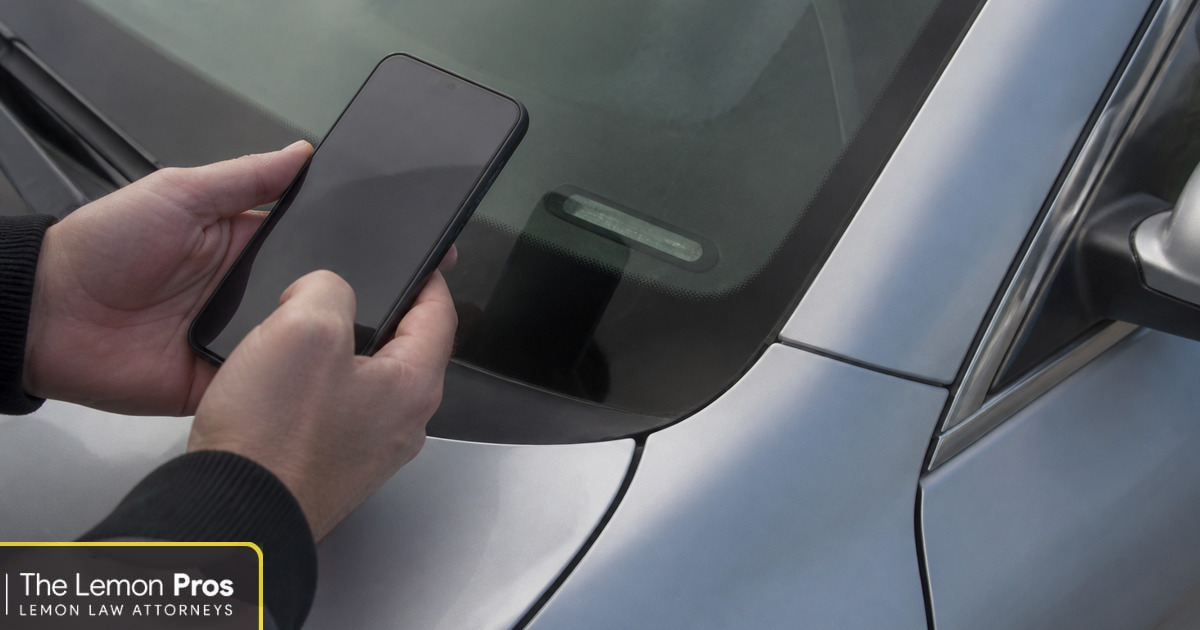
Work through five steps in order. Verify the notice, confirm it against your VIN, book the repair, follow any interim safety guidance while you wait, then keep the paperwork.
Step 1 - Verify the Recall Notice Is Genuine.
Real notices arrive by first-class mail from the car’s manufacturer and identify a specific vehicle and campaign. They never ask for payment, card details, or a fee to process the repair. If a letter asks for money, it is not a recall notice, and the free repair obligation is exactly why.
Step 2 - Confirm the Recall Against Your Vehicle Identification Number.
Your VIN is 17 characters and never contains the letters I, O, or Q. Look through your car’s windshield at the lower left, on the door jamb next to the driver’s seat, on your car’s registration card, or on your insurance card. Reading the VIN correctly is an important first step, because recalls usually cover a build range rather than a whole model year. Check it against the public NHTSA database, or use our free car recall check, which queries NHTSA live and does not store your VIN.
Step 3 - Book the Repair Appointment With a Franchised Dealer.
Perform recall repairs within the manufacturer’s dealership network, because that is where the free repair obligation is administered. Call ahead. Dealerships often advise owners about parts availability before scheduling, and on a large campaign the wait can run several weeks.
Step 4 - Follow Any Interim Safety Guidance in the Notice.
NHTSA flags some campaigns as do-not-drive. Others tell owners to park outside and away from structures because of a fire risk. Treat those as urgent safety advice.
Step 5 - Keep Every Document.
Hold the recall notice, the repair order, and anything the dealer gives you showing the recalled part was replaced. Unrepaired recalls follow a vehicle through resale, and a clean repair history is what proves yours was addressed.
What Should You Do After the Recall Repair?
Check the work before you leave, get written confirmation of what was done, and watch for the original symptom returning. A recall repair is a warranty repair, and the repair order is the record that it happened.
Monitor the car for the same nonconformity over the following weeks. If the symptom returns, that second visit matters more than the first, for the reasons explained in the next sections.
Do You Have to Pay for a Recall Repair?
No. When a vehicle is presented for remedy, the manufacturer must fix the defect at no charge. The duty sits with the car’s manufacturer rather than the local dealership, and it follows the vehicle to later owners rather than staying with the original buyer.
The manufacturer can choose among three remedies: repairing the vehicle, replacing it with an identical or reasonably equivalent vehicle, or refunding the purchase price less a reasonable allowance for depreciation. Under federal recall law, the manufacturer elects the remedy, not you. In our experience, repurchasing happens in rare cases, and you cannot demand it under the Safety Act.
The 15-Year Limit on Free Recall Repairs
A recall itself never expires, and it stays open indefinitely. However, there is a limit on the requirement that the remedy be free. Federal law ends the without-charge duty if the first purchaser bought the vehicle more than 15 calendar years before the recall notice was issued. For tires, including original equipment tires, the window is 5 calendar years.
Two details in that rule get mangled constantly, so read them carefully. The clock starts on the date of first purchase, not the model year or build date. Secondly, it is measured against the date the recall was announced. A car first sold in 2010 and recalled in 2024 keeps its free repair permanently, even if you present it in 2030. After the window, manufacturers often still perform the repair for free. They are no longer required to, so it is worth asking rather than assuming.
Can You Get Reimbursed for a Repair You Already Paid For?
Yes, in defined circumstances. Federal law requires a manufacturer’s remedy program to include a plan for reimbursing owners who paid to fix the defect before the recall was announced. The eligibility window generally opens one year before the manufacturer notified NHTSA, or when an engineering analysis was opened, whichever is earlier. It closes 10 calendar days after the manufacturer mails the last owner notification.
The manufacturer must act on your claim within 60 days and give written reasons if it denies you. Reimbursement comes as a check or cash, not a dealer credit. If a dealer refuses to carry out a free recall repair, take it to the manufacturer, because the duty to perform the repair without charge is theirs, not the dealership’s.
One limit to plan around on reimbursement: NHTSA will not mediate or resolve disputes about whether you qualify or how much you are owed. That is between you and the manufacturer, which is where documentation and, if it comes to it, a lawyer become the difference.
Can You Still Drive a Recalled Car?
It depends entirely on the recall, and the notice is what tells you. Recalls range from a mislabeled component to a defect that can cause a fire while parked. Treating them all as equally urgent is as wrong as ignoring them. NHTSA formally flags some campaigns as do-not-drive, and others as park-outside. Those designations are real agency classifications, not marketing language. Where one applies to your vehicle, stop driving it or move it away from your home and follow what the manufacturer tells you.
Be careful how you read the legal position, though. In our experience, federal law imposes no duty on a vehicle owner to obey a driving advisory, and no penalty for ignoring one. It is safety guidance, not a legal order. That said, continuing to drive a car you were warned about can affect how a later dispute is viewed, and your safety comes first.
The Recall-to-Remedy Framework
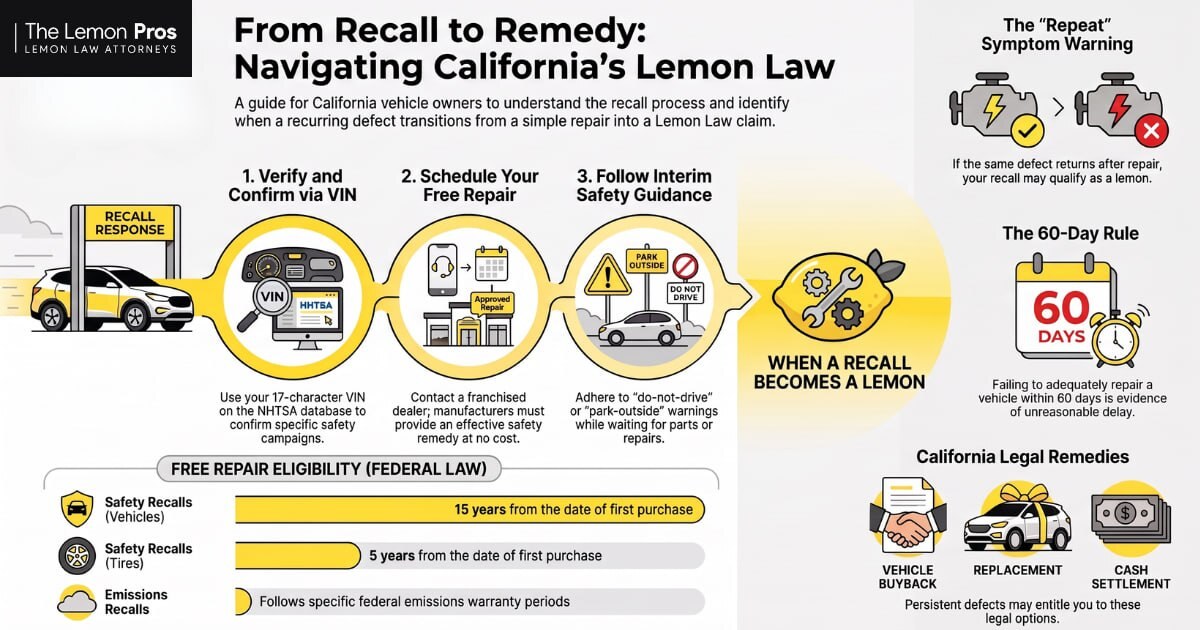
In our experience, a useful way to evaluate a California recall problem is to track four stages. There are recall, repair, repeat, and remedy.
Recall: Identify the campaign and determine exactly what defect the manufacturer says exists. Save the recall notice and VIN-specific information.
Repair: Have the authorized dealer perform the recall repair and obtain a repair order describing the work performed. Record the date the vehicle entered the shop and the date it was returned.
Repeat: Watch for the same symptom or defect after the repair. If it returns, take the vehicle back promptly and make sure the repair order identifies the continuing problem rather than simply stating that the vehicle was inspected.
Remedy: If the defect continues despite repair attempts, evaluate your warranty and California lemon law rights separately from the recall. The question has shifted from Does my vehicle have an open recall? to Has the manufacturer adequately repaired a covered defect within a reasonable number of opportunities?
This framework helps distinguish an ordinary recall repair from a recurring warranty problem. An open recall by itself does not establish a lemon law claim, but a documented pattern of failed repairs can create a much stronger record.
What Happens If the Recall Repair Does Not Fix the Problem?
This is where most recall guides stop and where the real problem starts. If the manufacturer chooses to repair your vehicle and doesn’t do it adequately within a reasonable time, federal law requires more. The manufacturer must then replace the vehicle or refund the purchase price less depreciation.
The 60-Day Rule Most Recall Guides Miss
Failing to repair a vehicle adequately within 60 days of its presentation is prima facie evidence of a failure to repair within a reasonable time. An adequate repair also does not include one that leaves the vehicle with substantially impaired operation.
That provision matters because it flips the usual dynamic. Everywhere else in federal recall law, the manufacturer picks the remedy. Here, a repair that drags past 60 days without working starts building the record for a replacement or a refund.
Do Recall Repairs Count Toward a California Lemon Law Claim?
They can, and this is the point Californians most often miss. In our experience, a recall repair is performed under warranty. California’s Song-Beverly Consumer Warranty Act asks whether the manufacturer or its authorized dealers fixed a substantial defect within a reasonable number of attempts.
Repeated visits for the same nonconformity build a record of whether the visit was prompted by a recall notice or by the car failing on you. If the recalled defect keeps returning after multiple attempts, you may be looking at a claim for a lemon law buyback rather than an open recall, and our guide on how to file in California sets out the process. Our guide on what happens if the dealer cannot fix your car covers that transition, and our guide on how the lemon law works sets out the California framework. A recall is not the same thing as a lemon. It is a useful place to start.
When a Recall Becomes a Lemon Law Problem
Consider a California driver whose SUV is subject to a recall for a defect that can cause the vehicle to lose power unexpectedly. The driver takes the SUV to an authorized dealer for the recall repair, but the same problem returns weeks later. The vehicle goes back to the dealer, the repair is documented again, and the defect continues.
At that point, the important question is no longer simply whether the recall was completed. The question is whether the manufacturer has had a reasonable opportunity to repair a covered defect and whether the problem substantially impairs the vehicle’s use, value, or safety. A documented history showing the recall repair, subsequent failures, repair attempts, and days the vehicle was unavailable can become important evidence in a California lemon law claim.
The lesson is simple: don’t assume a completed recall closes the door on your rights. If the same defect continues after the manufacturer has had repeated opportunities to fix it, preserve the repair history and have the vehicle’s warranty rights evaluated separately from the recall itself.
What If the Recall Part Is on Backorder?
Time your vehicle spends out of service still counts, which is why you should track backordered parts rather than tolerate them. On a large campaign, the recalled part can take weeks to arrive, and drivers are often told to keep using the car until it does.
California measures days out of service for repair as part of the lemon law analysis, so a long recall wait is not neutral. Keep dated records of every day the vehicle sits at the dealership. Our page on how long a dealership can hold your car for repair explains how that clock works. Ask the dealer about a loaner vehicle while you wait, though be aware no federal rule entitles you to one.
How Do You Check Whether Your Car Has an Open Recall?
Check by VIN. In our experience, it is the only method that returns results for your specific vehicle rather than the model generally. This is because recalls usually cover a build range rather than an entire model year. The table below compares the ways to check, since each answers a slightly different question.
| Method | What It Tells You | Best For |
|---|---|---|
| VIN lookup on the public NHTSA database | Every open safety recall on record for your exact vehicle | The definitive check |
| Our free recall checker | The same NHTSA recall data, by VIN or year, make, and model | A fast check without leaving this page |
| Manufacturer website by VIN | Open recalls plus manufacturer service campaigns | Finding campaigns NHTSA does not list |
| Recall notices in the mail | Recalls affecting a vehicle registered in your name | Passive awareness only |
Two limits are worth knowing. Recently announced campaigns can take a short time to appear in the public database. Also, notices reach you only if your registration details are current, which is the practical reason to check yourself rather than wait for the mail.
Third-party apps also track recalls with varying reliability. We do not run a recall alert service, and we would rather tell you that than sell you one. What we offer is the free VIN checker above and a straight answer on whether a recall on your car has turned into something worse.
What Are Your Rights as a California Vehicle Owner?
You are not legally required to get a recall repaired. The federal recall statute imposes duties on manufacturers, distributors, dealers, rental companies, and repair businesses. Vehicle owners are conspicuously absent from those lists, and there is no federal penalty for an unrepaired recall.
California also adds no state inspection that would catch one for you, because the state runs an emissions Smog Check rather than a periodic safety inspection. Nobody is going to flag an open recall on your behalf.
Consequences still exist, but they are not criminal. Unrepaired recalls can affect resale value, and an unaddressed known safety defect can complicate your position after a collision. Those are practical and civil risks, not a legal duty to comply.
In our experience, federal law prohibits selling a new vehicle with an open recall, but that prohibition does not extend to used cars once the vehicle has had its first retail purchase. The prohibition covers new cars in dealer stock, not the used market. A used car dealer can lawfully sell you a car with an unrepaired recall, so check the VIN before you buy rather than after. Our guide on whether it is legal to sell a car with a recall covers the exceptions, including the tighter rules that apply to rental fleets.
Your enforcement route under federal law is administrative. Any interested person can ask the agency to examine whether a manufacturer has reasonably met its remedy obligations. Your litigation route, by contrast, is state law, which for Californians means Song-Beverly and related consumer protection laws.
Why Do So Many Recalled Vehicles Go Unrepaired?
In our experience, this is because the system depends on owners acting, and many never do. The Government Accountability Office reported in GAO-24-106356 that about 22 million vehicles were recalled in 2022. The defects spanned everything from wiring that may cause fires to windshield wipers that do not operate properly.
The completion figure is more revealing. The same report notes that 69% of passenger vehicles recalled in 2018 had been remedied 15 months after a remedy became available. Roughly three in ten recalled vehicles were still unrepaired more than a year after the fix existed.
Separately, CARFAX estimated in January 2025 that 58.1 million vehicles on US roads, about one in five, carried an unfixed recall, with more than 14 million carrying two or more. That figure comes from a commercial vehicle history company rather than a government agency, so treat it as an estimate, not an official count.
A recall can be inconvenient or even alarming without giving the owner a lemon law claim. Many recalls are repaired successfully during a single dealership visit, and a manufacturer may resolve the safety issue without the vehicle experiencing any continuing defect.
The legal analysis changes when the problem persists. Repeated repair attempts, significant time out of service, an unavailable remedy, or a defect that substantially impairs the vehicle’s use, value, or safety can raise different warranty and lemon law questions. That distinction protects you from assuming every recall means you are entitled to a buyback, or assuming a completed recall means you have no further rights when the same defect continues.
Do You Need a Lemon Lawyer?
Most recall guides explain how to look up a recall and schedule the repair. That is only the first part of the problem. This guide explains the federal rules governing recall repairs and reimbursement, then shows where a failed recall repair can intersect with California warranty and lemon law rights. That distinction matters because an open recall does not automatically create a lemon law claim, but a recurring defect and a documented history of unsuccessful repairs can change the legal analysis.
For great advice, you want an experienced attorney on your side, such as the Lemon Pros. Our team of California Lemon Law attorneys focuses exclusively on California Lemon Law cases and has helped drivers pursue claims, total loss disputes, and manufacturer buybacks. Contact us today for a free case evaluation to discuss your options.
Frequently Asked Questions
These are answers to some of the questions California drivers ask us most often after receiving a recall notice.
How Do I Know if My Car Is Recalled?
Enter your 17-character VIN on the NHTSA database or our free recall checker. Registered owners are also notified by first-class mail, but only if the manufacturer has your current details.
What Should I Do if I Receive a Recall Notice for My Car?
Confirm the notice against your VIN, then contact a franchised dealer to schedule the free repair. Read the notice for any interim safety guidance before you drive the car again.
Is It Safe to Continue Driving My Car if It Has Been Recalled?
It depends on the specific recall, and the notice will say. Some campaigns are flagged as do-not-drive or park-outside, while many others carry no driving restriction at all.
How Long Do I Have to Get My Car Repaired After a Recall?
There is no deadline, because a recall does not expire and later owners are still covered. The free repair duty lapses only if the vehicle was first sold more than 15 years before the recall was announced.
Will the Manufacturer Cover the Cost of Repairs for a Recalled Car?
Yes, the manufacturer must remedy a safety recall without charge when you present the vehicle. You may also claim reimbursement if you paid to fix the same defect shortly before the recall was announced.
What Should I Do if the Repair Fails After a Recall?
Return to the dealer, insist the visit is documented, and keep every repair order. Repeated failed attempts on the same defect may support a claim under the California lemon law.
Do Recall Repairs Affect My Car Insurance?
An open or completed recall does not normally change your premium on its own. Insurers price on claims history and risk factors rather than recall status.
Legal Disclaimer: This article is for general informational purposes only and does not constitute legal advice. Reading it or contacting The Lemon Pros does not create an attorney-client relationship. Federal recall requirements and California lemon law remedies depend on the specific facts of each vehicle, defect, and manufacturer. Statutory references reflect federal and California law as of the date of publication and may change. Past results do not guarantee future outcomes. For advice about your own situation, consult a licensed California attorney.
ATTORNEY ADVERTISING. The Lemon Pros, 9100 Wilshire Blvd, Suite 500W, Beverly Hills, CA 90212. (855) 659-1784.
Reviewed by: Michael Saeedian, Esq., California State Bar No. 265470

Michael Saeedian, Esq.
Founding PartnerMichael Saeedian, Esq. is a California Lemon Law attorney and a founding attorney of The Lemon Pros; he develops tailored strategies to pursue the full compensation you're owed.
View Attorney Profile →