

Is There a Lemon Law for Leased Cars?

Many drivers assume lemon laws only protect people who buy new cars, but that’s not always true. In most states, lemon laws also apply to leased vehicles when a serious defect covered by the manufacturer’s warranty cannot be fixed after a reasonable number of repair attempts. If a leased car repeatedly breaks down or spends excessive time in the repair shop, the lessee may have legal rights to compensation, replacement, or even lease termination. You can avoid paying for a car that doesn't meet basic safety or performance standards by understanding how these protections operate.
The Lemon Pros have experience representing clients in California lemon law cases and have helped secure significant settlements. With our practice area centered on lemons, we run a law firm that strives to get results. Call (855) 725-2446 for a free initial consultation.
This blog explains how lemon laws apply to leased cars, how to get compensation when your leased vehicle is unrepairable, and why a lemon law attorney can maximize your chances of success.
Table Of Contents
- How Does the California Lemon Law Apply to Leased Cars?
- The L.E.A.S.E. Framework for Leased Car Lemon Law Claims
- How Does the Lemon Law Process Work for Leased Vehicles in California?
- Step 1: Identify a qualifying defect and track repair attempts.
- Step 2: Confirm warranty coverage and timing.
- Step 3: Gather and organize documentation.
- Step 4: Give the manufacturer a final opportunity and pursue a resolution.
- Step 5: Understand how lease contracts affect your claim.
- Repair Attempts and Their Importance
- What Issues Qualify a Leased Car as a Lemon?
- Differences Between Lemon Law Claims for Leased vs. Purchased Cars in California
- Does the Lemon Law for Leased Vehicles Apply in California?
- When Does a Leased Car Qualify as a Lemon?
- What Should You Do if Your Leased Car Is a Lemon?
- Can I Return a Leased Car if It Has Problems?
- Can I Break My Lease Early Due to Lemon Law?
- How Can You Prevent Leasing a Lemon in the Future?
- Real Example: California Leased Car Lemon Law Case
- When Should You Hire a Lawyer for a California Lemon Law Leased Car Claim?
- Need a California Lemon Law Attorney for Your Leased Car?
- Frequently Asked Questions
How Does the California Lemon Law Apply to Leased Cars?
Lessees whose cars have significant flaws that the manufacturer cannot permanently correct are protected by California's Lemon Law. The law covers motor homes and business vehicles under specific restrictions, and it applies to leased cars just like it does to purchased cars. The defect must be reported while the manufacturer's warranty still covers the vehicle and must significantly impair the vehicle's use, value, or safety to qualify.
A fair number of repair attempts and one last chance to resolve the problem must be granted to manufacturers or dealers. In addition to notifying the manufacturer via mail and maintaining copies of all documentation, lessees should maintain thorough repair records, commonly referred to as a Lemon Log. California is one of the states with the highest volume of lemon law lawsuits, with over 22,000 cases filed in 2024 compared to roughly 15,000 in 2023, according to the National Law Review. This demonstrates the prevalence of faulty cars and the need for lessees to be aware of their legal rights.
If the defect cannot be fixed, the manufacturer must repurchase or replace the leased vehicle. Lessees can receive a refund of most lease payments, plus additional costs such as security deposits, registration, and sales tax, minus a reasonable allowance for miles already driven. This can reduce capitalized cost and make pursuing a lemon law claim an attractive option, turning a frustrating experience into a fair resolution.
The L.E.A.S.E. Framework for Leased Car Lemon Law Claims
To determine whether your leased vehicle qualifies under California lemon law, use the LEASE framework:
L- Logged defects:Document recurring issues and symptoms.
E - Enough repair attempts:Confirm the manufacturer had reasonable chances to fix the defect.
A - Active warranty:Ensure the defect was reported during the warranty period.
S - Substantial impairment:Verify the defect affects safety, use, or value.
E - Evidence:Gather repair orders, lease documents, and communications.
If your case meets these criteria, you may have a strong lemon law claim.
How Does the Lemon Law Process Work for Leased Vehicles in California?
Leasing a car should be exciting and convenient, but if the car has major flaws that the manufacturer is unable to repair, it can quickly turn into a frustrating experience. Thankfully, leased cars are covered by California's Lemon Law, which offers robust protections to lessees who experience frequent repair problems. When your leased car qualifies as a lemon, knowing the exact steps of the lemon law process will help you safeguard your rights, get your money back from the lease, and seek just compensation.
Step 1: Identify a qualifying defect and track repair attempts.
A leased vehicle may qualify as a lemon if a defect substantially impairs its use, value, or safety, and the dealer or manufacturer cannot fix it after a reasonable number of attempts. In most cases, this means two to four repair attempts for the same issue or an extended period out of service. These rules apply not only to cars but also to certain motor homes covered by the manufacturer’s warranty.
Step 2: Confirm warranty coverage and timing.
The manufacturer’s original express warranty plays a critical role in lemon law claims because the defect must be reported while the vehicle is still under warranty. If the issue arises and is documented during this period, lessees preserve their rights to pursue a claim, regardless of whether they plan to keep or end the lease later.
Step 3: Gather and organize documentation.
Lessees should keep detailed records of every repair visit, including repair orders, dates, symptoms, and outcomes, along with written communication with the dealer or manufacturer. This documentation helps prove that the manufacturer had sufficient opportunities to fix the defect and supports claims for refunds of lease payments, cash, minus a reasonable allowance for vehicle use.
Step 4: Give the manufacturer a final opportunity and pursue a resolution.
If the defect persists, the manufacturer must be given one final chance to repair the vehicle. If they still fail to comply, lessees can pursue arbitration or file a legal claim. If successful, the manufacturer may be required to repurchase or replace the vehicle, refund lease-related costs, and potentially reduce capitalized cost, making the lemon law an attractive option when a leased vehicle repeatedly fails to perform as promised.
Step 5: Understand how lease contracts affect your claim.
Lease agreements can influence how refunds and compensation are calculated, since the lessee does not have full ownership of the vehicle. However, California law focuses on protecting the consumer’s financial investment and driving experience. Final thoughts: understanding each step of the process helps lessees protect their rights, turn a frustrating situation into a fair outcome, and preserve the value and enjoyment that vehicle ownership, or leasing, should provide as an exciting experience rather than a costly burden.
It takes careful documentation, prompt action, and knowledge of how lease contracts impact your claim to successfully navigate the lemon law process for leased cars. The lemon law can offer significant remedies, such as reimbursements, replacements, and compensation adjusted by a reasonable allowance, when a manufacturer is unable to fix a defective vehicle after a reasonable number of attempts.
Repair Attempts and Their Importance
A repair attempt occurs each time a dealer or manufacturer tries to fix a defect covered by the vehicle’s warranty. In California, a leased car may qualify as a lemon after a reasonable number of repair attempts, typically two to four for the same defect or multiple defects that render the vehicle unusable for an extended period. For non-safety issues, at least four documented attempts for the same problem are often required.
Documenting each repair is essential for a successful lemon law claim. Keep detailed records of dates, symptoms, work performed, and communication with the dealer or manufacturer. This evidence shows that the manufacturer had sufficient opportunities to correct the defect and supports your case if a refund, replacement, or arbitration becomes necessary.
What Issues Qualify a Leased Car as a Lemon?

A leased vehicle may qualify as a lemon when it has serious defects that substantially impair its use, value, or safety, and the manufacturer cannot fix the problem after a reasonable number of repair attempts. Common qualifying issues include engine and transmission failures, brake or steering problems, electrical system malfunctions, airbag defects, and persistent stalling or overheating. Safety-related defects are especially important because they pose risks to drivers and passengers, but recurring non-safety issues can also qualify if they repeatedly affect reliability or usability.
Repeated repairs are a key factor in lemon law claims, particularly when a vehicle spends excessive time in the shop or the same defect keeps returning. Many lessees mistakenly believe lemon laws only apply to purchased cars or major breakdowns, but leased vehicles are also covered, and even ongoing minor problems may qualify if they significantly impact performance. Understanding these criteria helps lessees recognize when a recurring defect crosses the line from inconvenience to a legally actionable lemon law claim.
Differences Between Lemon Law Claims for Leased vs. Purchased Cars in California
In California, lemon law protections apply to both leased and purchased vehicles, but ownership creates key differences in how claims are handled. Buyers own their vehicles, while lessees only pay for the right to use them, so lemon law claims for leased cars focus on the lessee’s financial investment rather than the full vehicle price. Although the legal standards for qualifying defects are similar, the structure of a lease changes how compensation is calculated.
For purchased cars, successful claims typically result in a full buyback or replacement based on the purchase price. For leased vehicles, outcomes usually include refunds of down payments and monthly payments, adjusted by a reasonable usage deduction, or a replacement vehicle under new lease terms. A lemon law settlement may also affect lease-end obligations by canceling remaining payments or penalties. A clear grasp of these distinctions helps lessees recognize their unique rights and pursue claims with clear expectations about potential remedies.
Leased vs Purchased Cars Under California Lemon Law
| Aspect | Leased Cars | Purchased Cars |
|---|---|---|
| Ownership rights | Lessee pays for the right to use the vehicle; does not own it | Buyer holds full ownership of the vehicle |
| Settlement options | Refund of lease payments, cash, down payments, and fees; replacement vehicle under new lease | Full buyback or replacement based on purchase price |
| Refunds | Adjusted by a reasonable allowance for miles driven | Typically full refund of the purchase price minus usage or depreciation |
| Legal obligations | Lease-end terms may be modified; remaining payments or penalties may be waived. | Buyer owns the car, so no lease-related obligations |
| Documentation needs | Repair orders, lease agreement, communication with dealer/manufacturer | Repair orders, purchase documents, and communication with dealer/manufacturer |
Lemon Law vs Other Legal Options for Leased Cars
Although lemon law claims are often the most effective solution for defective leased vehicles, they are not the only legal option available to consumers. In some situations, a warranty breach claim may apply when defects exist but do not fully meet lemon law requirements, while dealer fraud claims may be appropriate if a dealership misrepresented the vehicle’s condition or history.
Contract disputes can also arise when lease terms are unfair, misleading, or improperly disclosed. However, lemon law claims typically offer stronger remedies, faster resolution, and manufacturer-paid attorney fees, which is why they remain the preferred legal path for most leased vehicle disputes.
It is important to note that not all leased cars are lemons. Legal thresholds may not be met by minor problems that have no appreciable impact on value, safety, or use. Manufacturers may also contest claims by claiming that improper use or unapproved repairs were the cause of the flaws. Knowing these restrictions improves your approach to a possible claim and helps you set reasonable expectations.
Does the Lemon Law for Leased Vehicles Apply in California?

In California, the Song-Beverly Consumer Warranty Act is the leading legislation for defective vehicles. In the state laws, leased vehicles receive the same coverage as cars that are purchased. Other states may not provide coverage for cars with a lease agreement. For example, Georgia and Illinois only have coverage for purchased vehicles. For this reason, it’s extremely important to research whether the Lemon Law applies to leased vehicles in your state.
Leased cars are new vehicles that are basically rented for a time period from the dealership. These new vehicles could also be purchased, usually with a finance agreement. Both the leased and financed cars are covered under the California Lemon Law. However, the Lemon Law also applies to used cars. In this state, there’s also some Lemon law coverage for used cars as well, but they only receive coverage for as long as there is a warranty in place, so it’s much more difficult to get compensation on a used vehicle.
Signs Your Leased Car Might Be a Lemon
Not every leased vehicle with a problem is a lemon. Yet, some signs raise red flags, especially if there are recurring issues. Pay attention if your leased car has frequent mechanical issues. Under the Lemon Law, the defect must substantially impair the safety, value, or use of the vehicle, so it could be anything from engine trouble to a malfunctioning AC system.
A big factor with lemons is that they’ve been taken to a repair facility multiple times with no remedy. By law, you must have allowed the shop to supply four unsuccessful repair attempts (or two for serious safety issues) before the car can be deemed a lemon. There’s also the issue of how much time your car spends in the shop. If the dealer has had your car for more than a month, you may be due compensation.
What Special Considerations Apply Under the Lemon Law for Leased Cars?
Leased cars have their own set of rules when it comes to Lemon Law claims. In some cases, you may only be given the option to return the vehicle or exchange it for another. Because you don’t own the vehicle, it’s unlikely that you’ll be offered a cash and keep settlement.
There’s also the chance that a Lemon Law case may affect your lease agreement. You may have the option to cancel the lease early without paying a penalty, but this is not guaranteed. Check the terms of your contract carefully and speak with your dealership.
If the issues don’t get resolved with the authorized dealer or manufacturer before the lease ends, it could create end-of-lease complications. You may be held responsible for a car that never operated properly, so it’s important to act quickly.
When Does a Leased Car Qualify as a Lemon?
To qualify for a replacement vehicle in California, your leased car must meet specific lemon law requirements. The vehicle must have been leased new and covered under the manufacturer’s warranty, which typically applies throughout the lease term.
The car must have a substantial defect that repeatedly affects its safety, use, or value, and the manufacturer must have made a reasonable number of repair attempts. In most cases, this means at least four attempts for general defects or two attempts for serious safety issues, as documented in repair orders.
A vehicle may also qualify if it has been out of service for repairs for more than thirty cumulative business days. Coverage generally applies within the first 18,000 miles driven or 18 months from the original delivery date, whichever comes first. During this period, many consumers may require alternate transportation due to ongoing repairs.
If your leased car meets these criteria, you must provide the manufacturer with written notice before filing a claim. If successful, you may be entitled to a replacement vehicle or financial relief, including reimbursement of lease payments made in cash, a reduction in the capitalized cost, or a refund of total payments.
What Should You Do if Your Leased Car Is a Lemon?
Knowing what to do if your car is a lemon can help you get through the claim faster and with less stress. Here are some important steps to remember:
Document the Problem
If you want to win your Lemon Law case, you must document everything. Keep a detailed record of every issue that occurs, with the dates, symptoms, and relevant dashboard warnings. Take note of how the problem affects the value, use, or safety of the vehicle.
With every repair attempt, keep a copy of the invoice and work order. It’s helpful if the technician can write notes about what was found or fixed. You also want every call or email with the dealership or manufacturer. Write down who you spoke with and the outcome of that communication.
Take the Car to an Authorized Dealer for Repairs
It may be tempting to take your car to a different shop for another opinion, but for now, you should only visit an authorized dealer. With each attempt, make sure you request a work order or receipt. There may be a time at a later date when you can get a second opinion, under the advisement of your lemon lawyer.
Track the Reasonable Number of Repair Attempts
It’s your responsibility to track the multiple repair attempts made. If there’s a serious safety issue, you may only need to have two attempts from the service department, but it’s best to speak with an attorney. Otherwise, plan on having four unsuccessful repair attempts before a claim can be filed.
Notify the Manufacturer in Writing
You are required by law to send a certified letter to the manufacturer to explain the issue and request a resolution. Clearly outline the problems that have been dealt with and document the dates for every repair attempt. Keep your letter strictly factual with evidence to back up everything you say. This demand letter is best written by an attorney, especially if you want the manufacturer to take your request seriously.
Speak to a Lemon Lawyer
Lemon law attorneys protect consumers from being ignored by the manufacturer. Many of them work on a contingency basis, meaning you only pay the legal fees when the case is won. Additionally, the manufacturer may be responsible for paying attorney fees. For that reason, you should have a free case evaluation as soon as you realize there are unresolved problems with your car. A Lemon Law attorney ensures you qualify for a case and helps with every step of the claim. Often, the average Lemon law settlement is much higher when the case is handled by an attorney.
Can I Return a Leased Car if It Has Problems?
Many people believe that you can return a leased car within 30 days, but that’s not always the case. Most of the time, the car cannot be returned until the lease is completed. However, if there’s an unrepairable defect involved, you may be able to file a Lemon Law claim. Otherwise, you may have grounds to sue a car dealership, which is all the more reason to have a qualified lawyer on your team.
Can I Break My Lease Early Due to Lemon Law?
The short answer is that if the total lease payments haven’t been completed, you can’t just walk away from your agreement. You must complete everything agreed upon during the lease signing. To get out of the lease early because the same defect continues occurring, you will need to go through the Lemon Law process. Otherwise, you put yourself at risk of having a major hit to your credit and extensive penalties by taking the car back early. Before you stop any payments or return the vehicle, contact a Lemon Law attorney for more advice.
How Can You Prevent Leasing a Lemon in the Future?
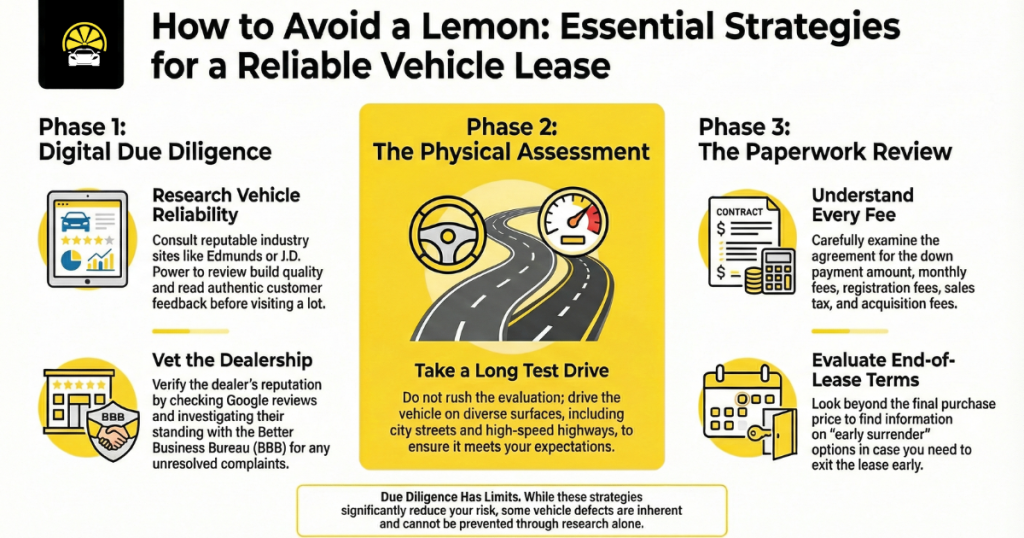
It can be difficult to know if you are making the right decision when leasing a car. After all, you don’t want to end up with a lemon. The next time you look at leasing a vehicle, consider these important tips:
- Research vehicle reliability. We recommend using sites such as Edmunds or J.D. Power to ensure the vehicle is built well and to read other customer reviews.
- Take a long test drive. Before signing the lease agreement, take time to make sure it’s everything you want. Drive it along varying road surfaces and types, such as highways and city streets.
- Read the agreement carefully. You need to understand everything you are agreeing to, especially the down payment amount, monthly fees, and additional expenses (sales tax, registration fees, acquisition fee, etc.). Beyond the purchase price available at the end of the lease, look at information about an early surrender option, in case you don’t want to see the lease through.
- Research the dealership carefully. Look at Google reviews from other customers and check with the Better Business Bureau (BBB) to make sure there are no outstanding complaints.
Some due diligence can help you avoid a lemon, but there’s always the chance that you get a car with defects that couldn’t be prevented.
Real Example: California Leased Car Lemon Law Case
A Beverly Hills driver leased a luxury SUV that repeatedly experienced transmission failures within the first year of the lease. Despite three repair attempts and over 35 days in the repair shop, the defect persisted.
After filing a California lemon law claim, the manufacturer agreed to terminate the lease, refund over $18,000 in lease payments and fees, and cover attorney costs. This case illustrates how leased vehicle owners can recover significant compensation when manufacturers fail to fix serious defects.
Arash Khorsandi, a seasoned lemon law lawyer with The Lemon Pros, says, "Manufacturers often underestimate leased vehicle claims, but California law treats leased cars similarly to purchased vehicles when warranty defects persist. In our experience, a lot of lessees are eligible for compensation but are unaware of it until they consult with a lawyer."
When Should You Hire a Lawyer for a California Lemon Law Leased Car Claim?
Getting legal help can significantly improve your chances of success in a California lemon law claim involving a leased vehicle. Lemon law cases often involve technical legal standards, detailed documentation, and negotiations with manufacturers, which can be difficult to handle without experience. An attorney who focuses on lemon law understands how to prove that a defect qualifies, calculate potential refunds, and push manufacturers to comply with their legal obligations.
When you work with a lemon law advocate or attorney, you can expect a thorough review of your lease agreement, repair history, and warranty coverage. They will help gather evidence, communicate with the manufacturer, and pursue compensation through negotiation, arbitration, or litigation if necessary. In many California lemon law cases, the manufacturer is required to pay the consumer’s attorney fees, which means you may be able to pursue your claim without paying legal fees out of pocket.
If your leased vehicle has persistent defects that the manufacturer cannot fix, speaking with an experienced lemon law firm can help you understand your rights and options. Contact a qualified California lemon law attorney today for a free case evaluation and find out whether your leased car qualifies for a refund, replacement, or other compensation.
Need a California Lemon Law Attorney for Your Leased Car?
Unlike generic lemon law articles, this guide explains leased vehicle claims step-by-step, clarifies how compensation is calculated under lease agreements, and highlights real-world outcomes. It is designed to help lessees understand not just their rights, but how to actually enforce them.
For the best advice, you want a qualified lemon law attorney on your side, such as The Lemon Pros. Our team of Lemon Law attorneys in California focuses exclusively on California Lemon Law cases and has helped drivers pursue claims, total loss disputes, and manufacturer buybacks. Contact us today for a free case evaluation to discuss your options at no cost.
Frequently Asked Questions
Lemon law for leased cars often raises questions about eligibility, attorney fees, and potential outcomes. The following FAQs address some of the most common concerns consumers have when considering a claim for their leased cars.
Does the California Lemon Law Cover Leased Cars?
Yes, leased vehicles are generally protected under California’s Lemon Law if they have serious warranty-covered defects that impair use, value, or safety. The law applies to vehicles that are leased with a written warranty and used primarily for personal or household purposes.
How Many Repair Attempts Are Needed to Qualify for a Lemon Law Claim?
Typically, a vehicle qualifies after two failed repairs for serious safety defects, four or more attempts for other defects, or 30+ days out of service for repairs. The exact number can vary depending on the defect’s severity and impact on safety, use, or value.
Can I Get My Lease Terminated if My Car Is a Lemon?
Yes, if your leased vehicle qualifies as a lemon, you may be entitled to remedies such as lease termination, refund, replacement, or settlement. Manufacturers must provide relief when they cannot repair a qualifying defect after a reasonable number of attempts.
Are Attorney Fees Covered Under California Lemon Law?
Yes, if you win a lemon law case, the manufacturer is typically required to pay your attorney’s fees. This means consumers often do not pay legal fees out of pocket when their claim succeeds.