

What Is a Lemon Lawsuit?

If you are stuck driving a defective vehicle that cannot be repaired, you may have the right to file a lemon lawsuit. A lemon law claim is a legal claim that allows you to demand that the manufacturer either repurchase the faulty car or provide a suitable replacement.
The Lemon Pros have experience representing clients in California lemon law cases and have helped secure significant settlements. With our practice area centered on lemons, we run a law firm that strives to get results. Call (323) 675-3282 for a free initial consultation.
In this guide, we will explain the basics of a Lemon Law case, focusing on both the federal Lemon Law and state Lemon Laws. We will show you the qualifications to start the Lemon Law process and give you valuable steps to get you out of that defective vehicle.
Table Of Contents
- What Is a Lemon Lawsuit? - The Legal Framework
- Understanding the Lemon Law Lawsuit Process
- Common Defects That Lead to a Lemon Law Lawsuit
- When Can You File a Lemon Law Lawsuit?
- How to File a Lemon Law Lawsuit?
- What Compensation Can You Expect From a Lemon Law Claim?
- How Does a Lemon Law Lawsuit Affect Vehicle Ownership?
- How Long Does a Lemon Law Lawsuit Take?
- How to Strengthen Your Lemon Law Lawsuit Case
- Filing a Lemon Law Lawsuit: Understanding Attorney Fees
- Want to Consult a Lemon Law Lawyer About Your Case?
- FAQs
What Is a Lemon Lawsuit? - The Legal Framework

A lemon lawsuit occurs when a claim moves beyond the process of negotiation and arbitration. It occurs when the case cannot be settled out of court. A Lemon Law attorney moves the dispute into the court system to be heard by a judge.
Whether you are facing your own lemon law lawsuit or you are still in the arbitration process, the same rules apply. California’s Lemon Law, known as the Song-Beverly Warranty Consumer Act, protects consumers within the state. In comparison, the federal law, known as the Magnuson Moss Warranty Act, is designed to add to those protections. In other states, the Magnuson-Moss Warranty Act would work in conjunction with the governing rules for lemon law as well.
Understanding the Lemon Law Lawsuit Process
Filing a lemon law claim helps consumers protect their statutory rights under California law when a vehicle cannot be repaired after multiple attempts. The lawsuit is filed against the manufacturer, not the dealership, and applies when the defect arises during the warranty period and significantly affects the vehicle’s use, value, or safety.
Steps to Initiate a Lemon Law Lawsuit
Most lemon law lawsuits follow these steps:
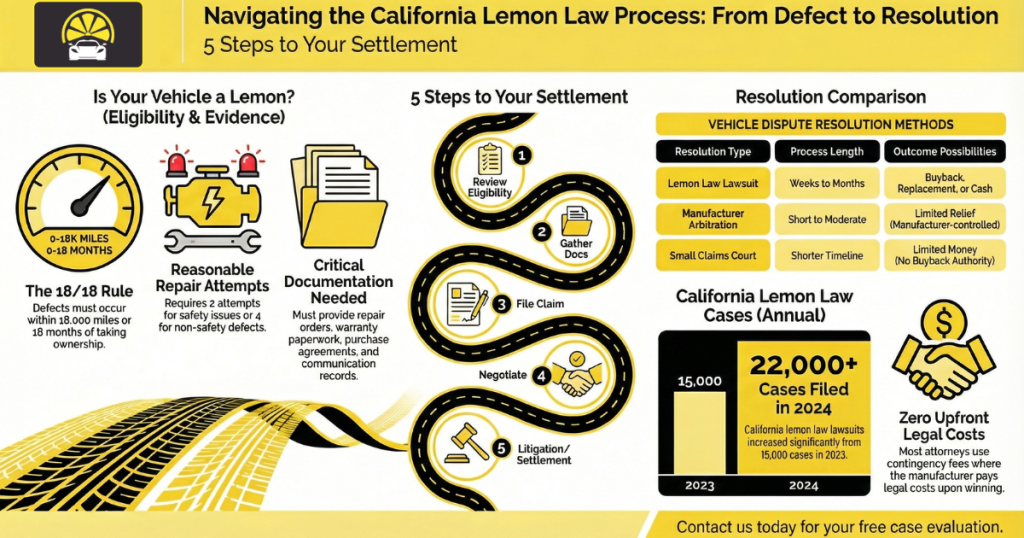
- Eligibility Review - The vehicle’s repair history, warranty coverage, and timeline are reviewed to confirm the claim qualifies under lemon law.
- Gather Documentation - A lawyer works with you to gather all of the necessary documentation to prove the case.
- Claim Filing and Manufacturer Notice - A formal claim or lawsuit is filed, and the manufacturer is notified of the alleged defect and repair failures.
- Negotiation or Dispute Resolution - Many manufacturers attempt to resolve the claim through settlement discussions, mediation, or arbitration, depending on the warranty terms.
- Lawsuit and Court Proceedings (If Needed) - If the claim does not resolve, the case may proceed through litigation. Trials are possible but uncommon.
It is important to know what happens when you win a lemon law case. Possible outcomes of a lemon law lawsuit include a vehicle buyback (refund), a replacement vehicle, or a cash settlement. In successful cases, the manufacturer may also be required to pay attorney fees and costs. Timelines vary, but many cases resolve within a few months, while contested cases can take longer.
To learn more about the Lemon Law process, keep up with the latest news on our blog.
Common Defects That Lead to a Lemon Law Lawsuit
Certain vehicle defects are more likely to qualify for a lemon law lawsuit because they repeatedly interfere with safety, reliability, or normal use. Common examples include engine failure, transmission problems, brake system issues, steering defects, electrical failures, and persistent warning lights tied to major systems. These types of problems often cause stalling, loss of power, unsafe driving conditions, or an inability to operate the vehicle as intended.
Defects that justify a lemon law lawsuit are typically those that significantly impact the vehicle’s safety, use, or value. Safety-related issues, such as brake failure or steering loss, may qualify more quickly.
Other defects, like repeated engine or transmission malfunctions, can also qualify when they leave the vehicle unreliable or frequently out of service. Minor or isolated repairs, such as cosmetic issues or one-time fixes, generally do not rise to the level of a lemon law claim unless they are part of a recurring, unresolved problem.
While some repairs naturally take longer, such as the time it takes for a dealership to replace an engine, you should still have your car back in a reasonable amount of time. If your car is out of service for more than thirty days, you may be entitled to bypass some of the other requirements.
Documenting and Reporting Vehicle Defects
Equally important is the repair history. Lemon law cases rely heavily on documented repair attempts by authorized dealers. Multiple unsuccessful repair visits for the same defect, extended time in the repair shop, and detailed service records all play a critical role in determining whether a defect qualifies for a lawsuit.
When documenting the repair attempts, make sure you write down the date and the name of everyone you have spoken with. It is also helpful to get video or photos of the defect, as well as written notes from the technician who worked on the car.
When Can You File a Lemon Law Lawsuit?

In California, a lemon vehicle is considered one covered by the manufacturer's warranty with a significant defect impairing its use, value, or safety. The defect must first start within 18,000 miles or 18 months of taking ownership of the vehicle with new cars.
Because the scope is so broad as to what a defect entitles, there’s a wide range of issues that will qualify. While it is obvious that repeated engine failure or transmission troubles would be included, even smaller complaints, such as a malfunctioning air conditioning system, can be included.
Once the defect begins, you are responsible for allowing a reasonable number of repair attempts. This number varies based on the severity of the defect. For example, when defective motor vehicles face a serious safety issue, there only needs to be two attempts made. Otherwise, four is the minimum.
Leased vehicles receive the same treatment as the new car that’s financed or bought outright. They are all eligible if you are dealing with the same issue that cannot be repaired.
But how do you know if your car is a lemon? It is critical that you talk with a Lemon Law lawyer as soon as possible to start the claim process. Otherwise, you could miss out on valuable cash compensation or a replacement vehicle.
What if I Bought a Used Car?
There are different rules when dealing with the Lemon Law for used vehicles, although you may still be able to get compensation. In California, used cars can be covered if there’s a warranty. For example, a certified pre-owned vehicle (CPO) may still have the original manufacturer’s warranty in place, giving you more protection. If you purchase used vehicles from a private seller, they are considered as-is, and there would not be any way to file a Lemon Law claim.
The same rules apply otherwise, such as you must have a significant issue affecting the auto safety, value, or use. You are also required to have the same number of repair attempts as with a new vehicle. If the same issue occurs after that, you can start your own case against the dealership or manufacturer.
How to File a Lemon Law Lawsuit?
Lemon Law lawsuits are on the rise in California. Recent reports show that there were more than 22,000 cases in 2024 compared to only about 15,000 in 2023. Thankfully, even if you have no previous experience, it is not that difficult to learn how to file a Lemon law in California. You can follow our expert steps to start your own case.
Gather Necessary Documentation

Many consumers lose their lemon lawsuits because of a lack of documentation. For this reason, it is imperative that you have everything well-documented, enough to prove your case beyond a shadow of a doubt. Among the top documents you should have, consider gathering the following information.
- Repair orders: Keep copies of every repair order with the date and resolution. You need these to prove the various repair attempts.
- Warranty paperwork: It is important to know the coverage period and the necessary exclusions.
- Purchase agreement: This paperwork shows the purchase price, date of purchase, and terms of the financing or lease.
- Communication records: You should keep all communication records between you and the dealer or manufacturer. Keep track of every email, letter, and phone call for your records.
Additionally, it helps to have photos and videos of the complaint. If you can document the complaint at various times throughout the repair attempts, you have a better chance of proving your case.
Contact the Manufacturer
You are required to send a written notice to the manufacturer before filing a claim. Send the letter by certified mail with a return receipt for proof. In the correspondence, include the VIN, make, and model of the vehicle, the mechanical issue you’ve experienced, and outline all of the repair attempts. You want to outline what you are asking for in return, whether it is a buyback or replacement vehicle.
From here, it is just a waiting game to see if the manufacturer responds. In some cases, you will be asked to participate in arbitration with a third party. This option can expedite your settlement if you agree with the offer. California offers an arbitration program through the Department of Consumer Affairs (DCA).
Work With an Experienced Lemon Law Attorney

It is important to know your legal rights before proceeding. A qualified attorney helps you understand what you are entitled to and fights for the maximum compensation. Attorneys are accustomed to working with the top manufacturers, and your case is more likely to be taken seriously when you have adequate representation.
Still, some consumers are hesitant to hire an attorney because of fees. This is a legitimate concern considering that recent reports reveal the average fees for California attorneys are nearly $400 per hour.
The good news is that most lawyers don’t charge attorney fees until the case is won, ensuring they work as hard as possible to get a satisfactory resolution. You may not have to pay any upfront fees, which helps you file the case as soon as possible.
If your case needs to go to court, you want an expert to handle the dispute resolution. The Lemon Pros have been representing consumers against top manufacturers with a near-perfect success rate. Contact us today for your free case evaluation.
Filing the Lawsuit
There may be a time when a lawsuit is needed. In this case, you want an attorney designed to protect your best interests. Mediation may be offered first and often results in a favorable resolution while avoiding a trial. If your case does need to go to trial, make sure you have all your evidence to present and that you are working with an expert attorney.
What Compensation Can You Expect From a Lemon Law Claim?
Cars, like all consumer products, are subject to local laws. Therefore, you will only get the compensation allowed through your local state. In California, you have the option to request a refund or a replacement vehicle once you’ve proven your case.
A refund, otherwise known as a Lemon law buyback, is going to cover the purchase price, taxes, registration fees, and other costs. However, there will be a mileage offset to account for the time you’ve used the vehicle without defects. The average settlement can be anywhere from $5,000 to $100,000, depending on the type of vehicle you drive.
If you prefer a vehicle replacement, the manufacturer may be required to provide you with a new, defect-free vehicle. You should receive the same make and model in exchange for the defective vehicle.
In some cases, you may prefer a cash and keep settlement. You receive a lump sum payment and keep the vehicle, making this a great option if the defects aren’t unbearable. However, you will be required to disclose that the car is a lemon when you are ready to sell it, meaning that the value will go down significantly.
Whichever option you choose, the manufacturer can be held responsible for your legal fees and court costs. When you consider that nothing may need to be paid upfront, you could finalize the case without paying any attorney fees out of pocket.

How Does a Lemon Law Lawsuit Affect Vehicle Ownership?
After a car is determined to be a lemon, the title status changes. With a lemon title, future consumers are warned that there was an unrepairable defect. The next question is, does a lemon title affect insurance? The short answer is yes, and it may be difficult to get insurance for a lemon vehicle.
Furthermore, it is important to know how a dealership will respond after the lemon status change. Dealerships may continue to perform warranty repairs during the lawsuit process, and they are generally not permitted to refuse service simply because a lemon law claim has been filed. After a case is resolved, the consumer is not required to continue working with the dealership if the vehicle has been repurchased or replaced.
How Long Does a Lemon Law Lawsuit Take?
The Lemon law timeline tends to be anywhere from a few months to a year, depending on your circumstances. If you have a very complex case, you could be looking at longer than a year, which is why you should have a lawyer working with you to shorten the time as much as possible.
| Resolution Type | Process Length | Cost to Consumer | Outcome Possibilities | Legal Complexity |
|---|---|---|---|---|
| Lemon Law Lawsuit | Several weeks to several months | Typically no upfront cost; attorney fees often paid by manufacturer if successful | Refund (buyback), replacement vehicle, or cash settlement | Moderate to high, handled primarily by attorney |
| Manufacturer Arbitration | Short to moderate timeframe | Usually low or no direct cost | Limited relief; manufacturer-controlled decisions | Low to moderate |
| Dealership Repair | Ongoing, can span months or years | No legal cost, but ongoing inconvenience | Continued repair attempts without guaranteed resolution | Low |
| Small Claims Court | Shorter timeline | Filing fees and time investment | Limited monetary recovery; no replacement or buyback authority | Moderate, consumer represents themselves |
Factors affecting the duration include the strength of the evidence, manufacturer cooperation, and court backlog. An expert attorney can examine your specific case and give you a better time estimate.
How to Strengthen Your Lemon Law Lawsuit Case
To get your payment or refund as quickly as possible, follow these tips to strengthen and expedite the settlement.
- File the claim as soon as possible. Following all state guidelines, you want to file quickly, avoiding the lemon law deadline.
- Don’t have any repairs by a third-party mechanic. It is critical that all repair attempts are performed by an authorized service center.
- Communicate in writing when possible. If you need to make a phone call, document the time, date, person you’ve spoken with, and the outcome.
- Keep all your documents well-organized. You can turn these over to your lawyer once you partner with an expert.
Above all, you want to work with a qualified Lemon Law attorney to keep the pressure on the manufacturer and get your settlement quickly. Contact a lawyer as soon as possible to learn more about your rights and start your claim.
Filing a Lemon Law Lawsuit: Understanding Attorney Fees
Under the Lemon Law, manufacturers may be required to pay the attorney fees when a consumer wins. This fee-shifting structure is designed to protect consumers and encourage manufacturers to resolve valid claims.
When choosing a lemon law attorney, it is important to look for experience with manufacturer claims, a clear explanation of the fee arrangement, and a willingness to review your repair history at no cost. An attorney who focuses on lemon law cases helps ensure the process is handled efficiently and in compliance with the law. When interviewing potential lawyers, be sure to choose one charging reasonable attorney fees under California Lemon Law.
Understanding Contingency Fee Arrangements
Many consumers hesitate to file a lemon law lawsuit because they are concerned about legal costs. In most lemon law cases, attorneys work on a contingency basis, meaning there are no upfront fees and no hourly billing. The attorney is only paid if the case is successful, lowering the financial risk for vehicle owners.
Want to Consult a Lemon Law Lawyer About Your Case?
Not all lemon cases need to end in a lawsuit, but it is always a possibility you should be prepared for. With the right attorney, you may be able to settle your case out of court. That’s why it is imperative that you choose a professional with a solid reputation for winning.
The Lemon Pros are the team for you. As trusted California lemon law advocates based in Beverly Hills, The Lemon Pros offer 24/7 free case evaluations to help consumers understand their legal options. Reach out for your free case evaluation today.
FAQs
Lemon law lawsuits often raise questions about eligibility, timelines, and potential outcomes. The following FAQs address some of the most common concerns consumers have when considering a lemon law claim.
What Makes a Vehicle Eligible for a California Lemon Law Lawsuit?
A vehicle is eligible for a California lemon law lawsuit if it has a defect that substantially affects its use, value, or safety. The problem must occur during the warranty period, and the manufacturer must be given a reasonable number of repair attempts to fix the issue before filing a claim.
How Long Does a Lemon Law Lawsuit Usually Take?
In California, the average Lemon Law claim takes several months to resolve. In some cases, the timeframe may be longer, especially if the case is complex or it needs to go to court.
Can I File a Lemon Law Lawsuit for a Used Car?
California does have some regulations for used cars, but they must still meet the same guidelines as a new vehicle. Therefore, the defect must occur within the first 18,000 miles or 18 months and be covered by the manufacturer's warranty.
How Much Are the Attorney Fees for a California Lemon Law Claim?
In most cases, California attorneys work on a contingency basis for Lemon Law cases. With this fee structure, you would not owe anything upfront, and the final payment would be taken from the settlement amount. There is also the chance that the manufacturer will be required to pay your lawyer's fees.
Disclaimer: This content is for informational purposes only and does not constitute legal advice. Laws vary by state, and outcomes depend on the specific facts of each case. Consult a qualified attorney for advice regarding your individual situation.