

Short answer
An engine replacement at a dealership usually runs one to three weeks, depending on the model, parts availability and workshop load. Those days count. Time out of service for warranty repair accumulates towards the thirty-day guidepost California courts use, so a long engine job can move a vehicle closer to qualifying under the lemon law.
An engine replacement at a dealer usually takes about 1 to 3 weeks. The time can vary depending on several factors, such as the vehicle model, engine availability, and labor. Delays can happen if the replacement engine is on back order or if other repairs, like the cooling system or gaskets, are needed after engine failure. If the repair is covered under a powertrain warranty, you may get a rental car, but the claim process can add extra time.
The Lemon Pros are experts in navigating the Lemon Law and defective vehicles. Since our practice area is focused on lemon vehicles, we have been able to secure compensation for hundreds of happy clients. Contact us today to get a free consultation about your defective vehicle!
This blog explains how long an engine replacement takes, what factors can delay the process, and what to expect from a dealership during the repair.
How Long Do Dealership Engine Replacements Typically Take?
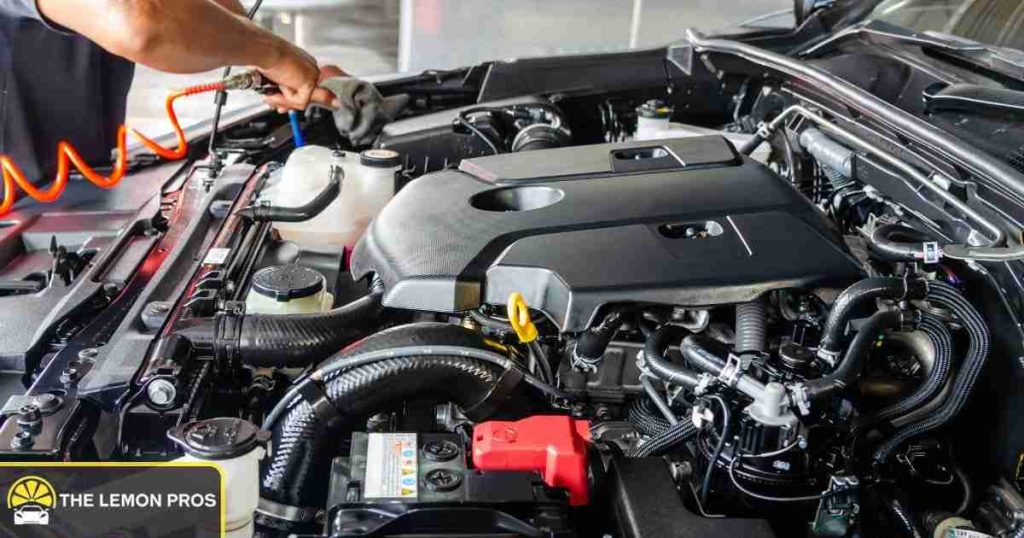
A dealership engine replacement can take anywhere from 1 to 3 days for a simple fix to about 1 week or more for a full engine repair. The time it takes to have an engine replaced depends on several factors, including engine availability, labor rates, the shop’s workload, and whether other necessary repairs are required.
For example, installing a new engine in a newer vehicle may take longer due to tech complexity, while a used engine or rebuilt option already in excellent condition can speed up installation if the parts are ready. High-mileage vehicles or cars that were not properly maintained may suffer additional delays because the mechanic may need to resolve related issues to protect the engine and ensure long-term reliability.
The type of replacement also matters, as a brand-new engine can take longer to source and may be more costly, while a rebuilt engine can offer a balance between cost and value with a slightly faster turnaround. In some cases, delays can feel crazy if parts are not immediately available or if the dealership is handling multiple repairs at once, increasing the wait time.
To save money and reduce delays, it is essential to keep up with regular maintenance like oil changes and fluid checks, which help keep the engine healthy and may prevent costly breakdowns in the first place. Overall, while every case is different, understanding these factors can help you better account for time, cost, and what to expect when your car is in the shop.
Case Study/Example
One of our clients, Jane from Los Angeles, had her Kia stuck at a dealership for 7 weeks due to a back-ordered replacement engine. By documenting every service update and contacting us early, she qualified for a Lemon Law buyback and received full compensation for her vehicle. This illustrates why keeping detailed records and acting promptly is essential.
What Factors Affect How Long a Dealership Takes to Replace an Engine?

The time it takes for a dealership to replace an engine can vary significantly, typically ranging from one week to over a month, with most cases falling between 7 and 21 days. A major factor is parts availability, as new or remanufactured engines for newer vehicles may arrive within a week, while older or rare models can take 6 to 8 weeks due to backorders, and parts shipping alone can take 1–2 weeks.
Costs also play a role, as replacing an engine can cost anywhere from $2,000 to $10,000 or more. While a used engine, which costs $400 to $700, can reduce what you pay and sometimes speed up the process. Dealership workload can add delays, with some shops requiring a 2 to 3 week wait just to begin work, while diagnostics can take one to two days before the engine repair starts.
Labor typically takes 10 to 12 hours at around $150 per hour, though installation may take a few days depending on the vehicle’s complexity and condition. While fast cases may be completed in about a week, more complex situations involving high mileage, wear and tear, or additional repairs can extend timelines to several weeks or longer.
Warranty and legal factors can also impact timing, specifically if delays exceed 30 days, which may qualify for a Lemon Law claim in some cases. Keeping documentation and understanding your rights can help protect your investment and improve your chances of a faster, more reliable outcome.
How Does Engine Part Availability and Type Affect Replacement Times?
The type and availability of the engine directly impact how long a dealership will take to complete a replacement. A new engine for a current model can sometimes arrive in less than a week, making installation relatively fast, while remanufactured engines take longer to source due to factory processes and limited stock. Rebuilt or used engines depend on availability and condition, which can vary widely and may require extra inspection or minor repairs before installation.
Supply chain issues, especially for older, rare, or high-demand engines, can further extend timelines, sometimes stretching replacements to 6 weeks or several months. Fast cases may be completed in about 1 week if parts are ready and overnighted, but typical dealership replacement averages around 3 weeks from drop-off to pickup. Labor usually takes 10 to 12 hours at about $150 per hour, with installation times influenced by engine complexity and the mechanic’s skill. Environmental factors, like high salt exposure or prior collision damage, can also complicate engine replacement.
Typical Engine Replacement Time by Engine Type
The length of time your car will be in the shop, the cost, and the kind of warranty coverage you get can all be greatly impacted by the engine you choose to replace. To assist you in planning and making an informed choice, the table below compares new, remanufactured, and rebuilt engines and offers a summary of typical timeframes, cost ranges, and warranty implications.
| Engine Type | Average Timeframe | Cost Range | Warranty Implications |
|---|---|---|---|
| New Engine | 1–3 weeks | $4,000–$10,000+ | Typically comes with a full manufacturer's warranty; best for long-term reliability |
| Remanufactured | 2–6 weeks | $3,000–$7,000 | Often includes a limited warranty; may cover specific parts or labor |
| Rebuilt/Used | 1–4 weeks (if available) | $400–$3,500 | Warranty varies by supplier; generally shorter coverage, and may be limited to certain components. |
Engine replacement timeframes, costs, and warranty coverage vary depending on the type of engine chosen. According to the U.S. Bureau of Labor Statistics, automotive service technicians and mechanics, who perform engine repairs and replacements, had a median wage of about $23.88 per hour in 2024. This reflects typical labor costs that contribute to overall repair expenses.
While a new engine typically takes 1–3 weeks to install and costs $4,000 to $10,000 or more, it usually comes with a full manufacturer's warranty for the best long-term reliability. Whereas remanufactured engines generally take 2–6 weeks and cost $3,000 to $7,000, they often include a limited warranty covering specific parts or labor.
Rebuilt or used engines, on the other hand, can be installed in 1–4 weeks and cost between $400 and $3,500, with warranty coverage varying by supplier and usually limited to certain components. Knowing these differences helps you plan for downtime, budget appropriately, and know what level of protection to expect for your vehicle.
What Should You Do If Your Engine Replacement Is Taking Too Long?

When your engine replacement is taking longer than expected, it can be difficult to know what to do next. The steps below provide a practical roadmap to protect yourself and your investment. To find out what the dealership is required to fix, first check your warranty coverage. After that, keep a record of everything so you have solid proof in case problems occur.
“Engine replacements can be unpredictable, but keeping detailed records and maintaining consistent communication with the dealership dramatically improves outcomes for our clients,” says Michael Saeedian of The Lemon Pros.
While evaluating delays enables you to determine when the wait becomes unreasonable, we have found that promptly following up and requesting a timeline holds the dealership accountable. Lastly, think about speaking with a Lemon Law lawyer to learn more about your legal options and possibly get compensation if your car has been in the shop for more than 30 days.
- Step 1: Check Warranty Coverage – Verify if your repair is covered under your powertrain warranty.
- Step 2: Document Everything – Keep service orders, dates, emails, and photos of the car. Document everything, including how many miles were on the vehicle, its condition, and all communication, as this can help create a strong record if problems continue.
- Step 3: Follow Up Promptly – Contact the dealer politely but firmly for updates.
- Step 4: Request a Timeline – Ask for estimated completion and parts arrival dates.
- Step 5: Assess Delays – Compare actual timelines to typical replacement durations.
- Step 6: Consider Legal Options – If delays exceed 30 days, you may have legal options under California’s Lemon Law, which requires timely repairs for serious defects. You could qualify for compensation, a buyback, or a replacement vehicle if the dealership fails to act within a reasonable timeframe. Contacting a Lemon Law attorney for a free evaluation can help protect your rights and avoid a costly, ongoing issue.
How Should You Document Your Case and Communicate With the Dealership?
An engine replacement that takes longer than expected can be frustrating and costly. Firstly, to protect your investment and strengthen your rights under warranty or Lemon Law, keep organized records of all repair orders, invoices, and service documents. In our experience, clients who start documenting emails and service dates from day one are twice as likely to resolve disputes without extended delays. We recommend taking photos of the vehicle, noting how many miles were on it, and logging each conversation with dealership staff.
Next, we suggest that you track the dates of purchase, drop-off, updates, and any communication with the dealership, including calls, emails, and in-person conversations. Afterwards, follow up politely but firmly to check on progress, and note any delays beyond the typical installation time. Finally, maintaining thorough documentation and monitoring whether the dealership provides timely updates can help support a buyback or replacement claim if the repair is unreasonably delayed.
What Are Your Rights Under Lemon Law When Engine Replacement Delays Occur?
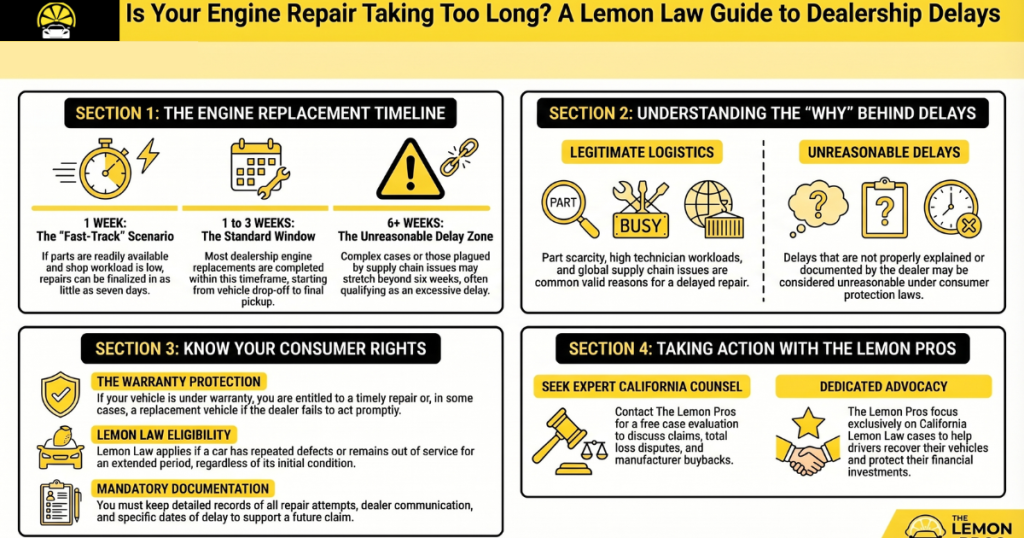
Even if a car was initially in good condition, Lemon Laws are intended to protect consumers when a serious defect, such as an engine failure, cannot be fixed in a reasonable amount of time. Generally speaking, these laws are applicable when repeated attempts at repair are unsuccessful or when the car is not in use for a long time.
Although state-specific details differ, the fundamental principle is the same throughout the United States. Manufacturers are required to either replace the vehicle, resolve the problem, or provide compensation if they are unable to do so.
Prolonged delays in engine replacement can strengthen a Lemon Law claim, especially if your car has been in the shop for over 30 days or if the dealership cannot complete repairs after multiple attempts. In states like California, the law is particularly consumer-friendly and may entitle you to a buyback or replacement, even if the issue started small and later worsened. These protections exist to block manufacturers from dragging out repairs or offering cheap, temporary fixes that do not fully resolve the problem.
In our experience, if you are dealing with ongoing delays, it is important to document everything and seek guidance on your options. Simple tips like keeping repair records, tracking time out of service, and noting communication with the dealer can make a strong difference in your case. Whether you drive a Kia or another brand, understanding your rights can help you take action and avoid being stuck with a vehicle that no longer meets reasonable standards of performance and reliability.
Need Help With a Car Stuck in the Dealership?
While some delays are due to legitimate issues like part scarcity or technician workload, other delays may be unreasonable. Depending on the documentation, correspondence with the dealer, and relevant Lemon Law provisions, even two similar delays may be handled differently. Knowing these specifics will enable you to take the appropriate actions to recover your vehicle and protect your investment.
For great advice, you want a qualified Lemon Law attorney on your side, such as The Lemon Pros. Our team of Lemon Law attorneys in California focuses exclusively on California Lemon Law cases and has helped drivers pursue claims, total loss disputes, and manufacturer buybacks. Contact us today for a free case evaluation to discuss your options at no cost.
Frequently Asked Questions
Engine replacements at dealerships can be confusing when it comes to timing and rights. Here are clear answers to common questions to help you understand how long a repair should take, what counts as an unreasonable delay, and when Lemon Law protections apply.
How Long Does a Typical Engine Replacement Take at a Dealership?
A typical dealership engine replacement usually takes about 1 to 3 weeks from drop-off to pickup, depending on the engine type and availability. Fast cases may be completed in about a week, while complex or delayed cases can take 6 weeks or more.
Can Dealerships Delay Engine Replacement Unnecessarily?
Yes, delays can happen due to high workload, parts availability, or supply chain issues, but some delays may be unreasonable if not properly explained. Keeping documentation of all interactions can help identify if the wait is excessive.
What Are My Rights if My Car Is in the Shop Too Long?
If your vehicle is under warranty, you may be entitled to a timely repair or a replacement vehicle if the dealership fails to act within a reasonable timeframe. Extended delays can also strengthen claims under consumer protection laws or Lemon Law provisions.
Does Lemon Law Apply if My Engine Replacement Takes Too Long?
Yes, Lemon Law can apply if your car experiences repeated defects or is out of service for an extended period, even if the vehicle was initially in good condition. Documentation of delays, repair attempts, and communication with the dealer is essential to support a claim.
Does the day I drop the car off count toward the thirty days?
Count each calendar day the vehicle is out of your hands for warranty repair, including the drop-off day and weekends the shop holds it. The days do not have to run back to back. Two separate engine visits of twelve and twenty days add up to thirty-two.
Does a loaner car stop the clock?
No. A loaner makes the wait easier to live with, but the count tracks how long your vehicle sits at the dealer for warranty repair, not whether you had transportation. Keep the loaner paperwork anyway. It documents the dates your car was in the shop.
The engine is on back order. Do those waiting days still count?
Yes. Parts delays are the manufacturer's supply problem, not yours. If your vehicle is sitting at the dealer waiting on a long-lead engine or a subassembly, those days accumulate the same as days on a lift. Ask the service writer to note the back-order date on the repair order.
Is a replacement engine a new engine or a rebuilt one?
Manufacturers use new long blocks, factory-remanufactured units and short blocks depending on the model and what caused the failure. Ask which one is going in and have it written on the repair order. That record matters later if the replacement fails and you need to show the repair history.
The new engine has the same symptom. Does that count as a fresh attempt?
It counts as another attempt at the same defect. An engine swap that does not resolve the complaint is evidence, not a reset. Document the symptom in the same words each visit so the repair orders read as one continuing problem rather than several unrelated ones.
Should I pay for the engine work while a claim is open?
A warranty repair should not be billed to you. If the dealer asks for payment on covered work, ask which part of the warranty excludes it and get the answer in writing. Keep every invoice either way. Out-of-pocket repair costs can form part of what you seek later.
Legal Disclaimer: This content is provided for informational purposes only and does not constitute legal advice. Lemon Law eligibility and outcomes vary based on individual circumstances, vehicle history, and applicable laws. Reading this article does not create an attorney-client relationship. For legal advice regarding your specific situation, consult a qualified Lemon Law attorney.

Michael Saeedian, Esq.
Founding PartnerMichael Saeedian, Esq. is a California Lemon Law attorney and a founding attorney of The Lemon Pros; he develops tailored strategies to pursue the full compensation you're owed.
View Attorney Profile →