
California Lemon Law Used Car Ruling

California’s new lemon law ruling has significantly changed how used cars are treated under the state’s Lemon Law. After a recent appeal ruled in favor of broader protections, more used-car buyers may now qualify for compensation in some cases. These developments have prompted consumer attorneys to reassess how claims are filed and argued for defective vehicles. If your used car has persistent defects that repairs cannot fix, the latest rulings may expand your legal rights and options.
The Lemon Pros are experts in dealing with the Lemon Law and defective vehicles. Because our practice area is focused on lemon vehicles, we have been able to secure compensation for drivers. Contact us today to get a free consultation about your branded title vehicle!
In this guide, we cover the latest news regarding the state’s Lemon Law and show you how it may apply to you. We also offer some guidance for filing claims due to defective used vehicles.
Table Of Contents
- What Is the California Lemon Law for Used Cars?
- Used Car vs. New Car Lemon Law Claims: Key Trade-Offs
- What Key Court Rulings Are Impacting Used Car Lemon Law Claims in California?
- How Do You File a California Lemon Law Claim for a Used Car?
- Step 1: Confirm Warranty Coverage
- Step 2: Identify a Substantial Defect
- Step 3: Report the Defect to the Dealer or Manufacturer
- Step 4: Allow Repair Attempts and Track Outcomes
- Step 5: Document Everything
- Step 6: Notify the Manufacturer in Writing
- Step 7: Evaluate Legal Options
- Step 8: Leverage Legal Representation
- Step 9: Resolve the Claim
- What Are the Necessary Documents for Your California Lemon Law Claim?
- What Are the Common Challenges in California Lemon Law Used Car Cases?
- How Do You Determine if a Used Car Qualifies for Lemon Law in California?
- What Should You Do if You Bought a Defective Used Car in California?
- Real Case Example
- Need a Lemon Law Attorney for a Used Vehicle in California?
- Frequently Asked Questions
What Is the California Lemon Law for Used Cars?

The California Lemon Law is a consumer protection law that protects vehicle buyers from serious defects that cannot be fixed after a reasonable number of repair attempts. Although it is often associated with new vehicles, the law can also apply to used cars when specific legal conditions are met. For used vehicles, Lemon Law protection generally depends on whether the car is covered by an express warranty and whether the defect substantially affects the vehicle’s use, value, or safety.
A used car may qualify under the California Lemon Law if it was sold with a manufacturer, dealer, or certified pre-owned warranty and the defect appeared during the warranty period. The buyer must have given the manufacturer or dealer a reasonable opportunity to repair the problem without success.
Consumer attorneys report that a significant portion of California Lemon Law claims now involve used vehicles with remaining manufacturer warranties. Industry data suggests that warranty-related disputes are among the most common causes of vehicle litigation, particularly involving powertrain, electrical, and safety system defects.
In most cases, the vehicle must have been purchased or leased in California and used primarily for personal, family, or household purposes, though some business-use vehicles may also be eligible. The key difference between new and used car Lemon Law protections lies in warranty coverage. New vehicles are usually covered automatically under the manufacturer’s original warranty, making eligibility easier to establish. Used cars, however, are only protected if they come with a qualifying warranty, while vehicles sold “as-is” are generally excluded.
Recent California court decisions have strengthened protections for used car buyers by recognizing that transferred manufacturer warranties can trigger Lemon Law coverage. Courts have also clarified that even limited or short-term warranties may support a Lemon Law claim if a serious defect arises during the warranty period, reinforcing the law’s importance in modern used car disputes.
New Car vs. Used Car Lemon Law Protections in California
| Protection Type | Eligibility Criteria | Repair Attempts Required | Time Limits | Typical Remedies |
|---|---|---|---|---|
| New Car Lemon Law | Vehicle must be new and covered by the manufacturer’s original warranty | Usually, 3–4 failed attempts for the same defect; 2 for safety issues | Must occur within the original warranty period | Repurchase, replacement, or compensation, including fees & taxes |
| Used Car Lemon Law | Vehicle must be sold with an express warranty (manufacturer, dealer, or CPO); some transferred new car warranties may apply. | Same standard: 3–4 failed attempts for the same defect; 2 for safety issues | Must occur during the warranty period; AB 1755 sets a six-year filing limit. | Repurchase, replacement, or compensation, including fees & taxes, if the defect persists and the warranty applies. |
Used Car vs. New Car Lemon Law Claims: Key Trade-Offs
While new car Lemon Law claims are often easier to establish because manufacturer warranties are automatic, used car claims can be more complex due to questions about warranty scope and duration. However, used car claims may still succeed when the defect arises during a qualifying warranty period and remains unresolved. The primary trade-off is that used car buyers must meet stricter evidentiary and procedural requirements, while new car buyers typically benefit from broader statutory presumptions.
What Key Court Rulings Are Impacting Used Car Lemon Law Claims in California?

The California Supreme Court has significantly shaped how the Lemon Law applies to used vehicles, especially in cases involving warranty coverage and manufacturer responsibility. Judges have clarified that the Song-Beverly Consumer Warranty Act or the Magnuson-Moss Warranty Act can protect used car buyers when an express manufacturer warranty is still valid or has been transferred to a subsequent owner. These rulings confirm that Lemon Law protections are not limited to new cars and can extend to used vehicles under qualifying warranty conditions.
Courts have also emphasized that transferred, certified pre-owned, and even limited or short-term warranties can trigger Lemon Law obligations if a serious defect arises during the warranty period and remains unrepaired after reasonable repair attempts. This interpretation has expanded consumer rights by preventing manufacturers and dealers from avoiding liability simply because a vehicle is used or because the warranty period is relatively short.
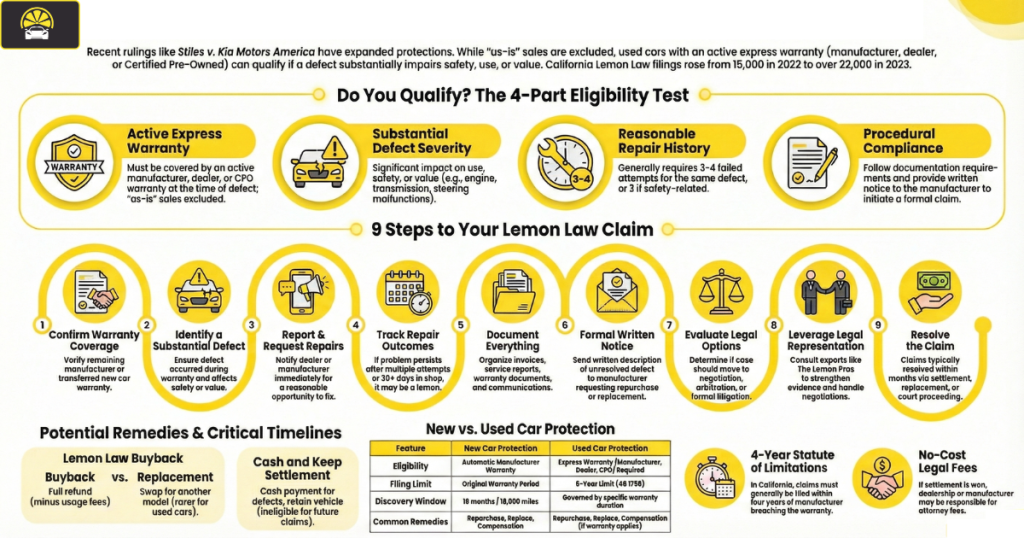
For example, Stiles v. Kia Motors America allowed for a California Lemon law claim for many of the newer model used cars with an unexpired manufacturer’s warranty. Also, in October 2024, the California Supreme Court ruled that used cars aren’t eligible for refund or replacement provisions unless the manufacturer’s warranty was issued at the point of sale, such as with CPO vehicles. The case, known as Rodriguez v. FCA US LLC, limits some of the protections for consumers but still allows for compensation in the right circumstances.
For claimants, these rulings mean stronger legal grounds to seek vehicle repurchase, replacement, or compensation when a defective used car is covered by a qualifying warranty. At the same time, manufacturers and dealers face increased obligations to honor warranty commitments and address defects promptly, making California Lemon Law protections for used car buyers more effective and enforceable.
The 4-Part Test Used by California Lemon Law Attorneys
In evaluating used car Lemon Law claims, attorneys often assess four key factors:
- Warranty Status: Whether an express manufacturer, dealer, or certified pre-owned warranty was active when the defect occurred.
- Defect Severity: Whether the problem substantially affects the vehicle’s use, value, or safety.
- Repair History: Whether the manufacturer or dealer had a reasonable opportunity to fix the defect.
- Procedural Compliance: Whether the buyer followed the required steps, including documentation and written notice.
If these elements are present, a used vehicle may qualify for relief under California’s Lemon Law, depending on the specific facts of the case.
How Do You File a California Lemon Law Claim for a Used Car?
Filing a California Lemon Law claim for a used car can be challenging, especially when eligibility depends on warranty coverage and repair history. California courts recorded a major rise in Lemon Law filings, increasing from about 15,000 cases in 2022 to over 22,000 in 2023, accounting for nearly 10% of all civil filings in some courts. This growth shows that more consumers are asserting their rights when vehicles develop persistent defects that cannot be repaired. A grasp of the correct steps to file a claim can help used car buyers pursue compensation, replacement, or refunds under California law.
Step 1: Confirm Warranty Coverage
Verify that the used vehicle is covered by an express warranty, such as a remaining manufacturer’s warranty or a transferred new car warranty. Without warranty coverage, a California Lemon Law claim for a used car generally cannot proceed.
Step 2: Identify a Substantial Defect
Determine whether the vehicle has a defect that significantly affects its use, safety, or value. The defect must have occurred during the warranty period to qualify under California Lemon Law.
Step 3: Report the Defect to the Dealer or Manufacturer
Notify the dealer or manufacturer of the problem and request repairs. Give them a reasonable number of repair attempts to fix the defect, as required by law.
Step 4: Allow Repair Attempts and Track Outcomes
Allow the dealer or manufacturer to attempt repairs and monitor whether the defect is resolved. If the problem persists after multiple repair attempts, the vehicle may qualify as a lemon.
Step 5: Document Everything
Collect and organize all relevant records, including repair invoices, service reports, warranty documents, proof of purchase or lease, and written communication with the dealer or manufacturer. Strong documentation is critical to proving your claim.
Step 6: Notify the Manufacturer in Writing
Send a formal written notice to the manufacturer describing the unresolved defect and requesting a repurchase, replacement, or compensation. This step often formally initiates the Lemon Law claim process.
Step 7: Evaluate Legal Options
Consider whether to pursue negotiation, arbitration, or litigation. Manufacturers may offer settlements, while more complex disputes may require filing a lawsuit.
Step 8: Leverage Legal Representation
Consult a California Lemon Law attorney or advocate to assess eligibility, strengthen evidence, and negotiate with the manufacturer. Legal representation often increases the chances of a successful outcome.
Step 9: Resolve the Claim
Depending on the complexity of the case, the claim may be resolved through settlement, arbitration, or court proceedings. Many used car Lemon Law cases are resolved within a few months.
Timelines for resolving a used car Lemon Law claim vary, but many cases are resolved within a few months through negotiation, arbitration, or litigation. Manufacturers may offer settlements, while more complex disputes may proceed to court, where prior appeal rulings can influence outcomes. Lemon Law advocates and attorneys play a critical role in evaluating eligibility, building evidence, negotiating with manufacturers, and representing buyers in legal proceedings, often increasing the likelihood of a successful claim under California’s Lemon Law for used cars.
What Are the Necessary Documents for Your California Lemon Law Claim?
To support a California Lemon Law claim for a used car, certain documents are essential to prove that the vehicle has a substantial defect and that the manufacturer or dealer failed to fix it. Repair orders and service invoices are critical because they show the history of attempted repairs and whether the defect persists despite multiple efforts.
The purchase contract or lease agreement is important to establish ownership, warranty coverage, and the terms under which the vehicle was bought or leased. Communications with the dealer or manufacturer, including emails, letters, and notes from phone calls, help demonstrate that the buyer reported the problem and allowed a reasonable number of repair attempts.
Additionally, warranty documents, including any remaining new car warranty or certified pre-owned warranty, are necessary to confirm that the vehicle was covered at the time the defect occurred. Together, these documents provide the evidence needed to support a Lemon Law claim and increase the likelihood of a successful resolution.
What Are the Common Challenges in California Lemon Law Used Car Cases?
One of the most common challenges in California Lemon Law used car cases is proving that a defect is serious enough to qualify for protection and that the manufacturer had a reasonable opportunity to fix it. The California Lemon Law applies to used vehicles still under the manufacturer’s original warranty, requiring manufacturers to repair substantial, safety-impairing defects, but demonstrating this can be difficult without strong evidence.
There is no strict number for reasonable repair attempts, but a lemon is usually defined by three to four failed repair attempts for the same issue or two attempts for safety-related defects, which means buyers must carefully document every repair visit and communication with the dealer or manufacturer.
Vehicle age and mileage also create legal and practical hurdles. Manufacturers often argue that defects are the result of normal wear and tear rather than warranty-covered problems, especially in older or high-mileage vehicles. Consumers must notify the manufacturer in writing about persistent issues before proceeding with a formal lawsuit under the Lemon Law, and failing to follow this procedural step can weaken a claim.
Recent legal developments, including California Supreme Court decisions, have sparked backlash from consumer advocates who argue that certain rulings weaken protections for used car buyers and make it harder to enforce active warranties on used vehicles, increasing uncertainty for claimants. Dealer resistance and evolving legal requirements further complicate used car Lemon Law claims.
Manufacturers may dispute liability, delay responses, or rely on technical defenses, while newer rules such as AB 1755 introduce stricter procedural requirements, including written notice and time limits for filing claims. If a manufacturer fails to fix a lemon, they must buy it back or replace it, including fees and taxes involved in the purchase, but achieving this outcome often requires persistence and legal expertise.
How Do You Determine if a Used Car Qualifies for Lemon Law in California?

With a used motor vehicle, the same basic rules apply for Lemon Law as with a newer model, except for a few changes. For the defect to be eligible, it must substantially affect the use, value, or safety of the vehicle. This defect could entail a critical malfunction with the engine or transmission, but also encompasses minor issues with the electrical system, brakes, steering, and other systems.
How long is the Lemon Law on a used car? That answer depends on the warranty coverage. Where new motor vehicles come with the manufacturer’s warranty, that isn’t always the case with a used car. However, a Certified Pre-Owned vehicle will still have the manufacturer's original warranty attached, giving the driver rights to better legal options if something goes wrong.
Additionally, you must have attempted to have the defect repaired. With the new or used car, California law states that there must be reasonable repair attempts for most issues before Lemon law remedies may be pursued. The exception to this rule is if the dealership has had your car for more than thirty days.
The Song-Beverly Consumer Warranty Act generally does not cover problems caused by normal wear and tear, such as minor cosmetic damage that results from ordinary use of the vehicle. It also excludes routine maintenance items and consumable parts, including worn tires, wiper blades, and brake pads, because these components are expected to degrade over time. In addition, vehicles primarily used for business purposes may fall outside the Act’s protections, although certain business-use vehicles may still qualify depending on their weight, use, and warranty coverage.
How Do Car Warranty Coverage Requirements Work?
There’s a clear distinction between the car warranty types available with a used car, and which ones allow for coverage under the Song Beverly Act and Magnuson Moss Warranty Act. Used and new car buyers who have the original manufacturer’s warranty in place receive a higher success rate of getting compensation. However, some dealer warranties are also eligible, depending on the circumstances.
Additionally, there’s coverage if there’s an implied warranty, but not all states offer this provision. With an implied warranty, there’s an expectation that the car will operate normally, considering its age and mileage. No matter which type, any remaining warranties must be in place when the defect first begins. If the car was purchased from a private seller, it doesn’t have warranty coverage. These cars are considered as-is, and there’s no Lemon Law protection.
What Are the Time Limits and Mileage Restrictions?
The consumer protection statutes with new cars allow for up to 18,000 miles or 18 months for the defect to be discovered, but that’s not the case with a used car. The time limit to discover the defect corresponds directly with the warranty on the vehicle.
However, there’s a statute of limitations that’s important to remember. In California, Lemon Law claims are generally subject to a four-year statute of limitations that begins when the manufacturer breaches the warranty, typically after failing to repair a defect within a reasonable time during the warranty period. It’s normally best to start this process as early as possible, leaving room for any issues to be dealt with.
What Should You Do if You Bought a Defective Used Car in California?
It is essential to understand the steps to take if you have purchased a defective used car in California. Here are the steps you want to take. First, gather all documentation. Collect your original purchase agreement, the warranty paperwork, and repair records to send with the claim. You also want to write down any communication you’ve had with the dealership. You can also get a copy of the car's history that may show there were defects recorded by the previous owner before it was sold to you.
After this, ask for repairs. You should go directly to the dealership and request repairs of the defective vehicle, especially if there’s a still active warranty in place. For a Lemon law claim to be valid, there needs to be a minimum of four repair attempts in most situations. We recommend keeping a record of every attempt, along with notes about the outcome, or a detailed repair report.
Furthermore, you can contact the dealership. You must first try to resolve the issue with the dealership. You can ask for further repairs, a replacement, or a refund. Send your requests in writing and keep a copy for your records. You should also evaluate the possibility of filing a claim. If your car meets the requirements of California Lemon Law, you may be eligible for a buyback, replacement, or refund.
Moreover, you should seek legal consultation. If the issue remains unresolved, seeking a consultation with a qualified attorney is advisable. You need to know your rights and get support when going up against your local dealership or big car companies. Contact The Lemon Pros for a free case evaluation.
Finally, file a consumer complaint. Aside from submitting a Lemon Law claim, you can also file with several consumer groups. These complaints protect consumers from bad dealerships and give the state a chance to take action. We recommend filing with the California Department of Consumer Affairs and the Better Business Bureau (BBB).
What Lemon Law Remedies Are Available for California Buyers?
- Lemon law buyback: With a Lemon law buyback, the manufacturer or dealership takes the vehicle back and pays you a settlement. There may be fees deducted from the payout for mileage or usage, but a Lemon law buyback calculator can help you estimate the settlement. Just enter your purchase price, the number of payments made, and other details to get started.
- Replacement vehicle: There’s the option to swap the vehicle out for another. With used vehicles, this option seems to happen less frequently because it’s unlikely that the same model will be available among the dealer-owned vehicles.
- Cash settlement: The dealer may offer a cash and keep settlement, meaning you keep the vehicle with its defects. This car then becomes no longer eligible for claims in the future.
It is imperative to secure legal representation when engaging with the dealership, particularly if litigation becomes necessary. Thankfully, the dealership may be responsible for paying your attorney fees if your settlement is won. Many lawyers also work on a contingency basis, meaning nothing needs to be paid unless you win the case.
Why Hire a California Lemon Law Attorney for a Used Car Case
Having a Lemon Law attorney on your side provides several benefits. They are listed below.
- Increased legal knowledge: Skilled attorneys know the latest laws and changes, even if there’s a new assembly bill.
- Quicker resolution: Dealers and manufacturers are more apt to settle with an attorney involved.
- Better negotiation: Attorneys won’t settle for an unreasonable offer.
While it’s always good that the consumer advocates for a quick resolution and their rights, we never recommend filing a Lemon Law claim alone. Vehicle owners can easily miss one small detail in a claim that could cost compensation.
Real Case Example
In a recent California Lemon Law case we handled, a used SUV owner purchased a certified pre-owned vehicle with a remaining manufacturer warranty. After multiple failed repairs for transmission issues, the court ordered the manufacturer to repurchase the vehicle and reimburse legal fees. This case shows that even used cars can qualify for Lemon Law protection when warranty coverage and documented repair attempts exist.
Need a Lemon Law Attorney for a Used Vehicle in California?
Unlike generic Lemon Law articles, this guide breaks down used car eligibility using real legal standards, court rulings, and practical steps tailored specifically to California law. It also explains the hidden differences between new and used car claims, helping buyers understand their true chances of compensation before filing a claim.
For the best advice, you want a qualified lemon law attorney on your side, such as The Lemon Pros. Our team of Lemon Law attorneys in California focuses exclusively on California Lemon Law cases and has helped drivers pursue claims, total loss disputes, and manufacturer buybacks. Contact us today for a free case evaluation to discuss your options at no cost.
Frequently Asked Questions
What Qualifies a Used Car as a Lemon in California?
A used car qualifies as a lemon if it has a substantial defect that impairs its use, value, or safety, and the defect persists despite repair attempts covered under a warranty. The vehicle must also be sold with an express warranty, such as a manufacturer, dealer, or certified pre-owned warranty.
How Many Repair Attempts Are Required Before Filing a Claim?
There is no strict number, but generally three to four failed repair attempts for the same defect or two attempts for a safety-related issue are considered reasonable. These attempts must occur while the vehicle is under warranty and properly documented.
Can I Still Use the Lemon Law If My Used Car Warranty Has Expired?
No, the California Lemon Law only applies while the vehicle is covered by a valid warranty, including transferred new car warranties. Once the warranty expires, Lemon Law protections no longer apply, although other consumer protections may still be available.
What Compensation Can I Expect If I Win a Lemon Law Case?
If successful, you can receive a vehicle replacement or repurchase, including fees, taxes, and incidental costs related to the defective car. In some cases, you may also recover attorney’s fees if the manufacturer loses.