

Short answer
Deadlines vary by state. In California the defect must first appear while the vehicle is still under the manufacturer's warranty, and the claim itself must generally be filed within four years of when you knew or should have known you had one. Used car coverage depends on what warranty came with the sale.
Lemon Law deadlines vary by state, but most protections last between 12 and 24 months or up to a specific mileage limit, while used car coverage often depends on the warranty provided and may be shorter. If your vehicle has the same problem after repeated repair attempts, the first step is to provide notice and keep records that prove the defect and repair history. You should contact a Lemon Law professional to provide information about your vehicle, warranty, and repair attempts so they can determine whether you may qualify for a replacement vehicle or money compensation.
The Lemon Pros has helped hundreds of California consumers pursue relief under the state's Lemon Law. Past results do not guarantee a similar outcome. Our firm's attorneys handle claims involving defective cars, trucks, SUVs, motorcycles, and electric vehicles, seeking buybacks, replacements, and cash settlements from manufacturers. The team is dedicated to helping consumers enforce their rights at no upfront cost. If you're driving a defective vehicle, contact us for a free case evaluation.
This blog post covers the used car Lemon Law regulations, their specific duration, and how to get a replacement vehicle or monetary compensation.
How Long Does Lemon Law Last Nationwide?
There is no single national answer. Every state writes its own Lemon Law, so the duration varies. Most states set a window of one to two years from delivery, paired with a mileage limit. A common pattern is 24 months or 24,000 miles, whichever comes first.
According to the National Highway Traffic Safety Administration (NHTSA), vehicle safety recalls affected more than 12.6 million vehicles in a single recent quarter, with hundreds of new vehicle recalls and defect investigations initiated during that period. Over the years, NHTSA has maintained recall records covering millions of vehicles involving defects related to brakes, engines, airbags, electrical systems, and other critical components.
What is Lemon Law, in plain terms? It is a state statute that protects buyers of new motor vehicles that have a defect the manufacturer cannot repair after a fair number of tries. A lemon car is a vehicle with a substantial defect, covered by the express warranty, that the manufacturer fails to fix. What is a lemon car in practice? Think of a persistent transmission fault, a recurring electrical failure, or a brake problem that returns after each repair. These are the lemon cars that Lemon Laws were written to address.
Federal law adds a second layer. The Magnuson-Moss Warranty Act, at 15 U.S.C. sections 2301 through 2312, gives consumers a federal cause of action for breach of a written or implied warranty, and it shifts attorney's fees to a prevailing consumer. It sets no fixed lemon duration and no separate statute of limitations. Courts borrow the state's UCC breach-of-warranty period, commonly four years under UCC section 2-725.
Most state Lemon Laws work through a Lemon Law rights period. This is the window during which the defect must appear and, in many states, be reported. Report the problem inside the window, and the law applies. Miss the window, and you may lose the state remedy even when the defect is real.
When a car qualifies, the manufacturer may replace it or buy it back. A buyback is generally the purchase price, less a reasonable allowance for use, which is a mileage offset. Refunds typically exclude interest and may cover incidental costs such as towing tied to the defect. New and used cars are treated differently. Most state Lemon Laws cover new vehicles sold with a manufacturer's warranty. A few extend coverage to used cars, but the rules and time limits are shorter.
The 4-Date Lemon Law Deadline Checklist
Every Lemon Law claim has a timeline, and missing a key date can affect your ability to seek a replacement vehicle, refund, or other compensation. While deadlines vary by state, most claims depend on when the vehicle was purchased, when problems first appeared, and whether the manufacturer had enough time to fix the issue.
To make sense of these deadlines, we recommend tracking four critical dates that can help determine whether your vehicle may qualify for protection. This simple 4-Date Lemon Law Deadline Checklist helps organize the most important timeline points and gives consumers a clearer picture of their legal options before taking action.
- Delivery Date: This starts the legal timeline in many states. Record the date you received the vehicle because many deadlines are measured from this point.
- First Repair Date: The first documented repair visit helps establish when the defect appeared and whether repairs occurred during the protected period.
- Warranty Expiration Date: Your rights often depend on whether the defect occurred while the manufacturer's warranty was active.
- Final Repair Attempt Date: Your final repair visit may become important when determining whether the manufacturer had a reasonable opportunity to fix the issue.
Using these four dates, consumers can quickly understand whether they may still have Lemon Law options.
What Are the Lemon Law Durations in Key States?
The table below compares eight states. Each row shows the duration, the mileage cap, whether used cars get any coverage, and a short note. Read the notes carefully, because two states with the same number can still work very differently. Verify your own state's current statute before you act, since legislatures amend these laws.
| State | Lemon Law Duration | Mileage Limit | Used Car Coverage? | Notes |
|---|---|---|---|---|
| California | 18 months (presumption period) | 18,000 miles | No (generally applies to new vehicles and leases covered by warranty) | Covered under the Song-Beverly Consumer Warranty Act. Consumers generally have four years to file a lawsuit after the claim arises. |
| Texas | 24 months | 24,000 miles | No | Consumers must file a complaint with the Texas Department of Motor Vehicles within six months after the earliest of the warranty expiration, 24 months after delivery, or 24,000 miles. |
| Florida | 24 months | No mileage limit | No | The Lemon Law rights period lasts 24 months from the vehicle's delivery date and applies to new vehicles, demonstrators, and leased vehicles. |
| New Jersey | 24 months | 24,000 miles | Yes (separate used-car protection law) | Used vehicle coverage depends on mileage at purchase, with repair coverage requirements based on the odometer reading at sale. |
| Ohio | 12 months | 18,000 miles | No | Defects must generally be reported within the Lemon Law coverage period. |
| Illinois | 12 months | 12,000 miles | No | A vehicle may qualify after four repair attempts for the same issue or 30 business days out of service during the coverage period. |
| Pennsylvania | 12 months | 12,000 miles | No | Coverage applies during the first year, first 12,000 miles, or the manufacturer warranty period, whichever occurs first. |
| Michigan | 1 year | Warranty term | No | Consumers must report the defect during the express warranty period or within one year after delivery, whichever occurs first. |
The Texas Lemon Law runs on a 24-month or 24,000-mile window, whichever comes first, and the Texas DMV administers it. You must file your complaint within six months following the earliest of three events: the express warranty's expiration, 24 months after purchase, or 24,000 miles from delivery. The Texas statute reaches a wide range of vehicles: new cars, trucks, vans, motorcycles, motor homes, towable RVs, neighborhood electric vehicles, and off-road vehicles such as ATVs.
In our experience, Florida's Lemon Law is based on time alone. The Florida Lemon Law rules set a Lemon Law Rights Period of 24 months from the date of original delivery. Florida covers new, demonstrator, and leased vehicles under a manufacturer's warranty. Used cars are not covered.
The Ohio Lemon Law sets a 12-month or 18,000-mile window. Lemon Law Illinois uses 12 months or 12,000 miles, plus a repair-attempt or days-out-of-service standard. Lemon Law PA covers the first year, 12,000 miles, or the first 12 months of the warranty, whichever comes first. The three read alike, but the mileage caps and repair thresholds differ, so match the exact statute in your state.
What Triggers the Start and End of Lemon Law Protection?
In our experience, the clock almost always starts at delivery when the vehicle is handed to the first retail buyer for personal use. For a first retail purchase, the delivery date is your anchor. Write it down, because every deadline counts from there. Repairs and written notification shape the rest of the timeline. Most states require that you give the manufacturer or its dealer at least one opportunity, and usually several, to fix the same defect at a reasonably accessible repair facility.
Some states also ask for written notification to the manufacturer before you file. Keep every repair order. The cumulative total of days your car sits out of service can matter as much as the number of repair attempts. In California, the Song-Beverly Consumer Warranty Act sets a lemon presumption at 18 months or 18,000 miles from delivery.
The deadline to file a lawsuit is four years, under California Commercial Code section 2725. That four-year clock generally starts at delivery. There is one twist. When a manufacturer's express warranty covers future performance, the clock starts when you discover, or reasonably should have discovered, the defect. That is the future-performance exception, not a general discovery rule.
New and used windows differ. A new-car window may run 24 months. A used-car window, where one exists, may run 90 days. Cooling-off or grace periods are rare and state-specific, so do not assume you have extra time.
"The biggest mistake we see consumers make is waiting too long to address repeated vehicle problems. Lemon Law deadlines are easier to protect when drivers document defects from the beginning rather than trying to recreate the history months later," says Michael Saeedian.
How Does a Car Qualify for Lemon Law in California?
For a car to qualify for Lemon Law, it must be covered under a warranty. Additionally, it must have an unrepairable defect that appeared within the first 18,000 miles or 18 months of ownership. The specific types of problems covered by Lemon Law in CA vary widely.
In some cases, it could be something as serious as a defective engine, but it can also cover milder issues such as moldy-smelling air conditioning. The bottom line is that defects must substantially impair the vehicle's use, safety, or value despite a reasonable number of repair attempts. Here are a few examples to consider:
Mechanical failures: Troubles with the transmission shifting, burning too much oil, misfiring engine, etc.
Electrical system malfunctions: Glitchy navigation system, random power surges, malfunctioning electric seats, etc.
Safety concerns: Airbag failure, safety-related recalls that remain unresolved, seat belt troubles, etc.
How Long Does the Lemon Law Process Take?
We have found that resolution takes time. A straightforward claim may resolve in several months. A contested claim can run past a year. The timeline depends on your state's law, how fast the manufacturer responds, and the path you take.
Many manufacturers run an informal dispute settlement procedure, a form of arbitration described in your owner's manual. Some states require you to try it before you sue. Some states route unresolved disputes through a state-certified program or the state attorney general's office. Arbitration is often faster than court. Court can deliver more, but it takes longer.
You can move a case faster with good records. Document each defect. Complete your repair attempts promptly at a reasonably accessible repair facility. Send written notification when your state calls for it. In our experience representing California drivers, the files that resolve fastest are the ones where every repair order, date, and mileage reading sits in one folder before the claim is filed.
How a Lemon Law Claim Timeline Can Unfold
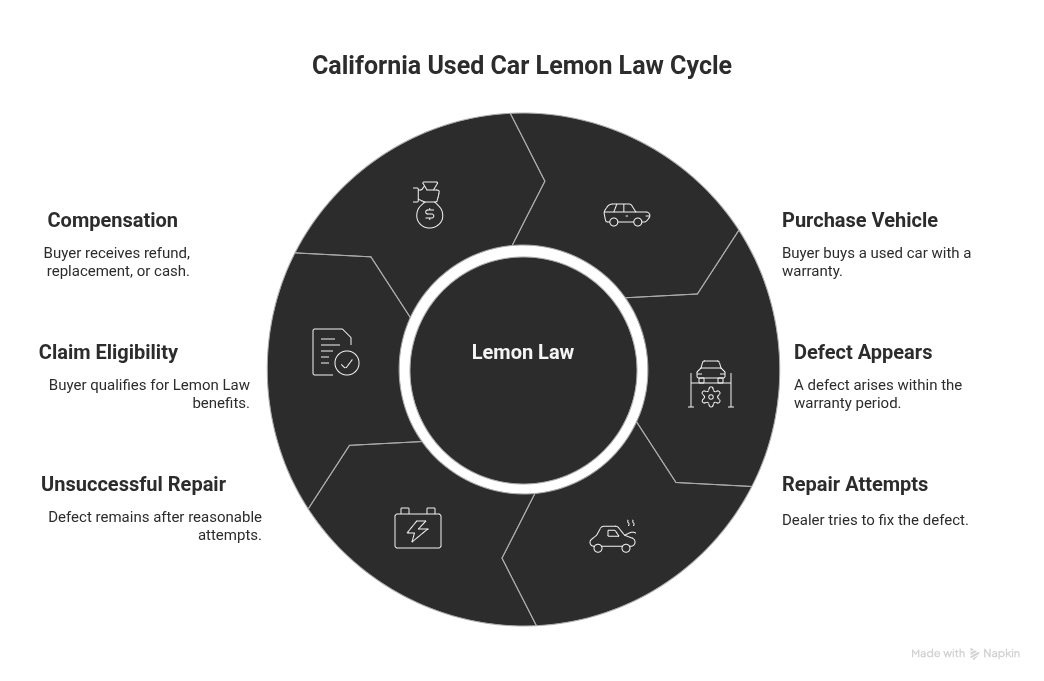
A California vehicle owner purchased a new SUV that began experiencing repeated transmission problems within the first year of ownership. The vehicle returned to the dealership multiple times for the same issue, including several extended repair visits. Since the owner kept every repair order, documented each communication with the dealership, and reported the defect while the vehicle was still covered under warranty, the claim was easier to evaluate.
After reviewing the repair history, the manufacturer agreed to resolve the matter through a buyback process rather than continuing additional repairs. The timeline from the first reported defect to resolution depended on the manufacturer's response and negotiations, but proper documentation helped avoid unnecessary delays. Lemon Law deadlines are not just about when you file. They are about identifying problems early, preserving evidence, and acting before your legal protections expire.
What Is the Lemon Law for Used Cars in California?

Lemon Law ensures that drivers aren't left with a defective vehicle while it has a warranty. Lemon Law applies to used cars only if there's a warranty on the car. For that reason, you can't expect Lemon Law protection if you purchase a car from a private seller.
With a manufacturer's warranty, such as with a Certified Pre-Owned vehicle, the car would receive the full 90 days or 3,000 miles of protection. However, during the warranty period, there would have needed to be a reasonable number of attempts to repair the problem.
All of these regulations can be confusing. Navigating the motor vehicle Lemon Law can be complicated. Determining if a problem is covered or determining what types of motor vehicles are covered can be challenging unless you have a background in law. Otherwise, it's best to have a qualified Lemon Law attorney on your side, guiding you through the process.
How Long Is the Lemon Law on Used Cars?
Since many factors are involved with used cars, each one falls under different timeline regulations. For starters, there are varying laws from state to state, which we will dive into deeper in a minute. There's also the issue of the vehicle's age and mileage. Most dealers aren't going to provide a warranty with an older car, so there aren't the same protections available.
The vehicle must also be sent to a qualified repair shop a reasonable number of times for the same defect. The number of times varies depending on the complaint. For example, with a serious safety hazard to worry about, the law often only requires two visits. On the other hand, a defective vehicle that struggles to air condition the cabin, or has another problem that doesn't affect the safety, may require up to four repair attempts before action can be taken.
Beyond these regulations, consumer actions and legal processes are similar to those of the new car laws. Ultimately, how long a Lemon Law process takes depends on how the manufacturer or dealer responds to your letter and if litigation is necessary. If the problem can be resolved through arbitration, you may have a resolution within weeks.
How Do Lemon Law Rules Vary by State?

California Lemon Laws are among the most inclusive in the nation. California drivers are well protected by protection for both new and used vehicles. There are even inclusions for other vehicles, such as all-terrain vehicles, motor homes, and motorcycles.
Texas Lemon Law also offers used car protection, along with Connecticut, Massachusetts, Pennsylvania, New York, and New Jersey. Texas also has the Deceptive Trade Practices Act (DTPA), which prevents deceptive business practices, including during the sale of used cars. On the other hand, Alabama, Mississippi, North Dakota, South Dakota, and Nebraska are among the states that don't include used cars at all.
How Can You Avoid Buying a Lemon When Purchasing a Used Car?
When looking to purchase a used car, it's important to take every precaution so you don't get a lemon. The following conditions and tips give you maximum protection.
Pre-Purchase Inspection

While this isn't a step needed with most new and leased cars, all pre-owned vehicles should be inspected by an independent mechanic before purchasing. You can expect some normal wear and tear on the vehicle, but there shouldn't be any major mechanical defects. Take the vehicle to a reputable shop in the area and pay a small fee to ensure it's sound.
Vehicle History Report
New vehicles have no report to worry about, but a used car can have a checkered history. Pay for a CARFAX vehicle history report to see its service record, whether it has been involved in any accidents, and if there are recalls worth looking into. It's best to choose vehicles that were used for normal household purposes, not a commercial fleet or rental car. You'll also be able to see how many previous owners it had.
Test Drive
Taking the used car for a test drive can help bring any problems to the surface. We recommend taking the car on several different types of roads (city streets, highways, country roads, etc) so you can get a feel for how the vehicle responds. It's also wise to try out all of the features during the test drive to ensure everything works as it should.
Extended or Manufacturer's Warranty
Without warranty coverage, there's no Lemon Law protection on a used car in California. Therefore, you want to choose a dealership that offers a lengthy warranty or provides a reasonable opportunity to purchase coverage. It's never a smart idea to purchase a car from a private party because there's no legal recourse if something goes wrong.
What Are the Benefits of Hiring a Used Car Lemon Law Attorney?

A qualified Lemon Law attorney understands the Lemon Law regulations, ensuring that your used car or other vehicle is covered before filing a claim. An experienced lawyer knows how to immediately notify the manufacturer or dealer about the defect and get quick results so you aren't left waiting for a replacement. You can find a great attorney by reading online reviews, asking your friends and family for recommendations, or checking their reputation with the Better Business Bureau (BBB).
It is also important that you choose an attorney who defers payment until you win the case. This way, you are sure the lawyer will work as hard as possible to settle. Considering the average cost for a lawyer can be expensive, you want an attorney who only gets paid if you do. Choose one that offers a free consultation, so you don't have to pay anything out of pocket.
What Should You Know About Used Cars and Lemon Law Duration?
Used-car protection usually rides on a warranty. When a used car still carries part of the manufacturer's original warranty, or a dealer adds one, lemon-type protection may apply for that term. Dealer warranties are often short, such as 90 days or 3,000 miles. When the warranty ends, the Lemon Law protection usually ends with it.
Used coverage differs from new coverage in scope and length. New-car windows run in years. Used-car windows, where they exist, run in days or a few thousand miles. The used car Lemon Law in most states is narrower than the new-car statute, and many states have none at all. Watch the common misconceptions. A private-party sale marked as-is is usually excluded from Lemon Law entirely.
New Jersey is the clearest example of a state with a real used-car statute. Its coverage scales by the odometer at sale. A car with 24,000 miles or less gets 90 days or 3,000 miles. More than 24,000 up to under 60,000 gets 60 days or 2,000 miles. From 60,000 to 100,000 gets 30 days or 1,000 miles. New Jersey does not cover a used car over 100,000 miles, more than seven model years old, sold for $3,000 or less, or declared a total loss.
Many consumers searching for Lemon Law help are unsure whether their vehicle actually qualifies. The Lemon Pros focuses exclusively on California Lemon Law claims and helps drivers evaluate their coverage, repair attempts, deadlines, and buyback options. Our approach focuses on reviewing the complete repair history rather than looking only at the number of visits.
Need a Lemon Law Attorney?
Lemon Law can provide strong protections, but not every vehicle issue qualifies. Claims may be harder when the problem involves normal wear and tear, the vehicle is outside its warranty period, repairs were not properly documented, or the defect does not significantly affect the vehicle's use, safety, or value. A review of your warranty, repair history, and state requirements can help determine whether Lemon Law or another consumer protection option is the right path.
For great advice, you want an experienced attorney on your side, such as the Lemon Pros. Our team of Lemon Law attorneys in California focuses exclusively on California Lemon Law cases and has helped drivers pursue claims, total loss disputes, and manufacturer buybacks. Contact us today for a free case evaluation to discuss your options at no cost.
Frequently Asked Questions
Wondering how long Lemon Law protections last on a used car in California? These FAQs break down the timelines and rules so you can know your rights, whether your vehicle is still under the original warranty or facing ongoing problems.
How Does Lemon Law Work for Used Cars in California?
In California, Lemon Law can apply to used cars that are still under the original warranty. You remain responsible for certain costs, like maintenance, but the manufacturer may cover defects that impair the car's safety or use. While you have some control over pursuing a claim, there are limitations depending on the vehicle's age, mileage, and warranty status.
Does the Lemon Law Apply to Used Cars After 30 Days?
Yes, Lemon Law can still apply to used cars after 30 days, but only if certain conditions are met. The car must have been purchased from an authorized dealer, and the issues must be covered under the purchase agreement or remaining warranty. Claims are generally stronger when problems show up early and are documented.
What Is the Time Limit to File a Lemon Law Claim for a Used Car?
In California, the time limit to file a Lemon Law claim for a used car depends on the remaining warranty and when the defect first appeared. You must give the dealer a chance to fix the problem, and you need access to repair records as proof of repeated issues. Filing within these limits helps protect your rights.
How Long Do I Have to Return a Used Car Under the Lemon Law?
Under California Lemon Law, there isn't a set "return period" for used cars, but you should act quickly once defects appear. Make your request as soon as possible after the date the problem is discovered, and seek legal assistance to ensure your claim is handled correctly.
Is There a Mileage Limit for Lemon Law Coverage on Used Cars?
Yes, California Lemon Law coverage for used cars often depends on the car's mileage, not to exceed 18,000 miles or 18 months from the original new car delivery date. The issue must occur within an acceptable range under the original warranty, and you should present all repair records in the proper form.
Are All Used Motor Vehicles Covered Under Lemon Law?
Not all used motor vehicles are covered under California Lemon Law. Coverage depends on meeting specific eligibility requirements, such as being purchased from a licensed dealer and still being under the original warranty. If your claim is denied, you may have the right to appeal the decision.
Can I Sue a Dealership for Selling Me a Lemon Used Car?
Sometimes, but it depends on the facts and the paperwork. A claim is stronger when the car came with a written warranty, when the dealer made specific promises, or when your state has a used-car Lemon Law, while a private as-is sale usually forecloses a lemon claim.
Is There a 30-Day Lemon Law for Used Cars in Florida?
No. Florida has no 30-day used-car Lemon Law, and the Florida statute covers new, demonstrator, and leased vehicles rather than used-car returns. The "30 days" people cite refers to cumulative days out of service that help establish a lemon presumption for new and demonstrator cars.
How Likely Are You to Win a Lemon Law Case?
Outcomes depend on the specific facts, so no honest answer includes a percentage or odds. A case tends to be stronger when the defect is well documented, when you met your state's repair-attempt standard, and when an active warranty covered the vehicle.
Legal Disclaimer: This article is educational and is not legal advice. Lemon Laws vary by state and change over time. Reading this article does not create an attorney-client relationship. For advice about your situation, consult a lemon-law attorney licensed in your state.
Does the four-year filing deadline start when I bought the car?
Generally no. The clock runs from when you knew or should have known you had a claim, which is often the point where repeated repairs made the problem look permanent rather than the purchase date. Because that date is arguable, do not sit on a file while it ages.

Michael Saeedian, Esq.
Founding PartnerMichael Saeedian, Esq. is a California Lemon Law attorney and a founding attorney of The Lemon Pros; he develops tailored strategies to pursue the full compensation you're owed.
View Attorney Profile →