
Short answer
In California, extended car warranties are optional plans that provide coverage for certain mechanical failures after your factory warranty expires. They are typically sold as either mechanical breakdown insurance (MBI) or vehicle service contracts (VSCs), and the rules for each type are different. Coverage depends on the provider and contract, so exclusions, repair limits, and claim requirements should be reviewed carefully before buying. California also gives consumers cancellation rights and requires sellers to be properly licensed to offer these products.
In California, extended car warranties are optional plans that provide coverage for certain mechanical failures after your factory warranty expires. They are typically sold as either mechanical breakdown insurance (MBI) or vehicle service contracts (VSCs), and the rules for each type are different. Coverage depends on the provider and contract, so exclusions, repair limits, and claim requirements should be reviewed carefully before buying. California also gives consumers cancellation rights and requires sellers to be properly licensed to offer these products.
The Lemon Pros has helped hundreds of California consumers pursue relief under the state’s lemon law and maintains a strong reputation backed by numerous positive client reviews. Our attorneys handle claims involving defective cars, trucks, SUVs, motorcycles, and electric vehicles, seeking buybacks, replacements, and cash settlements from manufacturers. Led by attorneys recognized within the legal community, the team is dedicated to helping consumers enforce their rights at no upfront cost. If you’re driving a defective vehicle, contact us for a free case evaluation.
In this guide, we educate vehicle owners on the basics of mechanical breakdown insurance, vehicle service contracts, and extended warranties.
What Are Extended Car Warranties in California?

Despite the name, an extended car warranty is not a legal warranty under California law. It is a marketing term for a product that helps cover repair costs after the manufacturer’s original warranty expires. In California, these products generally fall into one of two legal categories: Mechanical Breakdown Insurance (MBI) or a Vehicle Service Contract (VSC). Although they may be marketed as vehicle protection plans or extended warranties, the legal classification determines how they are regulated.
The distinction is important because each product is governed by different laws. Mechanical Breakdown Insurance (MBI) is an insurance product regulated by the California Department of Insurance (CDI). MBI policies must be issued by licensed insurers or sold through licensed insurance producers, and the CDI reviews and approves policy rates before they can be offered to consumers.
A Vehicle Service Contract (VSC), by contrast, is a service agreement rather than an insurance policy. It is generally sold through licensed automobile dealers or other authorized providers that assume responsibility for covered repairs. Because of California’s regulatory framework, many national warranty companies that sell VSCs in other states instead offer MBI products to California consumers.
Neither MBI nor a VSC is the same as the manufacturer’s factory warranty. The factory warranty is included with the vehicle, backed by the automaker, and forms the basis for California Lemon Law protections. An extended warranty is a separate product purchased for an additional cost and backed by an insurer or service contract provider. While it may help pay for repairs after the factory warranty expires, it does not extend the manufacturer’s warranty or create additional Lemon Law rights.
The table below compares these three forms of vehicle coverage. Keep in mind that pricing varies based on the vehicle, coverage level, and contract term, and the legal distinctions reflect current California law.
| Coverage | Typical Cost | Provider Examples | California Legal Notes | |
|---|---|---|---|---|
| Factory (Manufacturer) Warranty | Covers defects in materials or workmanship for a specified time or mileage. Included with the purchase of a new vehicle. | Included in the vehicle purchase price | Ford, Toyota, Honda, General Motors, Stellantis, Hyundai, and other automakers | Backed by the vehicle manufacturer. This is the warranty that generally forms the basis for California Lemon Law protections. |
| Mechanical Breakdown Insurance (MBI) | Covers specified mechanical and electrical failures after the factory warranty expires. Routine maintenance, wear-and-tear items, and cosmetic damage are typically excluded. | Approximately $600–$1,000+ per year, depending on the vehicle, coverage, and deductible | Olive, Toco, and other insurers or insurance producers licensed in California. | Regulated as an insurance product by the California Department of Insurance (CDI). Policies must be issued by licensed insurers or sold through licensed insurance producers, and rates are subject to CDI approval. |
| Vehicle Service Contract (VSC) | Pays for repairs to covered components after the factory warranty ends. Coverage ranges from basic powertrain plans to near bumper-to-bumper protection. | Approximately $1,000–$4,000+ over the life of the contract, depending on the term and level of coverage | Endurance, CARCHEX, CarShield, Mopar Vehicle Protection (for Stellantis vehicles), and dealer-backed plans | Regulated as a service contract rather than insurance. Generally sold through licensed dealers or authorized providers. California law provides consumers with statutory cancellation rights, including those under California Civil Code § 1794.41 where applicable. |
What Are California’s Laws and Restrictions on Extended Car Warranties?
California regulates mechanical breakdown insurance (MBI) and vehicle service contracts (VSCs) differently. MBI is an insurance product regulated by the California Department of Insurance, while many VSCs are sold as dealer obligor contracts or by companies authorized to provide coverage in the state. In our experience, MBI providers must meet strict financial requirements, including backup insurance or other financial security, to help ensure claims are paid.
California law also regulates who can sell these products. Unlicensed companies cannot legally sell MBI or VSCs to California consumers, whether through a website, phone, or any other method. While you may see claims that VSCs are illegal to sell directly to consumers online in the Golden State, the real issue is licensing. The California Department of Insurance can issue cease-and-desist orders against unlicensed companies that sell warranties.
California also gives consumers strong cancellation rights under California Civil Code § 1794.41. If you cancel within 60 days of receiving a service contract for a new vehicle and have not made a claim, you are entitled to a full refund. For qualifying used vehicles, the full-refund period is generally 30 days. After that, you may still request a partial refund based on time or mileage used, and any cancellation fee cannot exceed $25 or 10% of the contract price, whichever is less.
Finally, California does not require drivers to buy MBI or any extended warranty. These products are optional. Before purchasing, compare coverage carefully, as vehicle service contracts can be more expensive than mechanical breakdown insurance, and some VSCs may provide less coverage than an MBI policy.
What Problems Does Lemon Law Apply to?
There are many types of complaints covered by Lemon Law. In fact, any defect that substantially impairs the vehicle's use, value, or safety is covered. Therefore, engine failure is treated the same as a fuel system malfunction or glitches in the electrical systems. Lemon law also covers other expenses associated with the defect, such as towing bills or if a rental car was needed. When you file a lemon law claim with an experienced attorney, all of these costs can be recouped in some circumstances.
The Lemon Pros’ 5-Step Warranty Evaluation Method
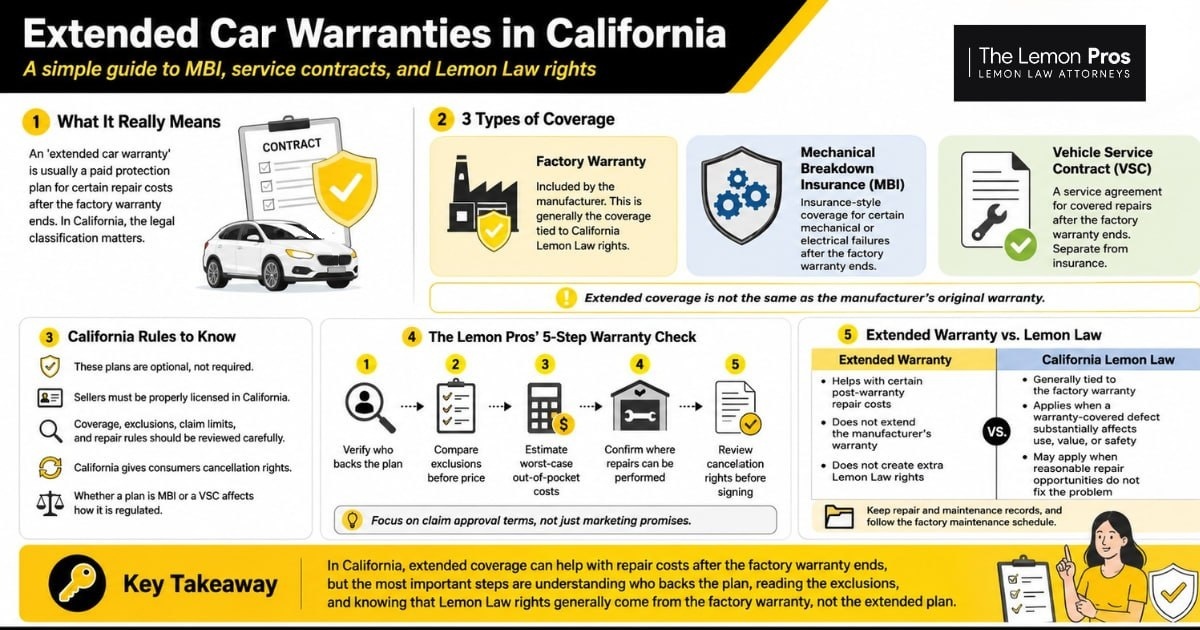
Whenever we speak with California drivers, we encourage them to evaluate any extended warranty using these five questions before signing.
Step 1: Verify who is actually backing the contract. Determine whether the plan is Mechanical Breakdown Insurance (MBI) or a Vehicle Service Contract (VSC). The company responsible for paying claims matters far more than the marketing name.
Step 2: Compare exclusions before comparing prices. Many inexpensive plans exclude seals, gaskets, electronics, diagnostics, or labor that commonly increase repair bills.
Step 3: Calculate your worst-case out-of-pocket cost. Consider deductibles, claim limits, labor rates, rental coverage, and diagnostic fees, not just the monthly payment.
Step 4: Confirm where repairs can be performed. Some plans restrict repairs to specific facilities while others allow nationwide licensed repair shops.
Step 5: Review cancellation rights before purchasing. California gives consumers valuable cancellation protections, but refund eligibility depends on timing and whether claims have been filed.
We recommend using this five-step review before comparing providers because it focuses on what determines claim approval rather than marketing promises.
Who Are the Top Extended Car Warranty Providers in California?
California offers two main types of extended warranty coverage: mechanical breakdown insurance (MBI) and vehicle service contracts (VSCs). Popular providers include Endurance, CARCHEX, CarShield, Olive, and Toco, while automakers also offer manufacturer-backed plans, such as Mopar Vehicle Protection for Chrysler, Dodge, Jeep, and Ram vehicles. Coverage ranges from basic powertrain protection to near bumper-to-bumper plans.
Since California regulates MBI and dealer obligor VSCs differently than many other states, a company may sell MBI in California but offer VSCs elsewhere. Before accepting an online quote or purchasing coverage over the internet, verify that the provider is properly licensed to sell the product in California. You should also review the contract’s cancellation terms, including eligibility for a full or partial refund, before signing.
Why Is It So Hard To Get an Extended Car Warranty in California?
California has strict and very specific laws surrounding extended warranties. These laws regulate who is allowed to sell extended warranties, what the contracts look like, and how they may be represented. It's essential to note that consumers can purchase either a vehicle service contract or mechanical breakdown insurance, but the two are very different.
Starting with the VSC, prices aren't regulated, but only a licensed car dealership can sell the plans. These plans offer a lot of customization and can be extensions of the original warranty or only cover a few components. Because they aren't an extended warranty, they aren't tied to the dealership in any way.
Mechanical breakdown insurance (MBI) is more similar to extended car warranty coverage, covering the costs of repairs from a breakdown caused by defects. These plans are regulated by the Department of Insurance Laws and can be purchased from licensed insurance companies, the provider itself, credit unions, and banks. They are not offered by the dealership or manufacturer. For this reason, you may want to discuss your needs with your licensed insurance company while purchasing liability and comprehensive coverage.
To avoid scams or unreliable providers, research the company before purchasing coverage by checking its reputation through sources like the Better Business Bureau and customer reviews. Never share personal or financial information with unsolicited callers or companies using high-pressure sales tactics.
Always request a written copy of the warranty agreement, review the terms carefully, and consider having a legal professional examine the contract if anything seems unclear. Take time to compare your options and avoid signing any agreement until you fully understand the coverage, exclusions, and costs.
Why Consider an Extended Car Warranty in California?

According to the California Department of Motor Vehicles (DMV), California has more than 31 million registered vehicles. Industry reports also show that dealership labor rates in many California markets commonly range from about $180 to $250 per hour, making even routine mechanical repairs significantly more expensive than in many other states.
There's no question that drivers spend a lot more on surprise repairs in this state, especially with all the time spent on the road. With more than 386,000 miles of roadway in California, cars tend to have higher-than-average mileage, leading to more wear and tear. Still, an extended car warranty can help alleviate some of the financial burdens.
With the right extended car warranty, Californians can keep their vehicle longer, getting more use of it so it provides a better value. Some extended warranty plans are also transferable, making it a good selling feature when it comes time to get top dollar for it. Research the extended warranty companies carefully before you purchase coverage to ensure you get what you need. You can set up new coverage before the factory warranty or powertrain warranty expires. Consider it an insurance policy against future breakdowns.
When an Extended Warranty Helped, and When Lemon Law Was the Better Solution
One California driver contacted us after purchasing a used SUV with an aftermarket vehicle service contract. Within months, the transmission began slipping. The warranty company approved replacement of several internal components but declined to replace the entire transmission because the contract excluded certain failure conditions. After multiple repair attempts failed, our review shifted away from the service contract and toward whether the vehicle still qualified for California Lemon Law protection under the manufacturer’s original warranty.
In another situation, a customer with a high-mileage sedan used a mechanical breakdown insurance policy to cover several thousand dollars in engine repair costs after the factory warranty expired. Since the failure resulted from a covered mechanical breakdown rather than a manufacturing defect during the warranty period, the insurance policy, not Lemon Law, provided the appropriate remedy.
These situations show us that an extended warranty can reduce repair costs, but it is not always the legal solution. The correct path depends on why the vehicle failed and whether the manufacturer still has legal responsibility.
How Much Does an Extended Car Warranty Cost in California?

For a one-to-three-year extended warranty, many California drivers see roughly $600 to $1,000 per year, though monthly quotes run anywhere from about $30 on the low end to $250 or more for broad coverage on an expensive vehicle. Over a full multi-year term, total cost commonly lands somewhere in the $1,000 to $4,000-plus range depending on how long and how deep the coverage goes. A shorter two-year plan on a newer, reliable car sits toward the lower end, while a longer bumper-to-bumper plan on a luxury or high-mileage vehicle climbs from there. These are ballpark figures, not a quote for your car.
Five things move the price more than anything else: your vehicle's age, its mileage, the coverage level you choose, your deductible (a higher deductible lowers the premium, a lower one raises it), and the provider itself. VSCs frequently run more expensive than MBI, partly because dealer markups aren't rate-regulated the way CDI-approved MBI rates are. That's one practical reason to price both, and to get the total out-the-door cost in writing rather than a monthly figure that hides the full number.
What Are the Pros and Cons of Buying an Extended Car Warranty in California?
Whether an extended car warranty is worth buying depends on your vehicle’s reliability, your budget, and your tolerance for unexpected repair costs. A quality plan can provide peace of mind by covering expensive mechanical failures after the factory warranty expires, helping you avoid large out-of-pocket repair bills and making vehicle ownership costs more predictable.
However, we have found that extended warranties are not always a good value. Depending on the plan, you may pay more than you ever receive in covered repairs, and many contracts exclude routine maintenance, wear-and-tear items, and other common repairs. In our experience, it is also important to compare coverage carefully, as not all VSCs sold in California offer the same level of protection.
An extended warranty also does not replace your rights under California’s Lemon Law. Those protections are tied to the manufacturer’s original warranty, so purchasing a vehicle service contract neither creates nor waives your ability to pursue a lemon law claim if your vehicle qualifies. Financial experts are divided on the value of extended warranties. Dave Ramsey, for example, generally advises against them, arguing that many plans are overpriced and generate substantial commissions for sellers.
Instead, he recommends setting aside the money you would spend on a warranty to build your own repair fund. If your vehicle remains reliable, those savings stay in your account and continue adding to your net worth rather than paying for coverage you may never use. Before signing any agreement, read every page of the contract so you understand exactly what is and is not covered.
Some consumer advocates argue that self-funding repairs is usually the better financial decision, particularly for highly reliable vehicles. Others believe extended protection makes sense for owners of luxury vehicles, complex hybrid or electric models, or anyone who would struggle to pay a major repair bill unexpectedly. The right answer depends on the vehicle, the contract, and your personal situation rather than a one-size-fits-all rule.
In our experience reviewing warranty disputes, the biggest mistake consumers make is assuming every expensive repair will automatically be covered. Most denied claims occur because the failed component falls within an exclusion or because maintenance documentation cannot be produced. In our experience, reading the exclusions before buying is often more valuable than comparing monthly prices.
What Is the Legal Framework for Extended Car Warranties in California?
California has a Vehicle Service Contract Law known as the VSC Law. This state law requires vehicle service contract providers to be licensed through the California Department of Insurance (DOI) and comply with regulations that ensure consumer protection.
For starters, all providers must offer consumers detailed information regarding all terms and conditions of the contract before it's purchased. This information may include the covered components, deductibles, all exclusions, claim procedures, limitations, and cancellation rights. In California, the consumer has the right to cancel the VSC within a set timeframe after the purchase, typically between ten and thirty days. During this time, the customer can cancel and get a full refund of the purchase.
Additionally, a California Car Buyer's Bill of Rights requires all licensed dealers to provide a detailed report of financial items, such as insurance and warranties. Through these guidelines, the dealer cannot misrepresent the benefits or terms of the warranty. The dealer is also not allowed to pressure the consumer into purchasing any warranty. The California Department of Motor Vehicles (DMV) is responsible for oversight and enforcing compliance. Additionally, the California DMV can take its own legal action if these guidelines are violated.
If that wasn't enough protection, the California Department of Consumer Affairs (DCA) gets involved with warranty disputes. Consumers can file a complaint through the DCA for warranty fraud, unfair warranty practices, or the failure to honor warranty obligations.
What Are the Key Features to Look for in an Extended Warranty?

When shopping for an extended warranty, choose a plan that fits your vehicle, budget, and driving needs. Consider your vehicle’s age, mileage, and condition, as providers have different eligibility requirements. Coverage options range from comprehensive bumper-to-bumper plans to basic powertrain protection for major components like the engine and transmission.
Review the warranty term, mileage limits, deductible, and exclusions before purchasing. A lower price may come with higher out-of-pocket costs when repairs are needed. If you own a used car or plan to sell your vehicle later, a transferable warranty can add value and make it more attractive to buyers.
Compare plans from manufacturers, third-party providers, and car dealers, and do not feel pressured to buy immediately. Take time to review the contract, ask questions, and negotiate pricing or coverage terms when possible. Look for additional benefits such as roadside assistance, rental car reimbursement, trip interruption coverage, and nationwide repair options. Always confirm what is covered, what is excluded, and whether the provider has a strong reputation for handling claims.
How Do You Evaluate and Choose the Mechanical Breakdown Insurance Plan?
There's no choice available when it comes to new car warranties, but the same isn't true with the comprehensive coverage provided by mechanical breakdown insurance. As you evaluate the providers offering extended warranties, you need to give special consideration to your vehicle's needs.
As discussed briefly before, you wouldn't want to choose powertrain-only coverage if you want the whole vehicle protected. In the same regard, paying for three years of protection may not make sense if you only plan to keep the vehicle for a short time. It's always our recommendation to discuss your needs with a licensed dealer or insurance agent who would be able to guide you better. You should also read through customer reviews to get a feel for how other car owners have been treated.
How Much Does an Extended Car Warranty Cost in California, and How Can You Finance It?
On average, the total cost for extended warranty protection may be around $3,000. The costs depend on the type of vehicle you drive, its mileage, the coverage protection you need, and the length of the agreement. Sometimes, you can finance the warranty cost to make it easier to afford. When purchasing a VSC through a dealer, the cost can often be rolled into the car's monthly payments or purchase price. Mechanical breakdown insurance plans may also be financed, so it's something to ask about.
The biggest question should be whether an extended warranty is right for you. If one trip to the repair shop would be detrimental to your financial standing, it may be best to put coverage in place. Otherwise, skipping the additional coverage could also be an option if you can afford to pay for the repairs out of pocket.
Beyond that, if you drive a newer, reliable car, the chances of an expensive repair bill are much lower, so it might not make sense to spend $3,000 on a plan you may never use. The most significant factor is whether you can afford to pay for the future repairs of major components. If you can't, it's best to consider an extended warranty to alleviate possible repair costs.
What Additional Protections Are Included Under a Vehicle Service Contract?
Lemon law protections are available if a defect cannot be repaired. It allows you to get a replacement vehicle or cash reimbursement when your vehicle doesn't provide the function it was supposed to. On the other hand, the extended warranty is going to protect you from normal mechanical breakdowns that occur over the life of a vehicle.
To get the most out of the vehicle service contracts or mechanical breakdown insurance, you should familiarize yourself with all the terms and conditions. It's also vital to keep thorough records of the car's maintenance and repair history because this documentation may be needed when filing a claim. You also want to use the additional benefits if they are available. Don't forget that you may have roadside assistance protection, trip interruption coverage, and rental car reimbursement as part of your plan.
Following the factory maintenance schedule is one of the most important things you can do for your vehicle. By getting regular oil changes and keeping up to date on service, you prevent mechanical breakdowns and headaches in the future.
Need Help Dealing With a Lemon?
Many articles treat every extended warranty as though it operates under the same rules. California is different. This guide explains the legal distinction between Mechanical Breakdown Insurance and Vehicle Service Contracts, how California regulates each product, when Lemon Law rights may still apply, and the practical questions our attorneys recommend asking before purchasing coverage.
For great advice, you want an experienced attorney on your side, such as the Lemon Pros. Our team of Lemon Law attorneys in California focuses exclusively on California Lemon Law cases and has helped drivers pursue claims, resolve total-loss disputes, and secure manufacturer buybacks. Contact us today for a free case evaluation and to discuss your options.
Frequently Asked Questions
In the process of writing this blog, we came across some questions people asked repeatedly. We did our best to answer them.
What Is the Best Extended Car Warranty in California?
There's no universal best. The right choice depends on your vehicle's reliability, your budget, and the coverage level you actually need, and the seller has to be properly licensed to sell MBIs or VSCs in California. Compare a few quotes, read the exclusions, confirm licensing with the CDI, and match the plan to your car rather than chasing a brand someone else crowned number one.
Is It Worth Buying an Extended Warranty on a Car?
It can be, for a vehicle that's expensive to repair or if the peace of mind is worth the premium to you. For a reliable car, or if you have savings to self-insure, it often isn't worth it. Compare the plan's total cost against the repairs you'd realistically face, and factor in the exclusions before deciding.
How Much Does a 2-Year Extended Warranty Cost?
Estimates only, but a two-year plan often falls in the low hundreds to a couple thousand dollars total, driven by your car's age, mileage, coverage tier, and deductible. Newer, reliable vehicles sit at the lower end; older or luxury cars run higher. Get a written quote for your specific vehicle rather than relying on an average.
Legal Disclaimer: This article is general information for an independent consumer resource, not legal, insurance, or financial advice, and reading it creates no attorney-client relationship. California rules for Mechanical Breakdown Insurance and Vehicle Service Contracts, including pricing, cancellation, and licensing, change over time and depend on the specific terms of your contract and your individual circumstances. Verify current requirements with the California Department of Insurance and read your contract in full before purchasing or cancelling, and consult a licensed attorney, insurance professional, or financial advisor about your situation. Any providers named are examples for research only, not endorsements.

Michael Saeedian, Esq.
Founding PartnerMichael Saeedian, Esq. is a California Lemon Law attorney and a founding attorney of The Lemon Pros; he develops tailored strategies to pursue the full compensation you're owed.
View Attorney Profile →