

Short answer
Routine servicing ranges from about thirty minutes for an oil change to several hours for larger work. Ordinary maintenance is not what the lemon law counts. What counts is time out of service for warranty repair of a covered defect, which accumulates towards the thirty-day guidepost California courts use.
A car service can take anywhere from about 30 minutes to several hours, depending on the type of maintenance required. A basic service like an oil change is usually completed in 30 to 60 minutes, while more detailed work takes longer. A full service typically takes around 2 to 4 hours because it includes more in-depth inspections and fluid checks. A major service at higher mileage intervals like 30k, 60k, or 90k miles can take most of the day if additional repairs or part replacements are needed.
The Lemon Pros are experts in navigating the Lemon Law and defective vehicles. Since our practice area focuses on lemon vehicles, we have secured compensation for hundreds of happy clients. Contact us today to get a free consultation about your defective vehicle!
This guide explains how long car maintenance takes, the duration of each service type, and the key factors that can affect timing, as well as what to do if repairs take longer than expected.
How Long Does It Take To Get a Car Serviced?

Basic service may only take thirty minutes, while more extensive needs may require additional time. Car maintenance involves routine checks, servicing, and repairs to ensure the vehicle operates safely and efficiently over time. Every car manufacturer sets its own maintenance schedule, with recommended intervals for service. The oil change is among the most basic requirements, but some require major service at larger intervals. These are going to be the longest service appointments.
Regular Car Service
Even though a car service takes time out of your schedule, routine maintenance helps protect your vehicle from costly repairs later. Many drivers find that staying on top of basic maintenance keeps the car running smoothly, improves fuel efficiency, and helps extend engine life.
Manufacturer maintenance schedules typically recommend service intervals of around 5,000 to 10,000 miles, with reductions of up to 30–50% under severe driving conditions such as stop-and-go traffic or short trips. Research on engine lubrication also shows that oil performance begins to degrade as early as 3,000–6,000 miles, according to the National Auto Authority. This is why regular servicing is critical to preventing accelerated engine wear and costly mechanical failures.
Routine service can range from a quick 30-minute visit to several hours, depending on the type of service being performed. Vehicle type also impacts maintenance time. High-performance, European, and large vehicles often have complex engine layouts that make parts harder to access and increase labor time. Older or poorly maintained vehicles may also take longer to service due to seized bolts, worn components, or underlying issues discovered during inspection.
Tire Rotation and Balancing
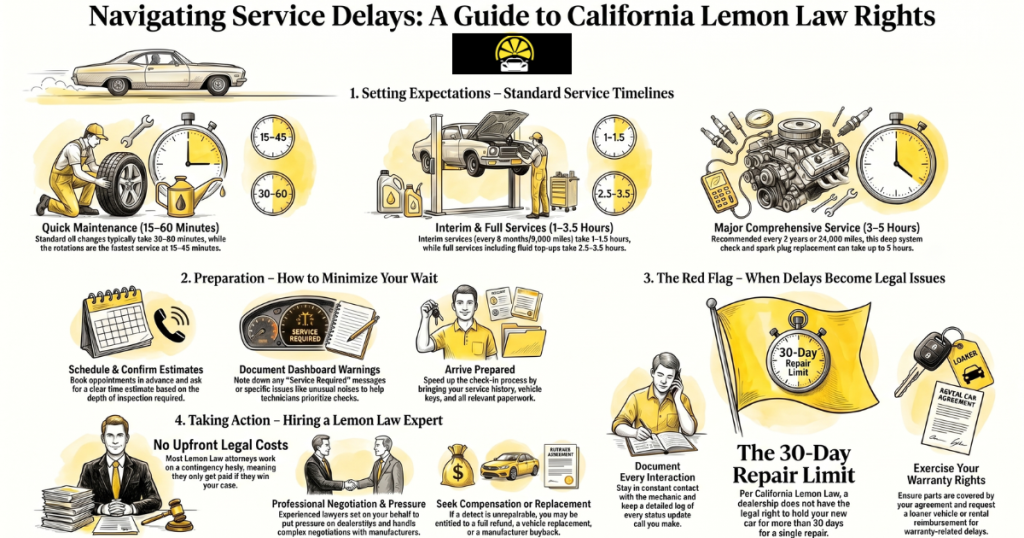
Regular tire rotation and balancing help keep the tread wearing evenly and allow drivers to get more life from their tires. Many drivers combine this quick task with an oil and filter change to save time and money. Tire rotations are generally recommended every 5,000 to 10,000 miles and usually take between 15 and 45 minutes, depending on how busy the service center is.
If wheel balancing or alignment is needed, the process may take longer. A wheel alignment typically takes 1 to 1.5 hours. Some vehicles also require additional labor because of larger wheels, specialty tires, or suspension designs.
Brake Service
During a routine inspection, mechanics may discover worn brake pads or damaged rotors that require brake repairs. Brake pad replacement can take anywhere from 1 to 3 hours, depending on the complexity of the vehicle and whether additional components need attention.
Finding a safety issue during inspection can extend the time spent at the shop while parts are sourced and approval is obtained. If a service center does not have a specific filter or brake component in stock, delivery may take 24 to 48 hours. In some cases, the car stays at the repair facility longer if significant issues are discovered during the inspection process.
Interim Car Service
An interim car service is designed for high-mileage drivers or vehicles that see heavy use in stop-and-go traffic or extreme temperatures. An interim service is generally recommended every 6 months or 6,000 miles and usually takes 1 to 2 hours to complete.
This type of service includes an oil change, oil filter change, fluid checks, and inspections of essential safety components such as tires, brakes, lights, and windshield wipers. Common interim services typically take 1 to 2 hours, although some shops may complete the work in as little as 45 to 75 minutes, depending on workload and vehicle accessibility.
Full Service
A full service is more comprehensive and typically takes 2.5 to 3.5 hours, although some vehicles may require additional time. A full car service generally includes all basic maintenance tasks along with detailed inspections of the brakes, suspension, exhaust system, filters, engine oil, and fluids, including transmission fluid where applicable.
A full service is often recommended annually or every 12,000 miles and may include air and fuel filter replacements, battery testing, brake fluid checks, and diagnostic scans. The thorough inspection helps identify major issues before they become expensive repairs and keeps the vehicle in optimal condition.
Major Car Service
A major car service is the most comprehensive maintenance option and is generally recommended every 2 years or 24,000 miles. Major services typically take between 3 and 6 hours, depending on the vehicle and the repairs required.
In addition to all full-service checks, a major service may include spark plug replacement, brake fluid changes, transmission service, and inspections of major engine and suspension components. Since some vehicles have tightly packed engine bays, the maintenance time can vary depending on accessibility and the condition of the vehicle. While most routine services are completed the same day, major repairs can take significantly longer. Common tasks and average durations include:
-
Oil and filter change: 30–45 minutes
-
Tire rotation: 15–45 minutes
-
Brake pad replacement: 1–1.5 hours
-
Battery replacement: 30 minutes–1 hour
-
Wheel alignment: 1–1.5 hours
-
Diagnostic scan: 15–90 minutes
-
Transmission service: 3–4 hours
Engine Replacement
Although engine replacement is not considered regular maintenance, neglecting routine service can eventually lead to major issues that require extensive repairs. Replacing an engine is a lengthy process that often takes 10 to 12 labor hours, meaning the vehicle may remain at the dealership or repair shop for several days or even a week, depending on parts availability and shop workload.
Whichever type of service your vehicle needs, proper maintenance is one of the most helpful ways to protect your investment, keep your car in top shape, and avoid unnecessary repair costs over time.
What Factors Affect How Long a Car Service Takes?

How long a car service takes depends on the type of service your vehicle needs, the condition of the car, and whether any additional repairs are discovered during the inspection. A basic oil change can take as little as 30 to 45 minutes, while a full car service generally takes around 2 to 3 hours.
More comprehensive major services can require most of the day, especially when tasks like spark plug replacement, brake fluid changes, or deep system diagnostics are involved. Vehicle type also matters, as some cars have complex engine layouts that increase labor time, and older or poorly maintained vehicles may take longer if underlying issues are uncovered during the process.
Service Complexity
A basic service takes the least amount of time, with only an oil change and maybe a tire rotation required. On the other hand, full service and unexpected repairs can add several hours to the time.
Age of the Vehicle
If it's the first service for a new car, the technician only needs to change the oil and maybe rotate the tires. Therefore, it's going to be considered a basic service that shouldn't last more than an hour. Older cars tend to need more service and often require necessary repairs to keep them running, both of which are going to increase the wait time.
Vehicle Type
Certain car makes may require more maintenance or be subject to more frequent repairs. A luxury or foreign car model may also require the attention of a specialized technician, thereby increasing your waiting time.
Parts Availability
If the car requires repairs, the garage may not have the parts in stock. Your automobile may be down until these parts arrive, which can take some time, especially if they are special-order parts or for a luxury vehicle.
Service Location
Servicing times vary based on the location you take the car to. One car can be at one dealership getting an oil change in thirty minutes, while another takes an hour at a different location. It all comes down to the availability of the technicians and how many appointments are scheduled for the same time. A smaller repair shop usually has fewer mechanics working, so it could take more time to get service or repairs than taking the car to a dealership.
Average Car Service Times Comparison
Car service times can vary quite a bit depending on the type of maintenance required, the condition of the vehicle, and how busy the workshop is. Below is a simple breakdown of the average time needed for common car services, along with the main factors that can affect how long each one takes
| Service Type | Average Duration | Factors Influencing Time |
|---|---|---|
| Oil Change | 30–60 minutes | Oil filter condition, vehicle type, workshop workload, and additional inspection requests |
| Tire Rotation | 15–45 minutes | Wheel condition, seized bolts, alignment checks, and technician availability |
| Brake Service | 1–3 hours | Pad/disc wear, rust or seized components, parts availability, safety inspections |
| Full Service | 2.5–3.5 hours | Depth of inspection, vehicle age, fluid top-ups, exhaust/suspension checks |
These times are typical estimates, but actual service duration can be longer if additional repairs are discovered during inspection or if parts need to be ordered.
Why Service Times Often Vary
In real-world repair and dealership environments, service times rarely match the initial estimates provided to vehicle owners. At our firm, we frequently see cases where a routine oil change quoted at 45 minutes ends up taking 90 minutes or more once technicians uncover additional issues such as a clogged air filter, worn brake components, or fluid contamination.
We also often observe delays beginning after a driver sees a service required warning on the dashboard. What starts as a simple diagnostic visit can quickly escalate into several hours of inspection if onboard systems detect faults in sensors, emissions components, or transmission-related functions.
These unexpected findings are a common source of extended repair timelines and repeated workshop visits. As our managing partner, Steve Nassi, often puts it, “Service times don’t fail because of the planned work. It’s the hidden issues that show up once the vehicle is on the lift.”
In more serious cases, such as brake service or component replacement, an estimate of 1 hour can easily extend to 2–3 hours when parts are seized, corroded, or require additional labor to safely remove. These kinds of delays are not just inconvenient. They are also part of the broader pattern we often review when assessing whether a vehicle may be experiencing recurring defects or repair inefficiencies.
How Long Does It Take to Service a Car at a Dealership vs. Independent Shops?
Car service times can vary depending on whether you visit a dealership or an independent shop. Routine service can range from 30 minutes to 5 hours based on the thoroughness of the inspection and maintenance being performed, the type of vehicle, and whether additional repairs are needed.
Dealerships typically take longer because they follow manufacturer procedures, perform detailed inspections, and often handle warranty-related work. A typical oil change takes approximately 30 minutes to an hour, while larger jobs like a full service may take 2.5 to 3.5 hours. A major service, recommended every 2 years or 24,000 miles, can take 3 to 6 hours and includes spark plug replacements, brake fluid changes, in-depth diagnostics, and additional component inspections.
Independent shops are often faster and less expensive for routine maintenance. Minor services typically take 30–60 minutes, interim services take 1–1.5 hours, and full services usually last 2.5–3.5 hours. An interim car service typically takes 45 to 75 minutes to complete and includes an oil change, air filter inspection, and safety checks.
Both options have advantages. Dealerships provide factory-trained technicians and OEM parts, while independent garages usually offer lower labor costs and shorter wait times. However, driving in extreme temperatures or heavy traffic may require more frequent, complex servicing regardless of where you go. Before scheduling service, check whether parts are in stock, ask how long the repair is expected to take, and use a trusted search page or review platform to compare service quality and pricing.
Why Do Some Car Services Take Longer Than Expected?
Whether you are taking your car in for an interim service or a repair, you could quickly run into unexpected delays. Here are some of the most common reasons for longer wait times:
- Unforeseen issues: Hidden problems may not be discovered until the mechanic starts to work on the car. These added repairs will increase the time needed in the shop.
- High demand: If the auto shop is busy and has few appointments available, you may wait longer.
- Complex repairs: Working on the engine or transmission can take longer than performing a simple brake job. Additionally, some systems are harder to diagnose. For example, it can take several hours for a mechanic to track down a short in the electrical system.
- Part shipment delays: If parts need to be ordered, getting them to the shop can be a fiasco. Depending on whether the parts are back-ordered or not, such as with a large-scale warranty repair, you may need to wait days to weeks for your car.
That thought leads us right to the next topic – do you know what to do if the dealer can't fix your car?
What Should You Do if Your Car Service Takes Longer Than Expected?

When you take your car in for service, you don't expect it to be out of commission for a long period. In fact, as per California Lemon Law, the dealership doesn't have the right to hold your new car for more than thirty days per repair. Here are some steps to follow if the dealership has kept your car for too long.
- Stay in contact with the dealership or mechanic. Continue calling and getting updates on the car's status. Make sure to document every call you make.
- Check your warranty coverage. Ensure that the parts being worked on are covered by the warranty and read the terms of the agreement.
- Request a loaner vehicle. If the dealership is keeping your car for warranty work, ask for a loaner or reimbursement for a rental.
- Evaluate if the car qualifies as a lemon. If the dealership can't repair your new car, it may be time to contact a Lemon Law attorney.
If you were wondering whether your car qualifies as a lemon, our team of professional Lemon Law attorneys can help see if your vehicle qualifies for reimbursement. Contact us today for a free consultation.
How Can a Lemon Law Attorney Help With Delays?
If the dealership has held your car too long for repair, it might be time to hire a Lemon Law attorney. An experienced Lemon Law lawyer can put pressure on the dealership and get results. They can act on your behalf in communication and negotiations.
There's also the option to file a Lemon Law claim if the defect is unrepairable. You may deserve compensation, replacement, or a refund if the car is deemed a lemon. Unless you are an expert in Lemon Laws, it's best to let the professionals handle the case.
Thankfully, most lemon lawyers work on a contingency basis, meaning they don't get paid until the case is won. This lawyer's pay structure ensures that you don't need to pay anything upfront, and your attorney will work especially hard to get results.
How Can I Prepare for My Car Service to Minimize Waiting Time?
Preparing properly for your car service can significantly reduce delays and help you get back on the road faster. Car services generally range from 30 minutes for a quick oil change to a full day for major repairs, so understanding what to expect before you arrive makes a big difference.
Start by scheduling your appointment in advance and confirming the expected service duration. The typical duration for a car service ranges from 1 to 6 hours, depending largely on the depth of the inspection required, so asking for a clear time estimate helps you plan your day better and avoid unnecessary waiting.
It also helps to understand the type of service your vehicle needs. Minor services typically take 30–60 minutes, interim services take 1–1.5 hours, and major services take 3–5 hours. An interim service is recommended every 6 months or 6,000 miles and includes basic maintenance plus detailed safety checks for high-mileage drivers, while a full service takes 2.5 to 3.5 hours and includes more detailed inspections of the exhaust, suspension, and additional fluid top-ups.
A major service, the most comprehensive, is recommended every 2 years or 24,000 miles and includes complex tasks like replacing spark plugs and performing deeper system checks. A major car service is the most comprehensive option, typically taking around 3 to 4 hours.
Before arriving, make sure your vehicle is ready for inspection. If your dashboard shows a “Service required” message, note it down and share it with the service advisor. This helps them prioritize checks and prepare any necessary parts or tools in advance. Also, bring your service history, keys, and any relevant paperwork to speed up check-in.
Clear communication with your service advisor is essential. Be specific about any issues you’ve noticed, such as unusual noises, warning lights, or performance changes. This allows technicians to focus on the right areas and avoid unnecessary delays during diagnosis. A typical oil change takes approximately 30 minutes to an hour, while tire rotations usually take around 15 to 45 minutes, so clarifying which tasks are needed helps avoid surprises.
Finally, plan your time realistically. Common interim services typically take 1–2 hours, and full services last 2.5–3.5 hours, but delays can happen depending on workload or additional repairs discovered during inspection. A clear grasp of these timelines helps you schedule your day more efficiently and reduces frustration while waiting.
Need an Expert Lemon Law Attorney?
While longer service times are often seen as inconvenient, they are sometimes a sign of thorough inspection and preventive maintenance. Identifying issues such as brake wear or fluid degradation can prevent breakdowns and significantly reduce long-term repair costs. In many cases, a slightly longer service appointment today can prevent unexpected vehicle downtime in the future.
For great advice, you want a qualified Lemon Law attorney on your side, such as The Lemon Pros. Our team of Lemon Law attorneys in California focuses exclusively on California Lemon Law cases and has helped drivers pursue claims, total loss disputes, and manufacturer buybacks. Contact us today for a free case evaluation to discuss your options at no cost.
Frequently Asked Questions
Below are direct answers to some of the most common questions asked concerning car services and everything related to them.
How Long Does It Take for a Car to Be Serviced?
A car service typically takes anywhere from 1 to 6 hours, depending on the type of service and the vehicle’s condition. A basic oil change may take 30–60 minutes, while a major service can take most of the day if additional repairs are needed.
How Long Does Regular Car Service Take?
A regular car service usually takes about 1 to 3 hours for most vehicles. This depends on whether it is an interim, full, or more detailed inspection service.
How Long Do Services Normally Take?
Most car services normally range from 30 minutes for quick maintenance to several hours for full or major servicing. The exact time depends on the depth of inspection, vehicle type, and whether extra repairs are found.
How Long Does a Tire Rotation and Oil Change Take?
A tire rotation usually takes about 15–45 minutes, depending on wheel condition and equipment. An oil change typically takes 30–60 minutes, though it may take longer if filters or inspections are included.
Why does routine maintenance not count toward the thirty days?
The count tracks time out of service for repair of a defect covered by the warranty. An oil change, a filter or a brake job at the wear interval is upkeep you would owe on any car. Warranty repair is different: the manufacturer is fixing something that should not have failed.
My service visit included both maintenance and a warranty repair. How is that counted?
Look at the repair order. Dealers usually split the visit into separate lines with their own labor operations and pay type. The warranty lines are what matter. If the car stayed extra days for the warranty portion, note that, and ask the service writer to reflect it on the paperwork.
What should I ask for at the end of every service visit?
A printed copy of the repair order. It should show the date in, the date out, your stated complaint in your own words, the diagnosis and what was done. Vague entries such as could not duplicate still count as a visit, so keep those too.
Does servicing at an independent shop affect my warranty?
Routine maintenance elsewhere does not void a factory warranty, as long as you keep receipts showing the work and the correct fluids and parts were used. Warranty repairs are a separate matter. Those have to go through a franchised dealer for your make to count as repair attempts.
The shop kept my car for a week on a simple job. Does the extra time count?
Only if the work was a warranty repair on a covered defect. A week spent on maintenance is inconvenient but outside the statute. A week spent chasing an electrical fault under warranty is different, and those days join any earlier warranty days your vehicle has already spent off the road.
How should I describe a problem when I book the appointment?
Describe what you notice, not what you think is broken. Say when it happens, how often, at what speed and whether a warning light appears. Concrete descriptions get written onto the repair order and make a pattern visible across visits, which is what a claim rests on later.

Michael Saeedian, Esq.
Founding PartnerMichael Saeedian, Esq. is a California Lemon Law attorney and a founding attorney of The Lemon Pros; he develops tailored strategies to pursue the full compensation you're owed.
View Attorney Profile →